There are moments that do not pass, but settle.
In the resin of ancient trees, time once slowed enough to hold what would otherwise vanish—a wing in motion, a leg mid-step, the small and constant labor of insects moving through a forest that no longer exists. Over millions of years, that resin hardened into amber, carrying with it not just individual forms, but fragments of a world suspended between motion and stillness.
Within these golden enclosures, scientists have long found isolated traces: a single ant, a fragment of a leaf, a wing caught in passing. Each piece offered a glimpse, partial and precise, into life during the Eocene epoch. But recently, a different kind of discovery has emerged—one that shifts the perspective from individual moments to something broader, more connected.
It comes from what researchers call syninclusions.
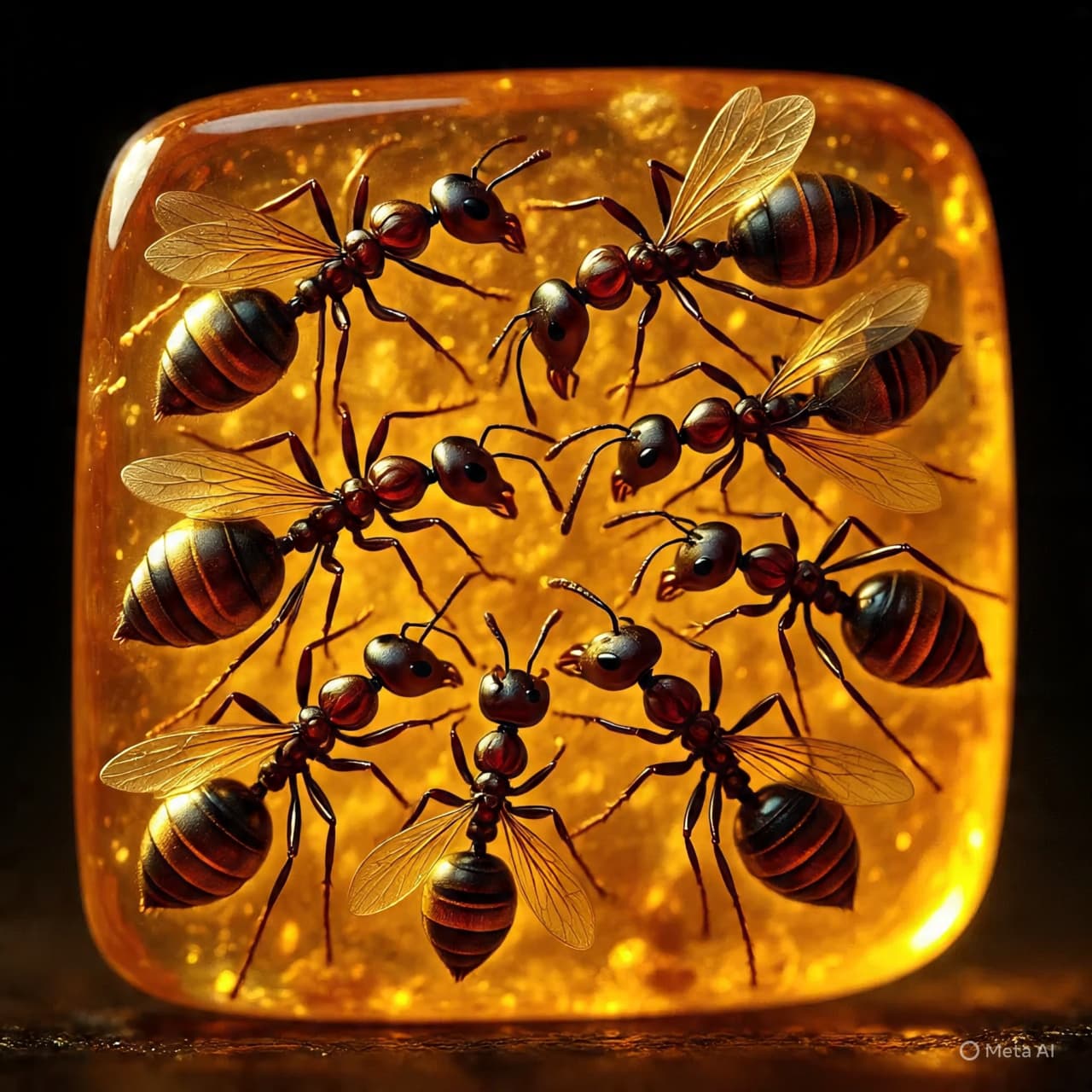
These are instances where multiple organisms are preserved together within a single piece of amber, their positions and relationships frozen at the same instant. In studying such specimens, scientists have begun to see patterns that extend beyond chance, arrangements that suggest not just presence, but structure.
In this case, the focus falls on ants.
The fossils reveal what has been described as an “ant mosaic,” a spatial pattern in which different species appear to occupy distinct but adjacent zones within the ancient forest floor. Rather than a random distribution, the arrangement suggests a form of organization—territories, perhaps, or ecological niches maintained through interaction and separation.
The idea is subtle, but significant.
Modern ant communities often display similar mosaics, where competing species establish boundaries, creating patchworks of occupation that shift over time but remain structured. To find evidence of such patterns in the Eocene—tens of millions of years ago—suggests that these dynamics have deep evolutionary roots, extending far beyond the present.
Amber, in this context, becomes more than a medium of preservation.
It acts as a kind of cross-section, capturing not just individual organisms, but relationships between them. The proximity of different ants within the same resin flow allows researchers to infer how they may have coexisted—whether they occupied overlapping spaces, avoided one another, or formed part of a larger ecological arrangement.
There is, however, a quiet caution in this interpretation.
Syninclusions are rare, and each piece of amber represents only a small, localized moment. The patterns observed must be assembled from many such fragments, each contributing a portion of the whole. What emerges is not a complete map, but a suggestion of one—a reconstruction shaped by both evidence and inference.
Still, the suggestion is compelling.
It implies that the structure of ant communities, their division of space and interaction, may have remained consistent across vast stretches of time. The forest itself is gone, its climate altered, its species evolved or vanished. Yet within the amber, a familiar arrangement persists, as though the logic of these small societies has endured.
There is something almost architectural in this continuity.
A mosaic is not a single image, but a composition of pieces, each distinct yet part of a larger pattern. In the Eocene forest, that pattern appears to have been present already, forming quietly beneath the canopy, unnoticed except by those who moved within it.
Now, through the slow work of analysis, it becomes visible again.
Researchers report that syninclusions in Eocene amber have revealed spatial patterns consistent with modern ant mosaics, suggesting that structured ecological partitioning among ant species was already established millions of years ago. The findings contribute to a deeper understanding of how insect communities have evolved and persisted over geological time.
AI Image Disclaimer
This visual content is AI-generated and serves as an artistic representation rather than real fossil imagery.
Source Check: Nature Communications, Current Biology, Science, Smithsonian Magazine, National Geographic
Published by Banx Network. This article is part of the Banx decentralized media programme, powered by the BXE token on the XRP Ledger.