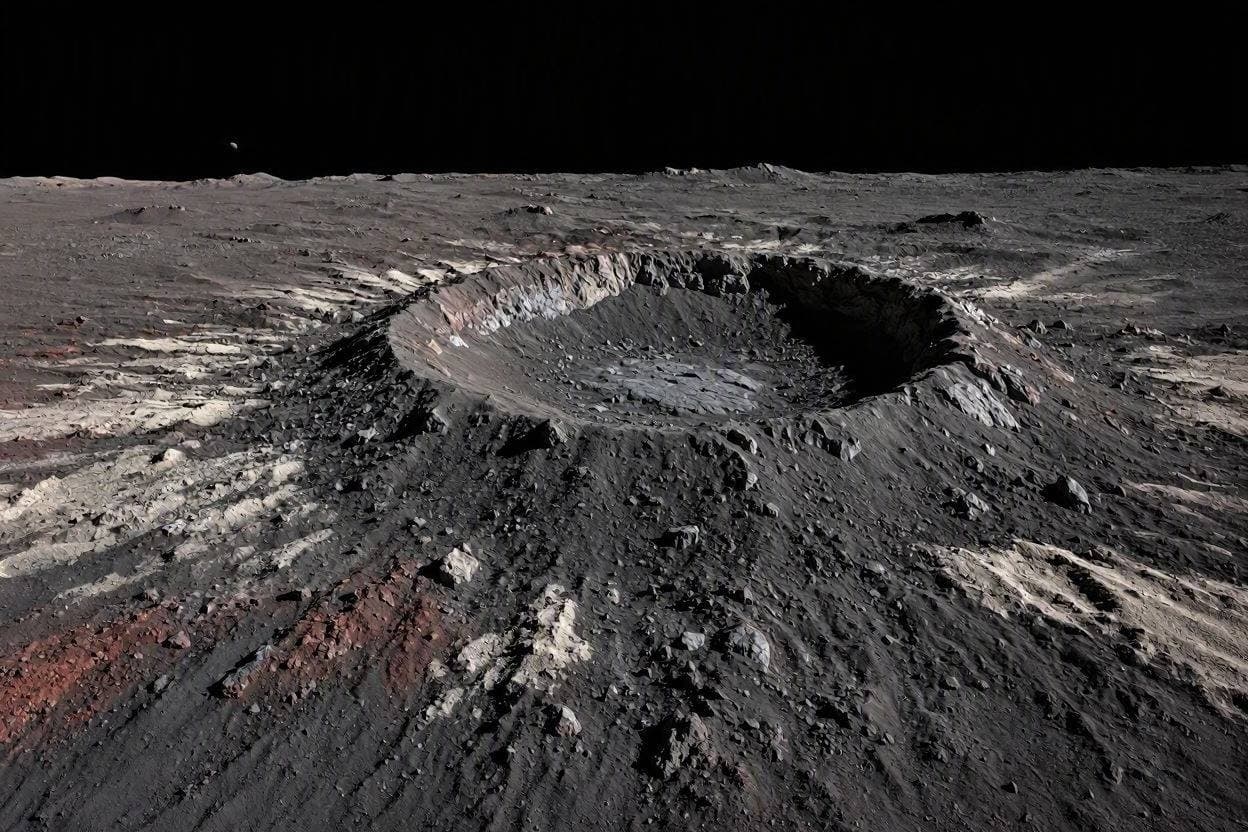
The moon has long been a silent witness to human ambition, its surface marked by the footprints of astronauts and the scars of robotic explorers. Recently, it gained a new mark: a crater created by the impact of a SpaceX rocket stage. Images captured by South Korea’s Danuri lunar orbiter have revealed the fresh impact site, offering a stark visual testament to the realities of space exploration. This event, while unintentional, highlights the growing traffic in cislunar space and the need for responsible space debris management. It is a moment that blends technological achievement with environmental caution, prompting reflection on our footprint beyond Earth.
The rocket stage, a leftover from a previous mission, struck the lunar surface at high speed, carving out a distinct crater. The Danuri orbiter, equipped with high-resolution cameras, was able to capture before-and-after images, clearly showing the disturbance in the regolith. The blackened hole and ejected material stand out against the pale gray landscape, a fresh wound on an ancient body. These images provide valuable data for scientists studying impact dynamics and lunar geology.
While the impact was not planned, it underscores the challenges of managing space junk. As more nations and private companies launch missions to the moon and beyond, the risk of accidental collisions increases. Debris from upper stages, defunct satellites, and other remnants pose a threat to active spacecraft and the lunar environment itself. This incident serves as a reminder that space is not an infinite void but a shared resource that requires careful stewardship.
SpaceX and other launch providers are increasingly aware of these issues, working on strategies for de-orbiting or disposing of rocket stages safely. Some companies are developing technologies to capture or redirect debris, while others aim for complete reusability to minimize waste. The goal is to create a sustainable ecosystem in space, where exploration does not come at the cost of clutter and danger.
The scientific value of the impact should not be overlooked. Studying the crater helps researchers understand the mechanical properties of the lunar surface. It provides real-world data that can refine models used for future landing missions. Every impact, whether natural or artificial, contributes to our knowledge of the moon’s composition and structure. In this way, even mistakes can lead to learning.
Public interest in the images has been high, reflecting a growing awareness of space activities. Social media has buzzed with discussions about the ethics of space debris and the beauty of the lunar landscape. This engagement is positive, fostering a broader conversation about how humanity interacts with the cosmos. It encourages a sense of responsibility alongside excitement.
The first images of the crater left by a SpaceX rocket on the moon offer a clear view of the physical impact of space exploration. As we continue to venture further, managing debris and minimizing unintended consequences will be crucial. The moon remains a symbol of our reach, and we must ensure our touch is as light as possible.
AI Image Disclaimer: The images provided are AI-generated to visually represent the technological and lunar aspects of the story.
Sources: Space.com Live Science ABC News Australia
Published by Banx Network. This article is part of the Banx decentralized media programme, powered by the BXE token on the XRP Ledger.