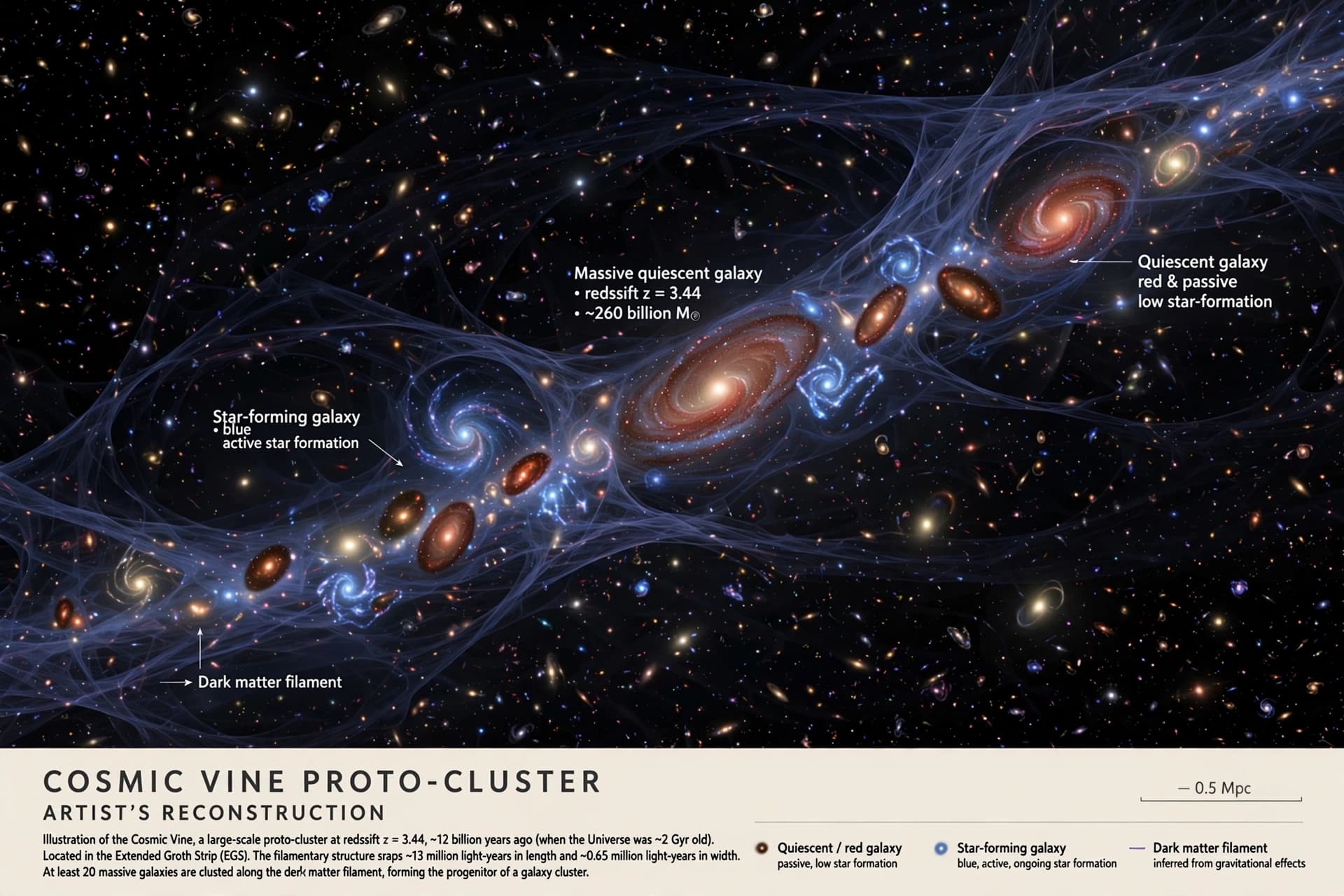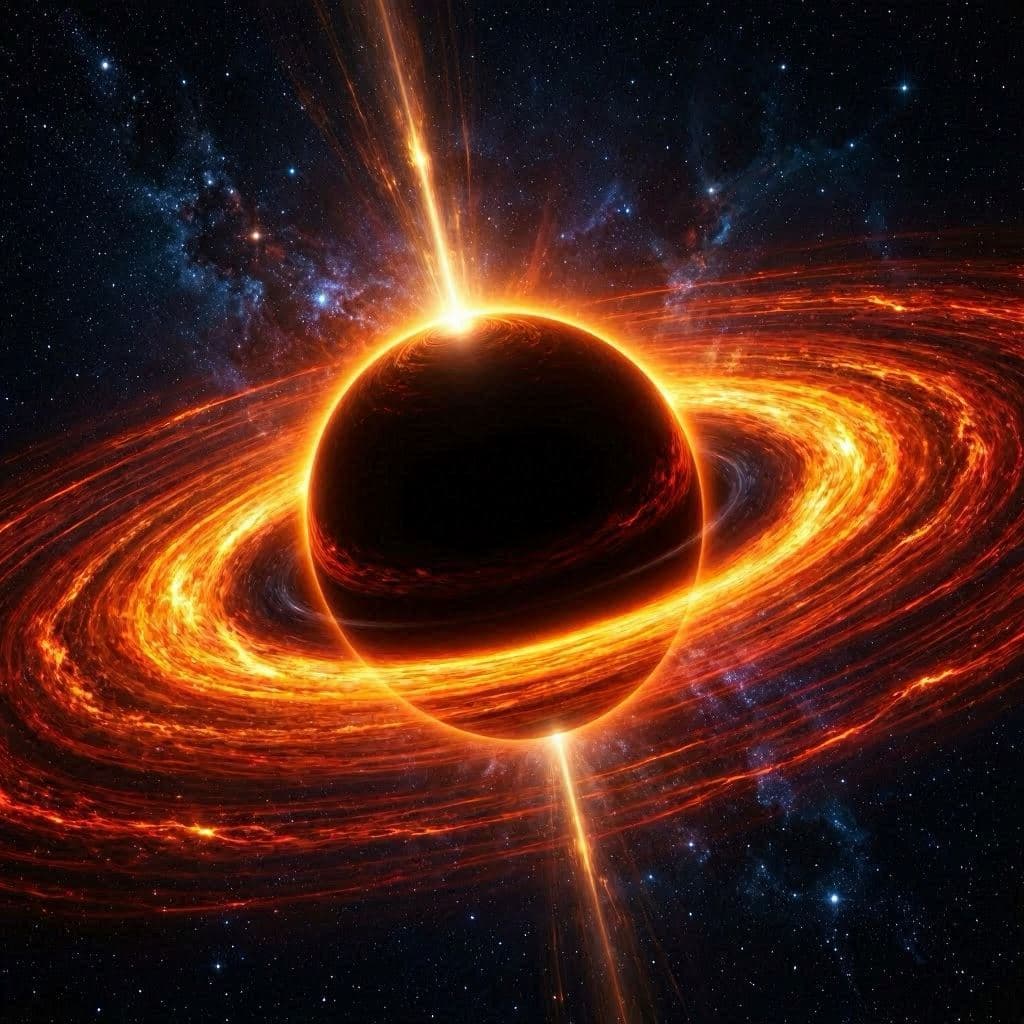
The universe is full of mysteries that challenge our understanding of physics and formation. Recently, the James Webb Space Telescope (JWST) detected enigmatic objects known as "little red dots" in the early cosmos. Initially thought to be compact galaxies, these sources are now suspected to be something even more exotic: "black hole stars." This hypothesis suggests that young black holes, enveloped in dense clouds of gas, emit a glow that mimics stellar light. It invites reflection on the boundaries of astronomical classification and the surprising ways in which gravity and matter interact in the infant universe.
Body: The "little red dots" appeared in JWST data as small, bright, and red sources, distinct from typical galaxies. Their compact size and intense brightness puzzled astronomers, as they seemed too massive and dense to be normal star-forming regions. The new theory proposes that these objects are active black holes accreting material at high rates. The friction and heat generated by this infalling gas create a luminous envelope, making the black hole appear star-like.
This interpretation resolves several inconsistencies in previous models. Normal galaxies of that era should not have been so compact yet so bright. By attributing the light to accretion disks around black holes, scientists can explain the observed properties without violating physical laws. It suggests that black holes played a more dominant role in the early universe than previously thought, influencing the formation of surrounding structures.
The term "black hole star" is metaphorical, describing the visual appearance rather than a true stellar object. Unlike stars, which generate light through nuclear fusion, these objects shine due to gravitational energy. This distinction is crucial for understanding their nature and evolution. It highlights the diversity of luminous phenomena in the cosmos and the need for precise terminology.
For cosmologists, this discovery offers insights into the growth of supermassive black holes. If these "dots" are indeed young black holes, they may represent the seeds of the giants found in galactic centers today. Understanding their formation and early behavior helps piece together the history of galaxy evolution. It connects the microscopic physics of accretion to the macroscopic structure of the universe.
Observational evidence supports this theory, including spectral lines indicative of high-velocity gas motion. JWST’s infrared capabilities allow it to peer through dust and detect these subtle signatures. Future observations will aim to confirm the hypothesis by monitoring variability and measuring masses more precisely. The process of scientific discovery is iterative, relying on continuous refinement of ideas.
Public interest in such findings is high, as they touch on fundamental questions about existence and origin. The idea of black holes masquerading as stars captures the imagination, illustrating the counterintuitive nature of astrophysics. It reminds us that the universe is often stranger than fiction, requiring open minds and rigorous inquiry.
As research continues, the definition of these objects may evolve further. Whether they are pure black hole systems or hybrid entities, they represent a new class of cosmic phenomena. Their study will likely lead to broader revisions of early universe models, enhancing our comprehension of cosmic history.
Closing: In the end, the "little red dots" are a testament to the power of new technology to reveal hidden truths. They challenge our assumptions and expand our knowledge of the early cosmos. As we decode their secrets, the hope is that we gain a deeper appreciation for the complexity and beauty of the universe.
AI Image Disclaimer: The visual representations associated with this article are AI-generated artistic interpretations designed to illustrate the themes of astronomy and theoretical physics.
Sources: NASA Space.com The Astrophysical Journal
Published by Banx Network. This article is part of the Banx decentralized media programme, powered by the BXE token on the XRP Ledger.