When we gaze up at the night sky, the stars seem like fixed points of light, timeless and reassuring. Yet above that serene canopy lies a universe in motion — vast and breathing, its expanses stretching like an endless tide. For nearly a century, scientists have known this gentle expansion carries galaxies ever farther apart, an insight that both humbles and inspires. Now, a group of physicists from the University of Illinois Urbana-Champaign and The University of Chicago has introduced a fresh way to listen to that cosmic heartbeat, potentially bringing sharper clarity to one of cosmology’s most enduring questions.
In physics, the universe’s expansion rate is quantified by the Hubble constant — a number that tells us how fast space itself stretches per unit distance. But measuring this rate has uncovered a puzzling tension: values inferred from the early universe don’t quite line up with those measured more locally. This “Hubble tension” suggests either new physics waiting to be discovered or subtle gaps in current observational methods. To address this, researchers from Illinois and UChicago have devised a novel gravitational-wave–based technique that could help bridge that divide.
Gravitational waves — ripples in spacetime produced by cataclysmic collisions of black holes or neutron stars — have already opened a new window on the cosmos. Traditionally, scientists used individual gravitational-wave events, known as “standard sirens,” to estimate the distance to their sources and infer the expansion rate. But the new method takes a broader view, turning attention not to the singular waves we detect but to the collective background “hum” created by countless distant mergers that current detectors haven’t yet individually resolved.
This background is a symphony of the cosmos’s most energetic events — a subtle, stochastic signal arising from many overlapping sources across space and time. The Illinois–UChicago team realized that the strength of this hum depends on how densely these collisions occur throughout the universe, which in turn is tied to the size of the volume of space they inhabit. Under slower expansion rates, this volume shrinks and the density of contributing events rises, enhancing the background signal. By modeling how this gravitational-wave background should behave for different values of the Hubble constant — even without detecting it outright — researchers can begin to exclude certain expansion scenarios and refine measurements with greater confidence.
The researchers call this new approach the stochastic siren method, because it treats the background as a statistical ensemble of unobserved mergers rather than focusing solely on distinct detections. In a proof-of-principle application using current data from the LIGO-Virgo-KAGRA gravitational-wave network, the team found that the absence of a strong background signal already places constraints against very low values of the Hubble constant. When combined with standard siren measurements from individual black hole collisions, this method yields a more precise measurement of the universe’s expansion rate even before the background itself is directly observed.
One of the most appealing aspects of this idea is its future promise: as gravitational-wave detectors grow more sensitive and the gravitational-wave background moves within reach of detection, the stochastic siren method could become an increasingly powerful tool for cosmology. Over the next several years, as technology advances and datasets expand, this technique may help cosmologists reconcile differing measurements, tighten constraints on the Hubble constant, and probe deeper into the nature of dark energy and cosmic history.
In the quiet depths of space, where trillions of unseen waves ripple through the cosmic sea, scientists are learning new ways to listen. By tuning into that faint gravitational hum, researchers hope to refine our understanding of the universe’s expansion — reminding us that sometimes the most profound insights come not from what we see, but from what we learn to hear.
A new study by physicists at the University of Illinois Urbana-Champaign and the University of Chicago introduces a gravitational-wave background–based method to measure the Hubble constant. By modeling how the background “hum” from unresolved black hole mergers depends on cosmic expansion, and combining this with individual event measurements, the team demonstrates a viable new approach that could sharpen constraints on the universe’s expansion as detector sensitivity improves.
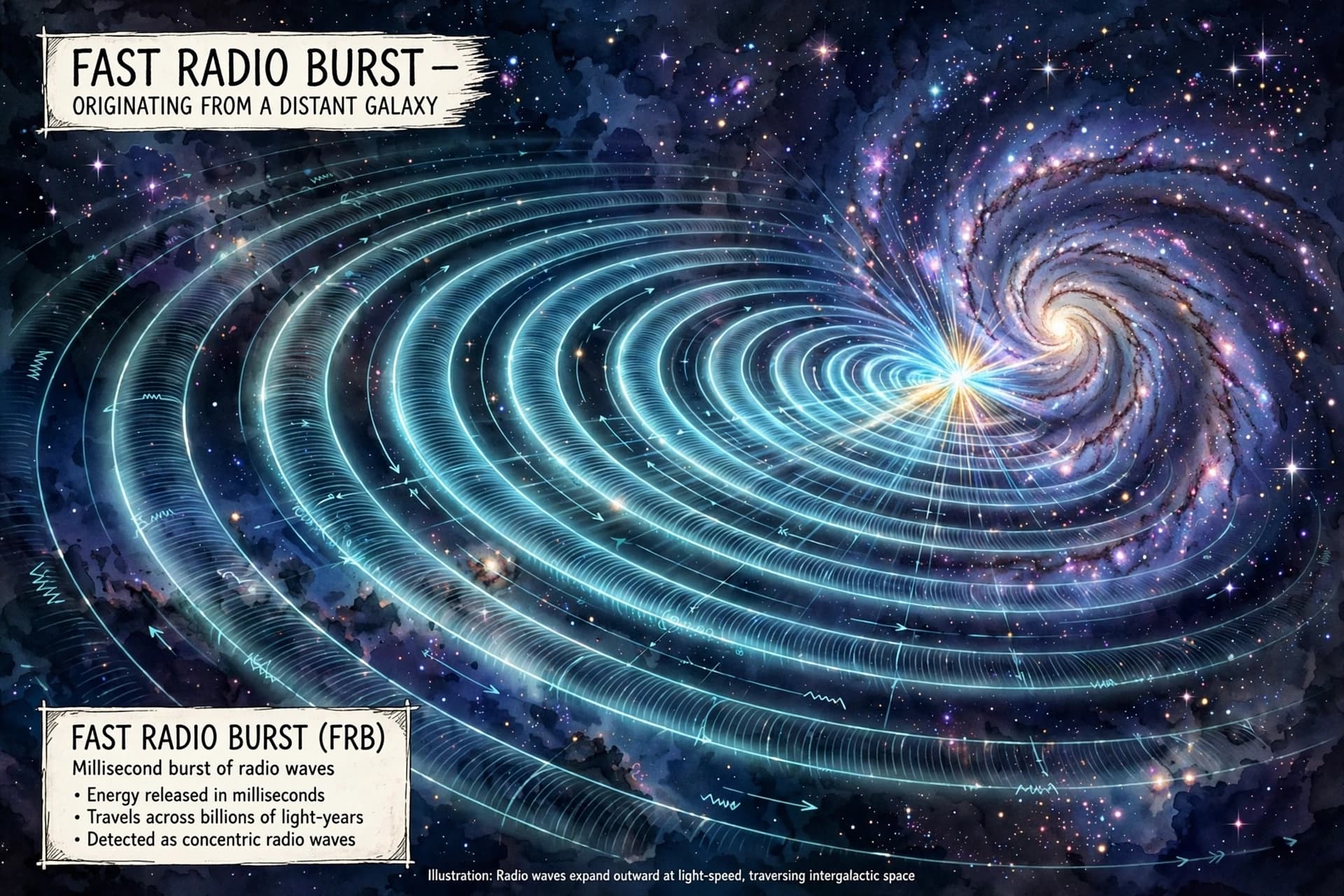
AI Image Disclaimer Visuals are created with AI tools and are not real photographs.
Sources University of Illinois / Newswise — Illinois and UChicago physicists develop a new method to measure the expansion rate of the universe. Phys.org — Physicists develop new method to measure universe’s expansion rate. ScienceBlog — Gravitational Wave "Hum" from merging black holes gives new measure of the universe's expansion rate.
Published by Banx Network. This article is part of the Banx decentralized media programme, powered by the BXE token on the XRP Ledger.