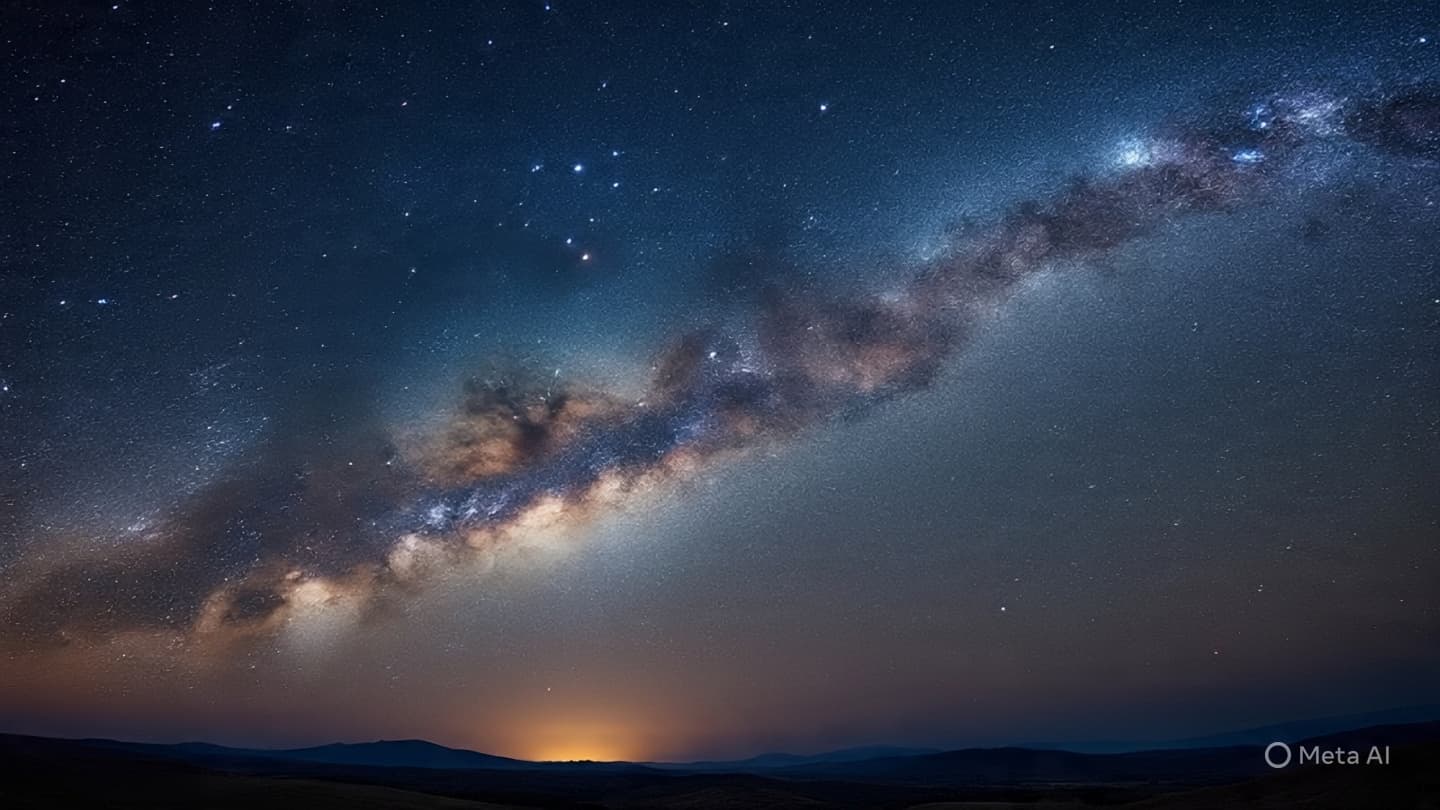
For centuries, humanity has looked outward and imagined the galaxy as something vast yet distant, its boundaries fading into abstraction. Now, like tracing the shoreline of an unseen ocean, scientists suggest that the edge of our home galaxy may be closer than once believed, bringing a subtle shift to how we understand our place in the cosmos.
Recent astronomical studies have proposed a revised estimate of the Milky Way’s outer boundary, suggesting it lies nearer than earlier models indicated. This conclusion emerges from improved measurements of stellar distribution and the behavior of stars at the galaxy’s periphery.
Traditionally, defining the “edge” of a galaxy has been complex. Unlike a solid object, galaxies gradually thin out, with stars becoming increasingly sparse. The Milky Way, in particular, contains extended structures such as the stellar halo, which complicate clear boundaries.
Researchers have relied on data from advanced observatories and space missions, analyzing the motion and composition of distant stars. By studying how these stars orbit and interact with gravitational forces, scientists can infer where the galaxy’s influence begins to weaken.
One key factor in the revised estimate involves distinguishing between gravitationally bound stars and those that are merely passing through intergalactic space. This distinction helps refine where the Milky Way effectively “ends.”
The findings suggest that earlier estimates may have extended the galaxy’s reach beyond where its core gravitational structure truly dominates. While the difference may seem modest on a cosmic scale, it carries implications for understanding galactic formation and evolution.
This adjustment also influences how astronomers model interactions between the Milky Way and neighboring galaxies, including the ongoing gravitational relationship with smaller satellite galaxies.
Importantly, the revision does not shrink the galaxy in any practical sense for observers within it. Instead, it sharpens the scientific definition of its limits, offering a clearer picture of its structure.
As observational techniques continue to improve, such refinements are expected. Each new dataset allows scientists to revisit long-held assumptions, gradually transforming broad outlines into more precise maps of the universe.
The idea that the Milky Way’s edge is closer than once thought does not diminish its grandeur; rather, it brings its structure into clearer focus, reminding us that even familiar cosmic landmarks remain open to discovery.
AI Image Disclaimer: Images included may be AI-generated visualizations designed to represent the Milky Way and its outer regions.
Sources: NASA European Space Agency (ESA) Nature Astronomy
Published by Banx Network. This article is part of the Banx decentralized media programme, powered by the BXE token on the XRP Ledger.