
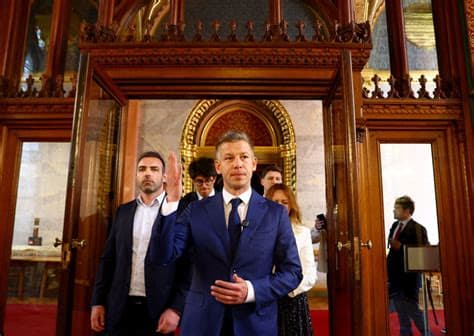
Key Highlights
- Péter Magyar's campaign challenged the foundations of Viktor Orbán's regime.
- The movement turned public anger into a political force.
- Trust in the regime's stability began to erode among supporters and opponents.
Péter Magyar’s campaign against Viktor Orbán’s regime did not result in an immediate overthrow; rather, it strategically targeted the very foundations that upheld the regime's perceived durability. By harnessing public discontent and channeling it into a coherent political movement, Magyar effectively challenged the narrative that stability under Orbán was inevitable. His approach involved highlighting systemic unfairness and identifying institutional pressure points that could be exploited to rally support.
As Magyar's movement gained traction, it began to erode the regime's credibility. By encouraging defections from Orbán's supporters and fostering a climate of skepticism, Magyar's campaign created an environment where the once-untouchable image of the regime started to crack. The increasing scrutiny of Orbán's policies and the growing conflicts within the political landscape led many to question the long-standing belief in the regime's durability.
The political environment in Hungary shifted as Magyar's supporters rallied around a vision of change, contrasting sharply with the status quo. This shift was not merely about opposing Orbán; it was about redefining what governance could look like in Hungary. The narrative of a 'built-to-last' regime began to falter as more citizens recognized the potential for political transformation.
Magyar's strategy involved not just mobilizing discontent but also articulating a vision for a more equitable political future. By addressing the grievances of ordinary citizens and presenting a viable alternative to Orbán's policies, he was able to attract a diverse coalition of supporters. This coalition included not only those disillusioned with the regime but also individuals who had previously supported Orbán but were now questioning his leadership.
As the political landscape continues to evolve, the implications of Magyar's campaign extend beyond Hungary. It serves as a case study in how grassroots movements can challenge entrenched political systems. The erosion of trust in Orbán's regime highlights the fragility of political power when faced with organized dissent and a compelling alternative narrative.
In conclusion, Péter Magyar's political movement represents a significant shift in Hungary's political dynamics. By dismantling the myth of a 'built-to-last' regime, he has opened the door for new possibilities in Hungarian politics, demonstrating that change is not only possible but also necessary for the future of the nation.
Published by Banx Network. This article is part of the Banx decentralized media programme, powered by the BXE token on the XRP Ledger.



