There are movements in nature so small that they escape ordinary notice, unfolding in spaces far beyond the reach of the human eye. And yet, within those unseen moments, life carries out its most essential acts—quietly, precisely, and with a kind of elegance that often reveals itself only after careful observation. The splitting of DNA, a process so fundamental it underpins all living systems, might seem well understood. But even here, there are gestures still waiting to be noticed.
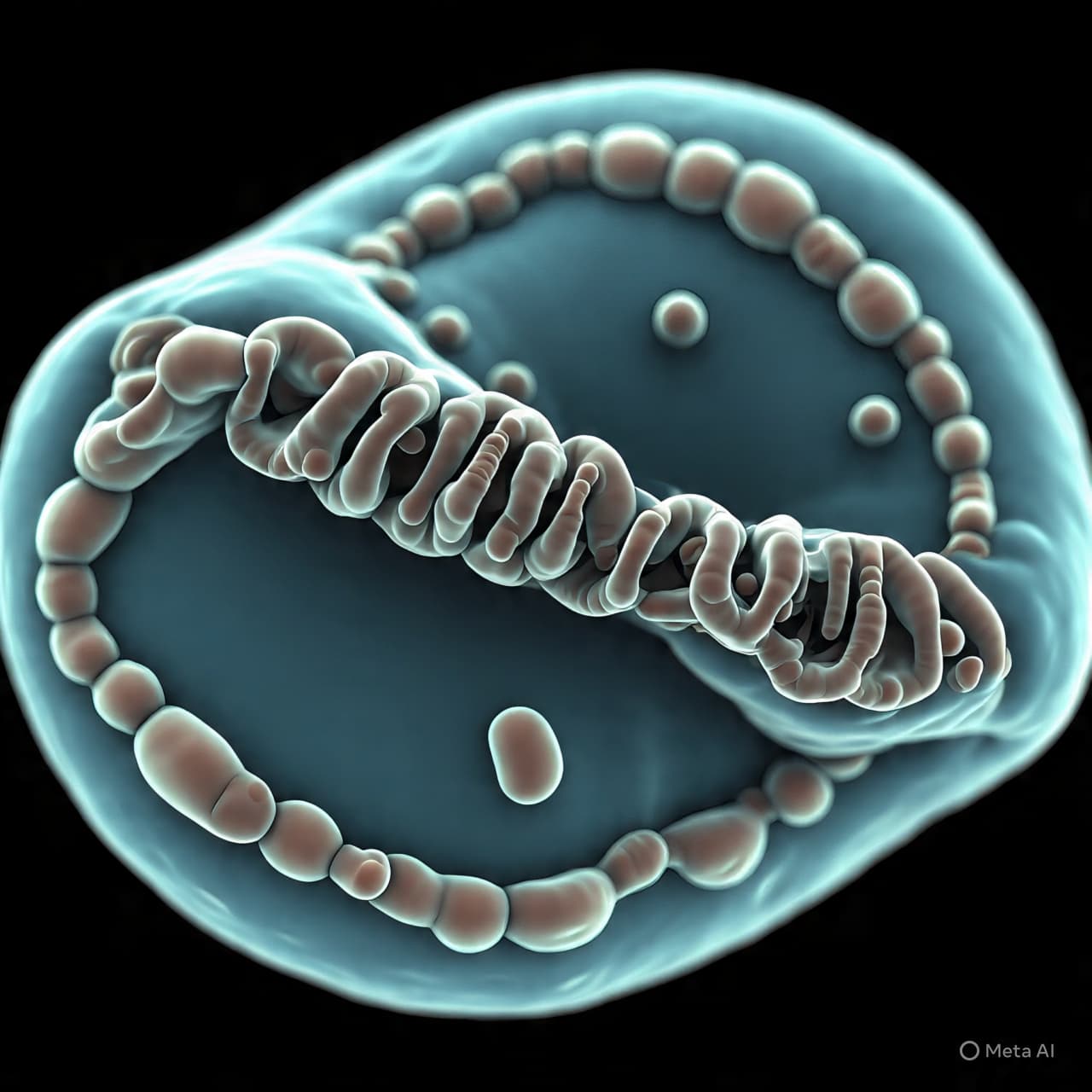
Recent research has uncovered a striking mechanism in certain bacteria, where DNA appears to separate using structures that resemble the folds of an accordion. Rather than unfolding in a simple, linear fashion, the genetic material organizes itself into compact, repeating folds that expand and contract during the process of replication and division. This motion, subtle yet coordinated, allows the DNA to be efficiently managed within the limited space of a bacterial cell.
At first glance, the image of an accordion may seem more poetic than scientific. Yet it offers a useful way to understand how the DNA behaves. These folded structures enable large strands of genetic material to be compressed without becoming tangled, maintaining order even as they prepare to split into two identical copies. When the time comes for division, the folds can extend, guiding the separation in a controlled and organized manner.
Scientists have long studied how DNA replicates, focusing on the enzymes and molecular machinery involved in copying genetic information. What this discovery adds is a deeper understanding of the physical arrangement—the architecture that makes the process not only possible, but efficient. It suggests that structure and motion are as important as chemistry in ensuring that life continues accurately from one generation to the next.
The implications of this finding extend beyond bacteria alone. By observing how nature solves the challenge of organizing and dividing complex molecules in confined spaces, researchers may gain insights applicable to other fields, from synthetic biology to nanotechnology. The idea that folding patterns can guide function opens new avenues for thinking about how biological systems are designed and how they might be replicated or adapted.
There is also a certain humility in recognizing that such mechanisms have existed all along, operating quietly within the simplest forms of life. What appears straightforward on the surface often conceals layers of sophistication, revealed only when tools and perspectives evolve enough to see them.
At the same time, scientists approach these findings with care. While the accordion-like model offers a compelling framework, further research is needed to fully understand how widespread this mechanism is and how it interacts with other aspects of cellular function. Each discovery, while illuminating, becomes part of a larger and still-unfolding picture.
In this way, the study of bacterial DNA continues to move forward—not through dramatic leaps alone, but through the gradual refinement of understanding. Each new detail adds texture to a process that is both ancient and ongoing, reminding us that even the most familiar aspects of life can still hold quiet surprises.
The research has been published in leading scientific journals, with ongoing studies exploring the structural dynamics of DNA in various organisms. Scientists aim to further investigate how these folding mechanisms influence replication accuracy and cellular organization across different biological systems.
AI Image Disclaimer Images in this article are AI-generated illustrations, meant for concept only.
Source Check — Credible Coverage Exists
Relevant coverage and scientific reporting found in:
Nature Science Magazine New Scientist Phys.org Scientific American
Published by Banx Network. This article is part of the Banx decentralized media programme, powered by the BXE token on the XRP Ledger.