There are instruments that do not simply observe, but listen.
Not in sound, but in the faint signatures of matter itself—in the way particles move, how they respond to fields, how they reveal their presence through patterns too small to perceive directly. In laboratories, where measurement becomes a form of translation, devices are built to hold the invisible just long enough to understand it.
Among these, mass spectrometry has long stood as a quiet interpreter.
It separates ions by their mass and charge, allowing scientists to identify molecules, trace compositions, and follow transformations across chemistry, biology, and physics. The process depends on control—guiding charged particles through electric and magnetic fields, capturing them, releasing them, measuring their behavior with precision that approaches the limits of detection.
For decades, this control has been refined within a familiar structure.
Ions are trapped, often in small numbers, within carefully designed fields, their signals read in sequence. The approach is effective, but bounded. Each measurement takes time. Each trapped group represents a fraction of what could, in principle, be observed.
Now, a different arrangement has begun to take shape.
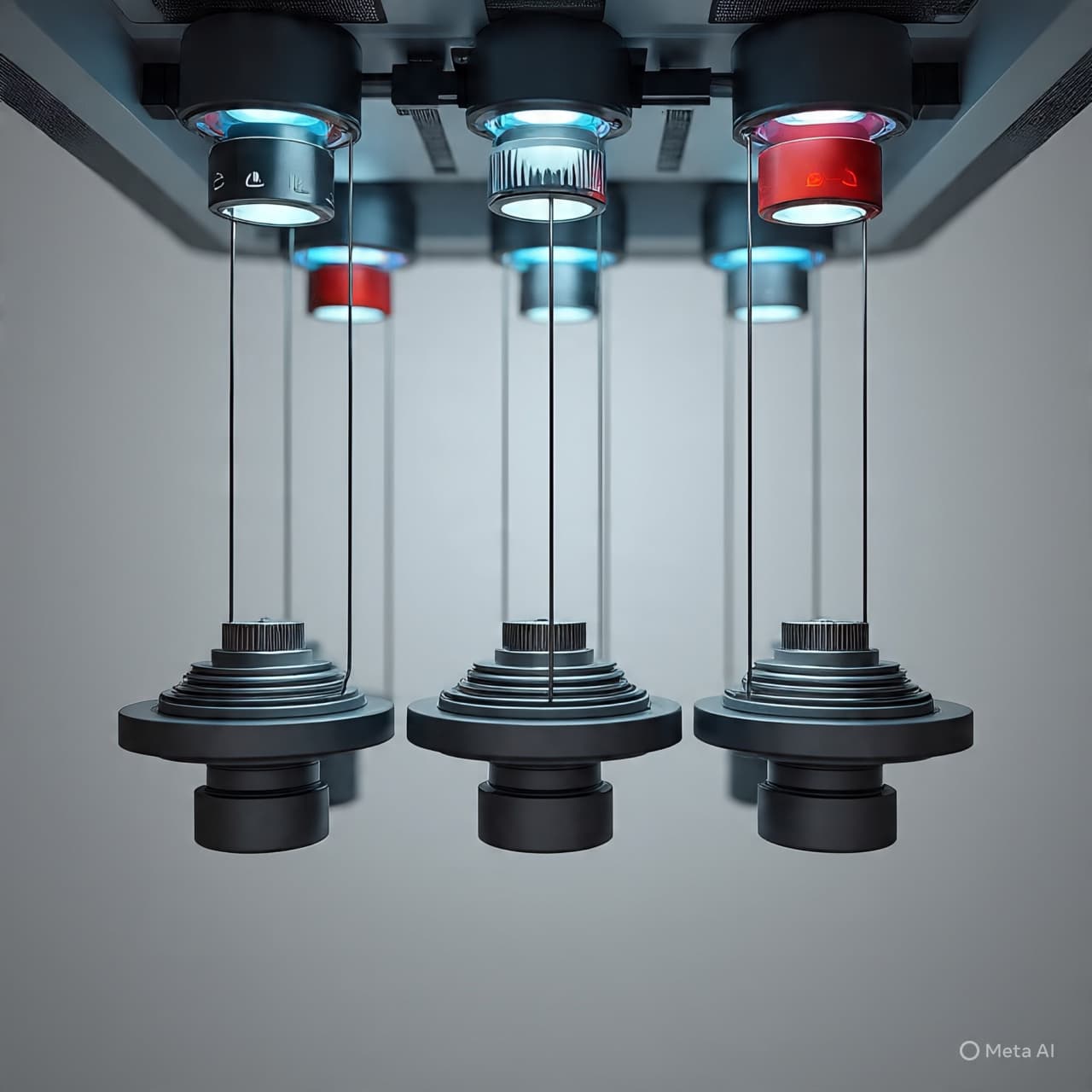
Researchers have developed a prototype system based on massively parallel ion trapping, where not one, but many trapping regions operate simultaneously. Instead of guiding ions into a single analytical path, the system distributes them across an array—multiple traps working in concert, each contributing its own stream of data.
The change is not dramatic in appearance, but it alters the rhythm of measurement.
Where once ions were handled in sequence, they are now processed in parallel. The effect is a substantial increase in throughput—the number of ions that can be analyzed within a given time. It is a shift from singular focus to distributed attention, allowing the instrument to capture more information without extending the duration of analysis.
There is also a subtle change in sensitivity.
By increasing the number of ions measured simultaneously, the system can improve signal strength and reduce noise, revealing details that might otherwise remain obscured. Complex mixtures—biological samples, environmental extracts, chemical reactions—become more accessible, their components more readily distinguished.
The prototype suggests not only greater speed, but a different scale of observation.
Mass spectrometry has often balanced resolution, sensitivity, and throughput, each influencing the others. Parallel ion trapping introduces a new dimension to that balance, offering the possibility of advancing multiple aspects at once. It does not eliminate the constraints entirely, but it shifts them, opening space for new configurations.
There is a certain restraint in how such developments are understood.
A prototype is not yet a standard. Its performance must be tested across conditions, its reliability established, its integration with existing systems considered. The promise of a “step-change” in capability is less a declaration than an indication—a direction in which the field may move.
Still, the principle is clear.
By rethinking how ions are held and measured—by allowing many small processes to occur together rather than one after another—researchers are expanding the capacity of an instrument that already plays a central role in modern science.
The invisible becomes, if not fully seen, then more fully resolved.
Scientists report that a massively parallel ion trapping prototype has demonstrated the potential to significantly increase throughput and sensitivity in mass spectrometry. Ongoing work will focus on refining the technology and evaluating its performance across a range of analytical applications.
Scientific visualization of multiple ion traps operating in parallel within a mass spectrometer, clean and technical style, 1920×1280
Published by Banx Network. This article is part of the Banx decentralized media programme, powered by the BXE token on the XRP Ledger.