In a striking development on the international stage, President Donald J. Trump, joined by the leaders of Qatar, Egypt, and Turkey, officially signed the Gaza Peace Plan—a bold initiative aimed at fostering peace in the Middle East.
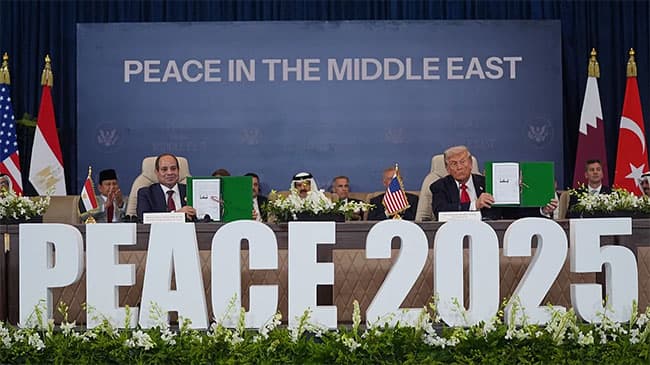
The ceremony, hailed by the White House as a “historic moment,” featured the signing of the agreement before an audience of dignitaries, diplomats, and media. Under the banner “Peace 2025”, the document signals a fresh attempt to address long-standing tensions in the region.
At the event, Trump was seated alongside the Egyptian leader and others at a grand table, with national flags forming a backdrop and the phrase “Peace in the Middle East” emblazoned overhead. Several regional leaders were present—underscoring the collaborative nature of this effort.
Though details of the plan remain under wraps, the symbolism is clear: a collective push by multiple nations to move forward from conflict and toward negotiation and stability. The presence of Qatar, Egypt, and Turkey highlights a broad coalition beyond traditional power blocs.
For the United States, this move represents a renewed diplomatic investment in Middle Eastern affairs. Trump’s role in orchestrating and endorsing the plan underscores his administration’s intent to be a central actor in any future peace architecture.
Given the volatile history of Gaza and its surrounding territories, any peace proposal must contend with deep-seated grievances: territorial disputes, humanitarian crises, border security, and questions of sovereignty. How each country—especially Israel, Hamas, and other local actors—responds will be critical.
The reaction in the region is likely to be mixed. Optimists may see this as a meaningful step toward peace, while skeptics will question whether the framework has sufficient teeth and whether parties will honor it. The success of this plan will depend on both political will and enforceable mechanisms.
For now, the signing event stands as a compelling symbol: four nations uniting to lay a foundation for peace in Gaza. Whether that foundation holds remains to be seen.
Published by Banx Network. This article is part of the Banx decentralized media programme, powered by the BXE token on the XRP Ledger.