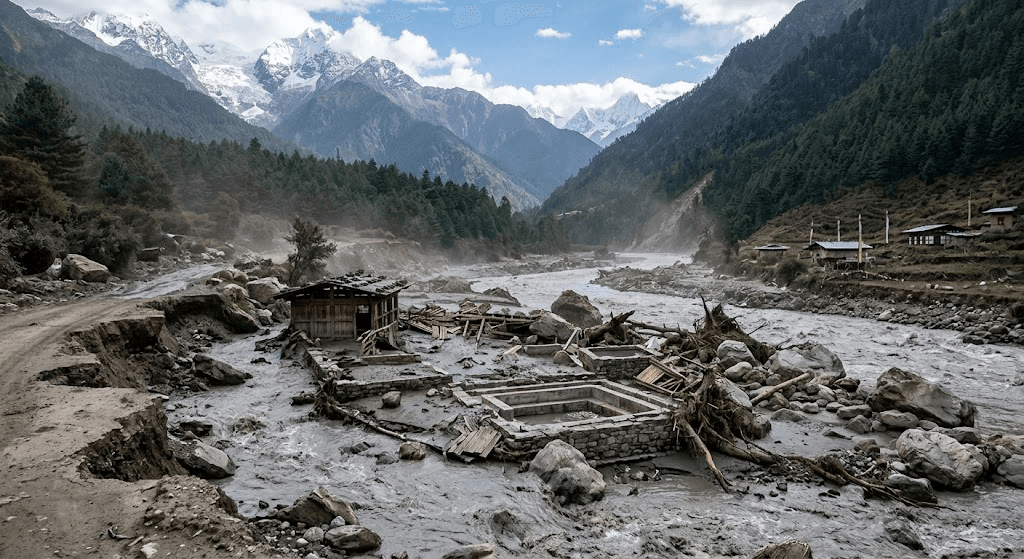
THIMPHU / GASA — In a dramatic manifestation of climate vulnerability across the high Himalayas, a Glacial Lake Outburst Flood (GLOF) originating from Sintaphu Lake has swept through northern Bhutan’s Gasa district. The sudden surge of torrents and debris tore down the Mo Chhu valley, washing away the country's famous Gasa Tshachu hot springs complex, severing critical transport links, and triggering cross-border emergency alerts downstream into India.
The disaster unfolded on Thursday evening when the natural moraine dam holding back Sintaphu Lake—a high-altitude glacial body nestled near Wakila Mountain in Laya Gewog—breached unexpectedly. Sintaphu Lake, situated at the headwaters of the Mo Chhu river, had long been monitored by Bhutanese hydrologists as one of the kingdom's 17 designated "potentially dangerous glacial lakes".
At around 8:15 PM, a massive surge of water, mud, and boulders roared downstream through Taktsemakhang. Early warning sirens were activated across the valley, allowing residents in immediate flood-prone zones to evacuate to higher ground, preventing loss of life or serious injuries.
Despite the timely evacuation, the physical destruction along the Mo Chhu river basin has been severe. The revered Gasa Tshachu complex—a centuries-old therapeutic hot spring facility and a major cultural and tourism landmark—was completely inundated and washed away by the torrents.
Transport infrastructure was also critically hit, with a major section of the Punakha–Gasa Secondary National Highway near the 31.85-kilometer mark being completely destroyed, leaving the road indefinitely closed. Furthermore, key road routes and bridges leading toward Laya, one of Bhutan's most remote high-altitude settlements, sustained severe structural damage, leaving local populations isolated.
As the surge travelled south, the Mo Chhu joined the Pho Chhu at Punakha to form the Punatsangchhu, which flows directly into eastern India as the Sankosh River.
Recognizing the impending threat of sudden river level rises, disaster management authorities in the neighboring Indian states of Assam and West Bengal issued high alerts. In West Bengal’s Alipurduar district alone, over 10,000 residents living along vulnerable riverbanks were evacuated to temporary relief centers set up in local schools. National and State Disaster Response Forces (NDRF and SDRF) remain deployed along the Sankosh river basin to manage emergency operations.
Glacial lake outburst floods represent one of the most unpredictable threats facing the Himalayan region. As global temperatures rise, glaciers retreat at accelerated rates, forming unstable meltwater lakes bounded by fragile ice or loose rock moraines.
While Bhutanese authorities continue damage assessments and recovery planning, environmental experts emphasize that the destruction of Gasa Tshachu serves as a painful reminder of the fragile balance between rising global temperatures and Himalayan ecosystems.
Published by Banx Network. This article is part of the Banx decentralized media programme, powered by the BXE token on the XRP Ledger.