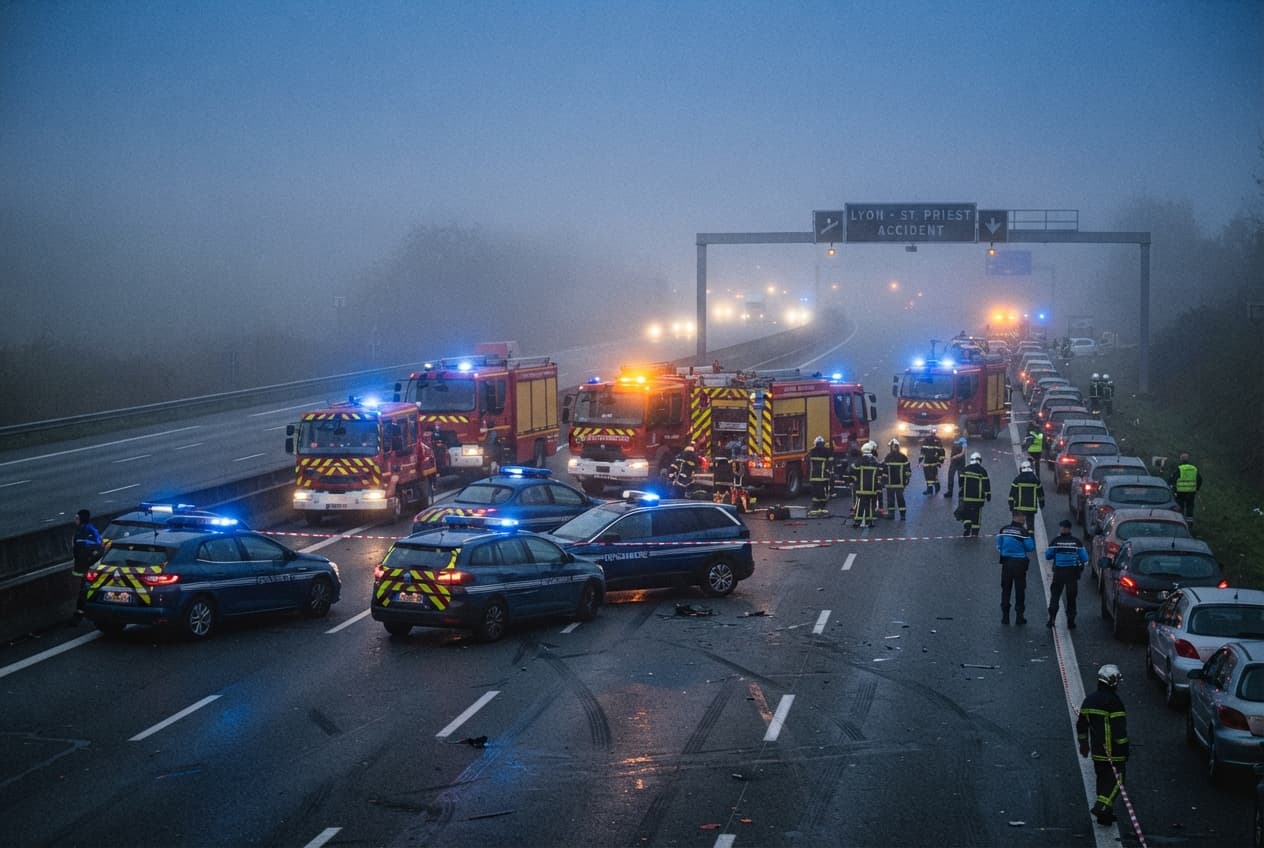
Lyon, France—Gendarmerie highway patrol units and emergency medical services rushed to a major motorway corridor outside Lyon early Tuesday morning following a violent multi-vehicle pileup that left three individuals dead and several others critically injured. The catastrophic crash occurred amid poor visibility caused by dense early-morning fog banks sweeping across the open expressway lanes.
Initial accident telemetry indicates that a heavy freight carrier clipped a slowing passenger transport vehicle, triggering a massive chain-reaction collision involving more than a dozen cars and commercial vans. The sheer force of successive impacts compressed several vehicles beneath larger haulage units, blocking all southbound lanes and trapping panicked motorists inside mangled metal chassis.
Specialized fire and rescue extraction teams deployed heavy hydraulic cutting shears to peel back crushed body panels, working frantically against the clock to reach victims trapped in the wreckage. Paramedics established a triage perimeter directly on the asphalt, administering advanced life support before airlifting critical trauma patients to regional university hospitals in Lyon.
"Our rescue teams encountered extremely complex structural entrapment patterns across the compressed vehicle chain," explained motorway safety operations commander Henri Lefevre during a roadside press briefing. Transport authorities implemented wide-scale diversion routes, channeling dense commuter flows onto parallel secondary roads that quickly experienced severe gridlock.
Forensic accident investigators utilized laser mapping equipment and drone photography to record skid marks and vehicle debris trajectories across the multi-lane expanse. Prosecutors opened an immediate judicial inquiry into vehicle speeds and adherence to mandatory following distances under reduced visibility conditions.
As afternoon gave way to evening, heavy-duty recovery winches cleared the last of the burned and twisted vehicle hulks from the asphalt, allowing maintenance crews to begin resurfacing heat-damaged sections of the road. Authorities warned that full structural and traffic normalization would take hours, keeping regional transit corridors under heavy monitoring.
Published by Banx Network. This article is part of the Banx decentralized media programme, powered by the BXE token on the XRP Ledger.