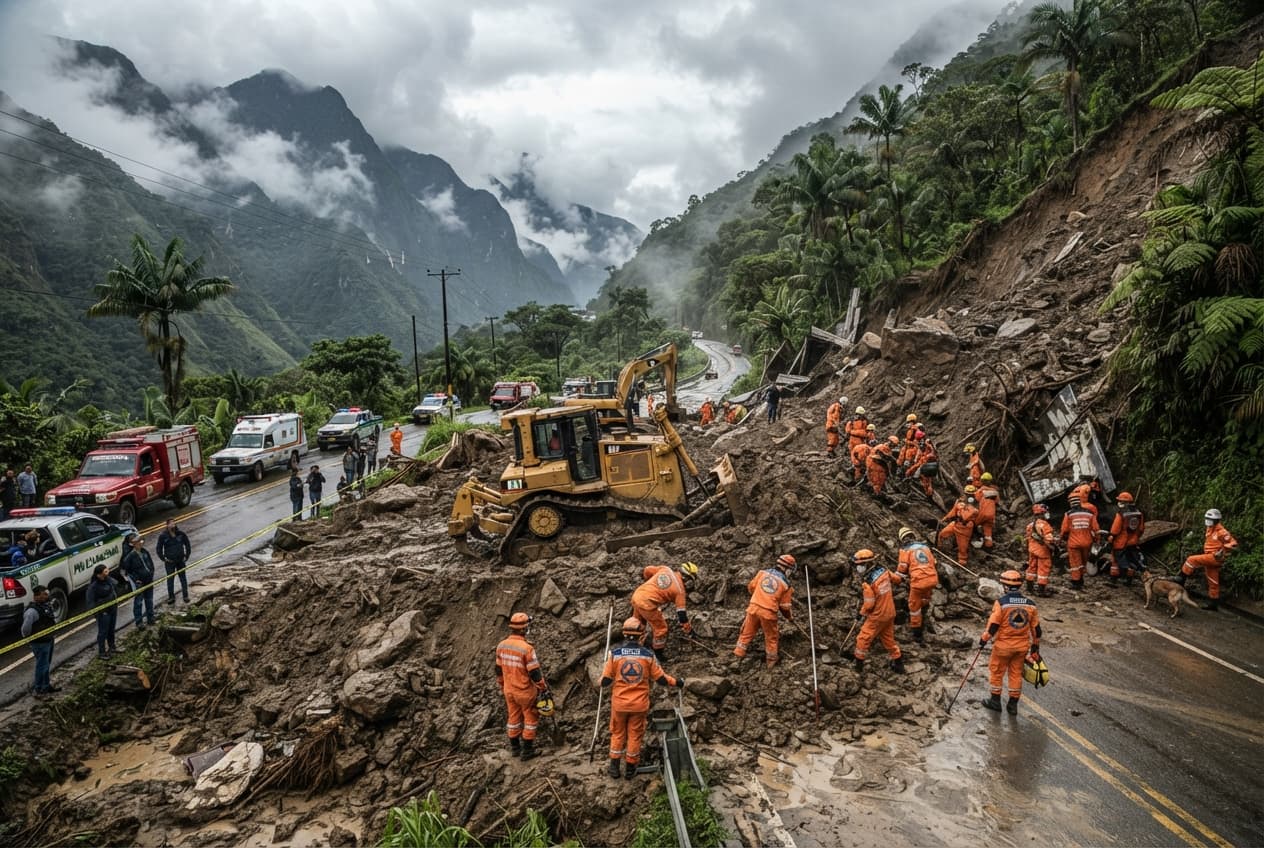
Bogotá, Colombia—Torrential mountain rains unleashed a wall of mud and rock that crashed directly across a major regional transit corridor. A catastrophic landslide buried an intermunicipal passenger bus and several smaller vehicles, leaving twelve people dead beneath tons of debris. Emergency disaster response agencies rushed heavy excavation equipment to the remote Andean highway following frantic emergency calls from surviving motorists. First responders encountered treacherous conditions as continuous downpours triggered secondary mudslides along the unstable slope.
Rescue workers utilizing hydraulic jacks and manual shovels dug through compacted earth to reach the crushed hull of the passenger bus. Civil defense personnel confirmed that twelve occupants perished inside the vehicle before extraction teams could break through. Several injured survivors were pulled from the wreckage and airlifted by military helicopters to regional medical facilities in critical condition. Transport ministry officials ordered an immediate closure of the vital mountain pass as instability threatened rescue personnel.
Geological engineers assessed the surrounding mountain face, warning that saturated soil conditions create extreme risks for further structural failures. Initial findings indicate that weeks of unseasonal rainfall weakened the unstable hillside above the unpaved highway segment. Local community leaders pointed to deforestation and inadequate drainage infrastructure as compounding factors behind the deadly slope collapse. Government disaster agencies mobilized additional heavy machinery units from neighboring provinces to accelerate clearance operations.
The tragedy triggered intense national debate concerning the safety of aging road infrastructure traversing Colombia's rugged Andean terrain. Lawmakers criticized transport ministries for delaying structural reinforcement projects along high-risk mountain routes prone to seasonal slides. Presidential representatives issued formal statements expressing condolences to the victims' families and promising comprehensive financial support. Relief organizations established emergency coordination centers to manage donations and assist grieving relatives arriving at the staging area.
Medical personnel at regional hospitals reported treating trauma patients suffering from severe crush injuries, hypothermia, and exhaustion. Forensic specialists supervised the transfer of recovered remains to temporary morgue facilities established in a nearby municipal sports stadium. Family members gathered outside the disaster security perimeter awaiting heartbreaking updates regarding missing relatives still unaccounted for. Search dogs combed through the periphery of the mudslide zone to ensure no other victims remained trapped.
Highway maintenance crews brought in massive bulldozers to clear thousands of cubic meters of mud blocking the vital commercial artery. Environmental protection officers monitored nearby river channels for blockages that threatened downstream farming settlements with flash flooding. Utility technicians disconnected downed power lines running parallel to the damaged roadway to safeguard rescue workers. The highway corridor remained sealed off to general traffic as engineering assessments continued into the night.
State meteorological bureaus warned that precipitation levels across the Andean region remain well above historical seasonal averages. Transport authorities urged commercial freight operators and private motorists to avoid mountainous routes until weather warnings expire. The devastating slide highlighted the persistent vulnerability of rural transit networks facing intensifying climatic anomalies. Recovery operations transitioned from rescue to heavy debris removal as darkness enveloped the valley.
Published by Banx Network. This article is part of the Banx decentralized media programme, powered by the BXE token on the XRP Ledger.