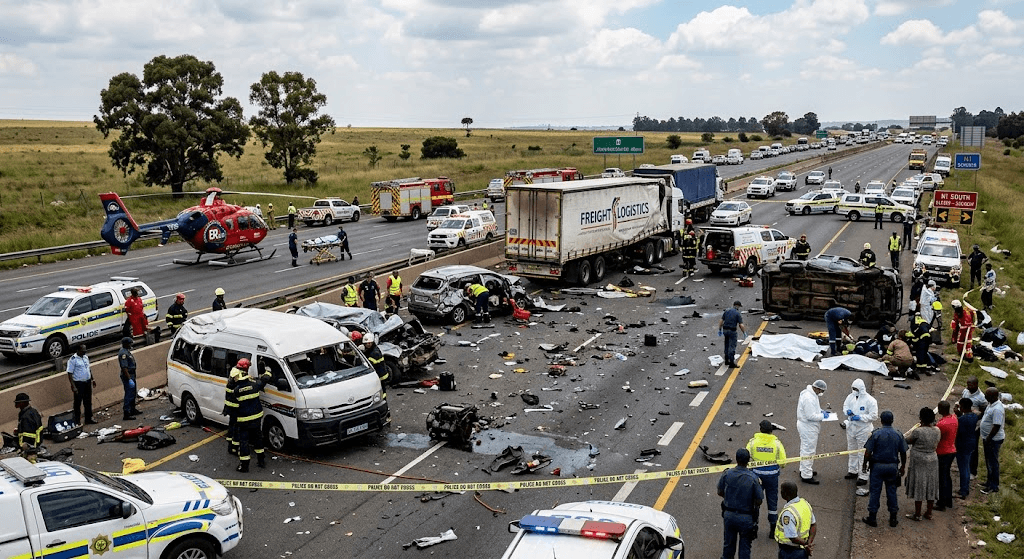
JOHANNESBURG, South Africa — A catastrophic multi-vehicle crash along a major transport corridor has claimed at least 21 lives and left dozens more injured, marking one of the country's most devastating highway incidents in recent memory.
The massive pileup occurred during high-density travel hours when a heavy freight truck lost control, barreling into oncoming traffic and colliding with multiple passenger vehicles, minibuses, and commuter cars. The chain-reaction impact crushed several vehicles upon collision, scattering debris across hundreds of meters of highway and creating an immediate mass-casualty crisis. Eyewitnesses reported severe smoke, leaking fuel, and widespread panic as surviving commuters rushed to assist trapped passengers before emergency crews arrived.
First responders, medical personnel, and specialized search-and-rescue units swarmed the scene shortly after receiving initial Mayday calls. Emergency teams deployed hydraulic rescue tools to cut through twisted wreckage, freeing survivors trapped within pulverized vehicles. Paramedics established an immediate field triage station to stabilize critical patients before fleet ambulances and emergency transport helicopters airlifted the most severely injured to regional trauma centers.
Traffic police completely shut down the highway in both directions, establishing extended detours to facilitate heavy rescue operations and keep the emergency corridor clear for life-saving transport vehicles.
"Emergency services operated under extremely challenging conditions to extract trapped survivors and stabilize the injured," stated a regional transport public safety official. "Our immediate focus remains on treating the survivors and systematically managing the scene."
Accident reconstruction experts and forensic traffic investigators have launched a comprehensive investigation to pinpoint the precise mechanical or human factors that triggered the pileup. Forensic teams are conducting detailed brake system evaluations on the commercial freight truck, analyzing vehicle telemetry data, and surveying road surface conditions to determine whether mechanical failure, excessive speed, or driver fatigue initiated the initial collision.
The tragic disaster has reignited urgent calls for sweeping reforms regarding heavy freight movement and commercial transit safety nationwide. Department of Transport officials announced immediate plans to step up roadside safety inspections for heavy vehicles, enforce stricter mandatory rest periods for commercial haulers, and fast-track structural safety upgrades—including expanded runaway truck ramps and automated speed-enforcement zones—along high-risk highway corridors.
Published by Banx Network. This article is part of the Banx decentralized media programme, powered by the BXE token on the XRP Ledger.