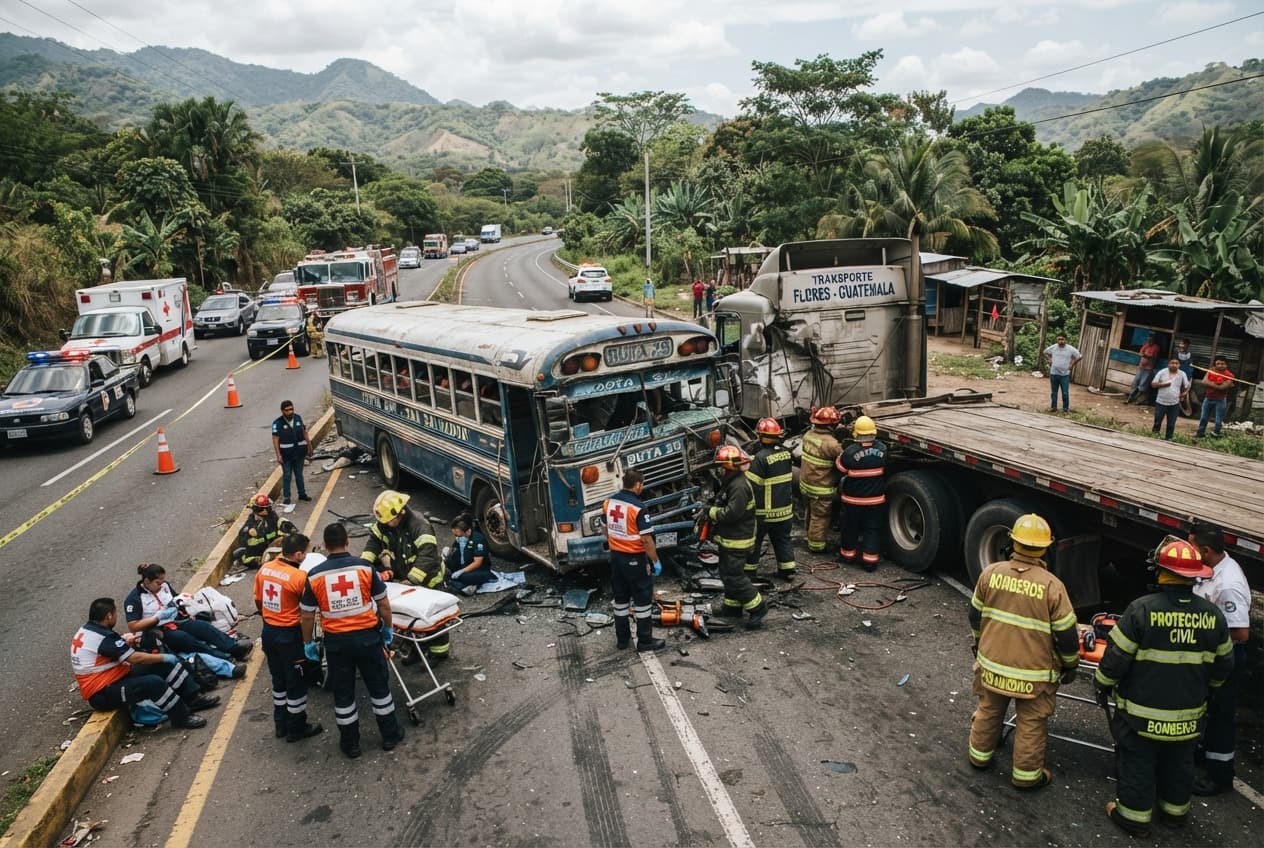
San Salvador, El Salvador—A high-speed collision on the Pan-American Highway left two people dead and at least ten others seriously injured early Sunday morning. The crash involved a packed intercity passenger bus and a heavy flatbed truck transporting construction materials across a notorious stretch of road. First responders cut through the mangled metal frame of the bus cabin to extract trapped passengers screaming for help. Traffic along the critical trade artery backed up for miles as emergency ambulances ferried casualties to regional medical centers.
National civil protection units confirmed that the impact occurred when one of the vehicles veered into oncoming traffic during dense morning fog. Debris fields stretched across both lanes, scattering shattered glass, diesel fuel, and twisted automotive parts across the asphalt. Witnesses reported hearing a deafening screech of tires moments before the metal vehicles smashed together with immense force. Traffic police established wide perimeter blocks to prevent secondary collisions as rescue teams worked under intense pressure.
Hospital administrators reported that several of the ten hospitalized victims arrived with severe polytrauma and internal bleeding. Surgeons performed emergency operations throughout the day as blood banks launched urgent appeals for public donations. Relatives of the passengers converged on hospital waiting rooms desperate for updates on their loved ones' conditions. The driver of the freight truck sustained critical injuries and remained under police guard in intensive care.
Transportation ministry officials faced immediate criticism over chronic safety enforcement failures along the mountainous highway corridor. Commercial transport unions have repeatedly demanded better speed monitoring and improved road lighting across high-risk sections. Investigators deployed drone units to map skid marks and reconstruct the precise trajectories of both vehicles prior to impact. Heavy tow trucks arrived at noon to drag the charred wreckage off the highway lanes and onto the shoulder.
Highway maintenance crews worked feverishly to scrub spilled fuel and clear construction debris to restore partial traffic flow. Stranded motorists spent hours trapped inside vehicles under a blistering sun as temperatures climbed past thirty degrees Celsius. Long-distance bus services connecting capital routes faced indefinite delays due to the sweeping transit blockade.
Forensic teams gathered technical data from the bus braking systems to determine whether mechanical failure contributed to the disaster. Prosecutor offices opened a formal investigation into reckless driving and potential vehicular manslaughter charges. The sheer frequency of heavy vehicle accidents along this specific trade route reignited fierce political debates over national transit safety.
Public works authorities promised a comprehensive audit of commercial vehicle permits and driver qualification standards moving forward.
The highway remained restricted to alternating single-lane traffic as cleanup operations extended late into the evening hours.
Published by Banx Network. This article is part of the Banx decentralized media programme, powered by the BXE token on the XRP Ledger.