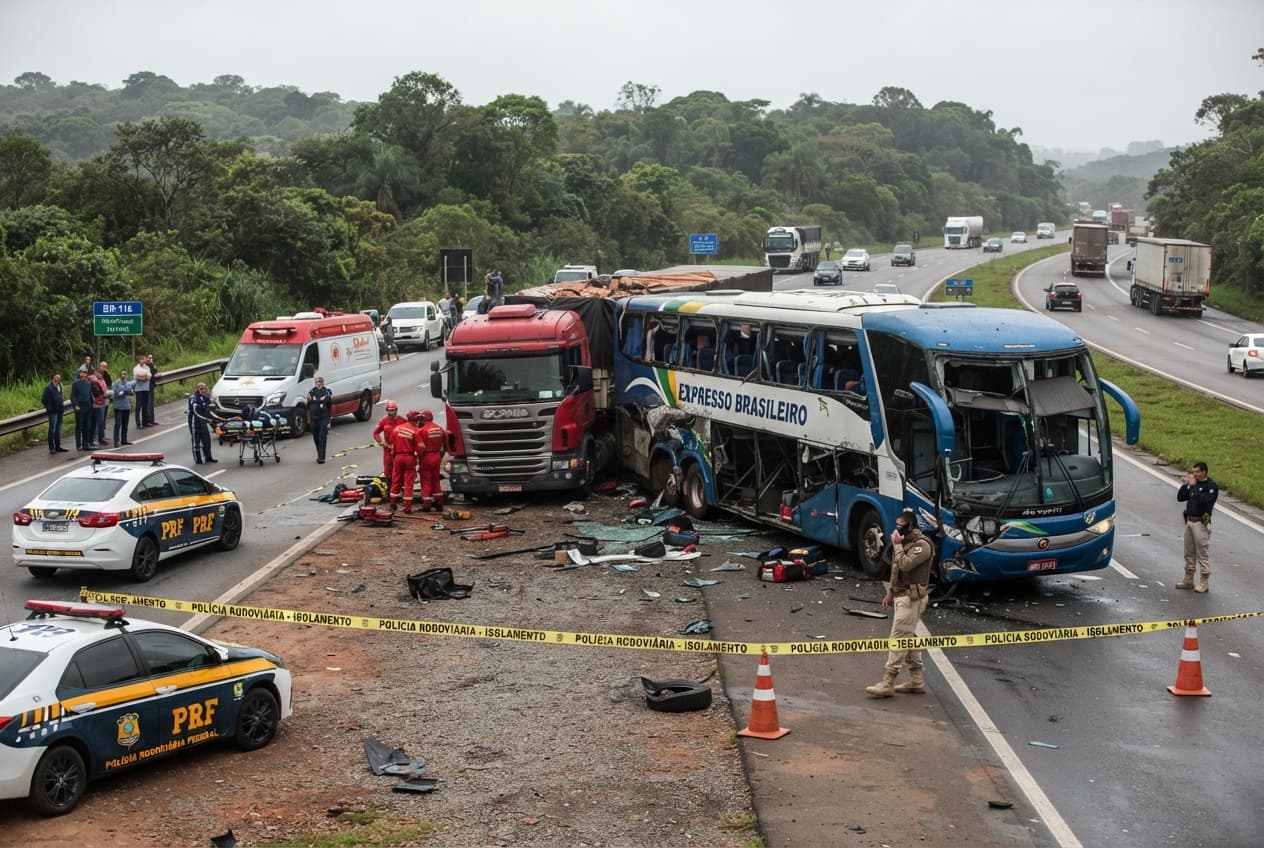
Ipiranga, Brazil—A catastrophic head-on collision between a municipal transport bus and a heavy freight truck killed at least twenty-three people on a major southern highway. The fatal crash occurred during the early morning hours when the northbound truck crossed the center divider into oncoming traffic on the regional corridor. The impact crushed the front section of the passenger bus, which was transporting medical patients from Imbituva to specialized clinical centers in Curitiba. Federal highway police and emergency rescue units arrived at the scene to find wreckage strewn across both lanes of asphalt.
Paramedics confirmed that twenty-three individuals died at the impact site, including the driver of the freight carrier and multiple passengers aboard the bus. Five survivors sustained severe polytrauma injuries and were extracted by firefighters using hydraulic cutting equipment before being airlifted to nearby hospitals. "At least twenty-three deaths have been confirmed, and most of the victims were on the bus," highway police authorities stated in an official release. Local press photographs showed the twisted chassis of the passenger vehicle wedged against the overturned frame of the commercial transport truck.
Highway concessionaire operators closed the multi-lane transportation artery in both directions, creating a standstill spanning several kilometers of backed-up commercial freight. Imbituva municipal leaders declared two days of official mourning while community facilities opened to support grieving relatives of the deceased patients. State transport investigators seized tachograph disks and electronic logging units from both vehicles to analyze speed parameters prior to impact. Preliminary skid mark analysis suggested the truck driver may have suffered a sudden medical emergency or fatigue-induced lapse before steering into the opposing lane.
Federal transportation safety boards launched an independent inquiry into commercial trucking regulations and mandatory rest period enforcement across interstate routes. Local advocacy groups renewed demands for physical concrete median barriers along single-carriageway segments of the aging highway infrastructure network. Funeral arrangements for the victims were coordinated collectively by municipal health departments across the southern region. Heavy recovery cranes labored throughout the afternoon to hoist the mangled wreckage onto flatbed trailers and clear the blocked asphalt lanes.
Traffic engineers inspected the roadway surface for oil contamination and structural damage before authorizing the gradual resumption of light passenger vehicle transit. Commercial freight carriers faced prolonged delays as logistics coordinators diverted long-haul transport trucks onto secondary rural detour routes. Federal police investigators interviewed surviving witnesses receiving treatment in intensive care units to reconstruct the final moments before the collision.
Published by Banx Network. This article is part of the Banx decentralized media programme, powered by the BXE token on the XRP Ledger.