
Key Highlights
- Europa is believed to have a vast subsurface ocean beneath its icy crust.
- Tidal heating from Jupiter's gravity keeps the ocean in a liquid state.
- Upcoming missions like NASA's Europa Clipper aim to explore this hidden world.
Europa, one of Jupiter's most intriguing moons, has long captured the attention of scientists and space enthusiasts alike. Beneath its icy exterior lies a vast subsurface ocean, potentially containing more liquid water than all of Earth's oceans combined. This discovery not only raises questions about the moon's geological history but also ignites curiosity about the potential for life in such extreme environments.
The existence of this ocean is primarily attributed to a phenomenon known as tidal heating. As Europa orbits Jupiter, the immense gravitational forces exerted by the gas giant create friction within the moon's interior, generating heat. This heat is crucial in preventing the water beneath the ice from freezing solid, allowing it to remain in a liquid state despite the frigid temperatures of outer space. This process challenges traditional notions of habitable zones, which typically depend on proximity to a star.
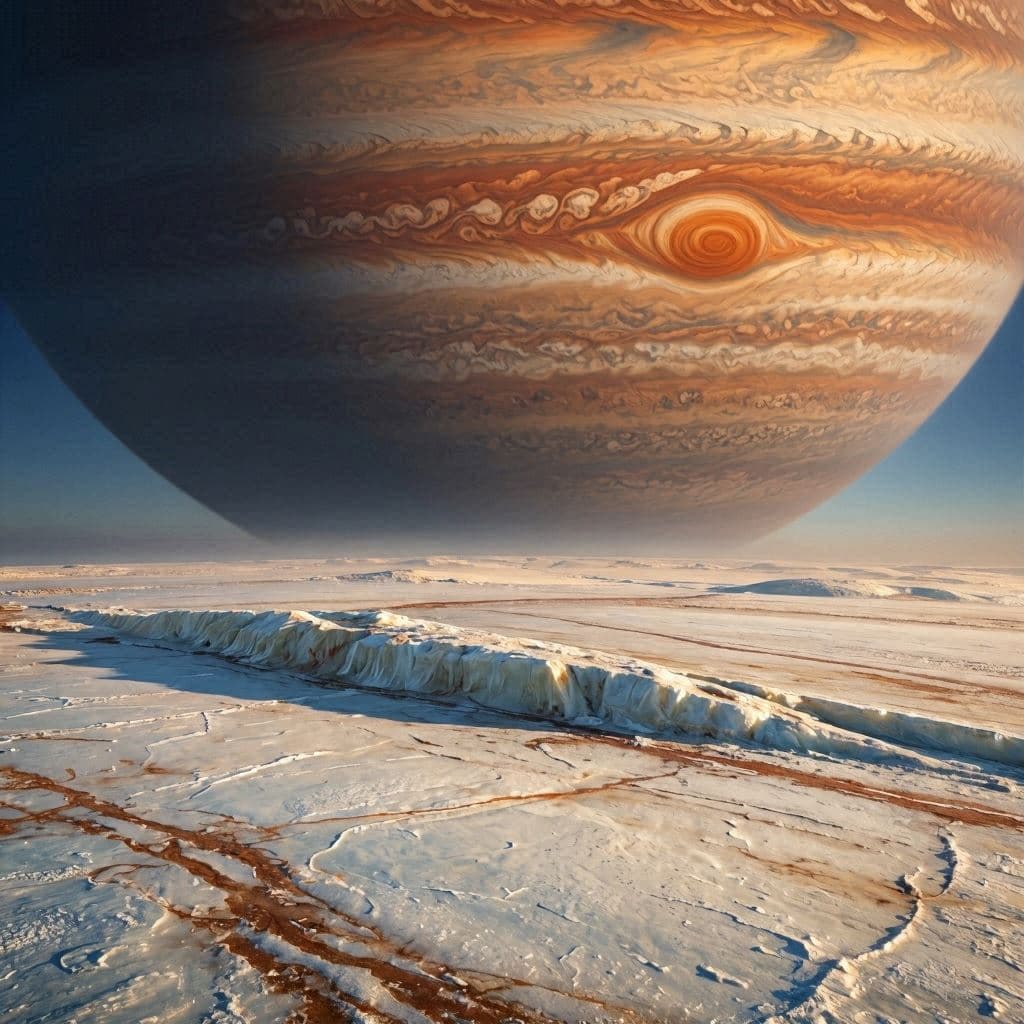
The surface of Europa is a testament to its dynamic nature. The intricate patterns of fractures and ridges indicate that the ice shell is constantly shifting, influenced by the tides of the ocean below. This movement may facilitate the exchange of materials between the surface and the subsurface ocean, potentially providing the necessary chemical ingredients for life. For astrobiologists, this interaction is a beacon of hope, suggesting that Europa could harbor the essential building blocks of biology in its hidden depths.
However, exploring this enigmatic world presents significant technological challenges. Any mission aimed at penetrating the thick ice must contend with extreme cold, high radiation levels, and the considerable thickness of the crust. NASA's upcoming Europa Clipper mission is designed to study the moon's composition and structure in unprecedented detail. By analyzing plumes of water vapor that may erupt from the surface, scientists hope to gather samples from the ocean without the need for a landing, marking a cautious yet ambitious approach to unlocking the mysteries of Europa.
The potential for life on Europa has captivated the public imagination for decades. If microbial life exists in its ocean, it would fundamentally alter our understanding of life's prevalence in the universe. This possibility suggests that life is not a rare occurrence limited to Earth but rather a common outcome of planetary processes. Such a perspective shifts the search for extraterrestrial intelligence from a narrow focus on Earth-like conditions to a broader appreciation of biological diversity across the cosmos.
Comparing Europa's ocean to Earth's highlights the uniqueness of our planet while underscoring the universality of water as a vital component for life. On Earth, water serves as the solvent of life, shaping climates and ecosystems. In contrast, on Europa, it exists as a hidden reservoir, shielded from the harshness of space by miles of ice. Both worlds remind us of water's central role in sustaining complexity, whether in sunlight or shadow.
The scientific community remains cautiously optimistic about the existence of a global ocean beneath Europa's icy surface. While evidence strongly supports this hypothesis, direct confirmation requires further exploration. Each new data point brings researchers closer to understanding the moon's interior dynamics. This journey of discovery is incremental, built on patience and rigorous analysis, reflecting the collaborative spirit of international science.
As we look toward future missions, the focus remains on preserving the integrity of Europa's environment. Planetary protection protocols are in place to ensure that we do not contaminate potential habitats with Earthly microbes. This ethical consideration reflects a growing respect for other worlds as places of intrinsic value, emphasizing a commitment to responsible exploration.
Ultimately, the ocean beneath Europa's ice symbolizes the unknown possibilities that await us in space. It challenges our assumptions about where life can exist and inspires a deeper curiosity about our cosmic neighborhood. As we prepare to explore this hidden realm, the hope is that we will find not just water, but answers to the enduring question of whether we are alone in the universe.
Published by Banx Network. This article is part of the Banx decentralized media programme, powered by the BXE token on the XRP Ledger.



