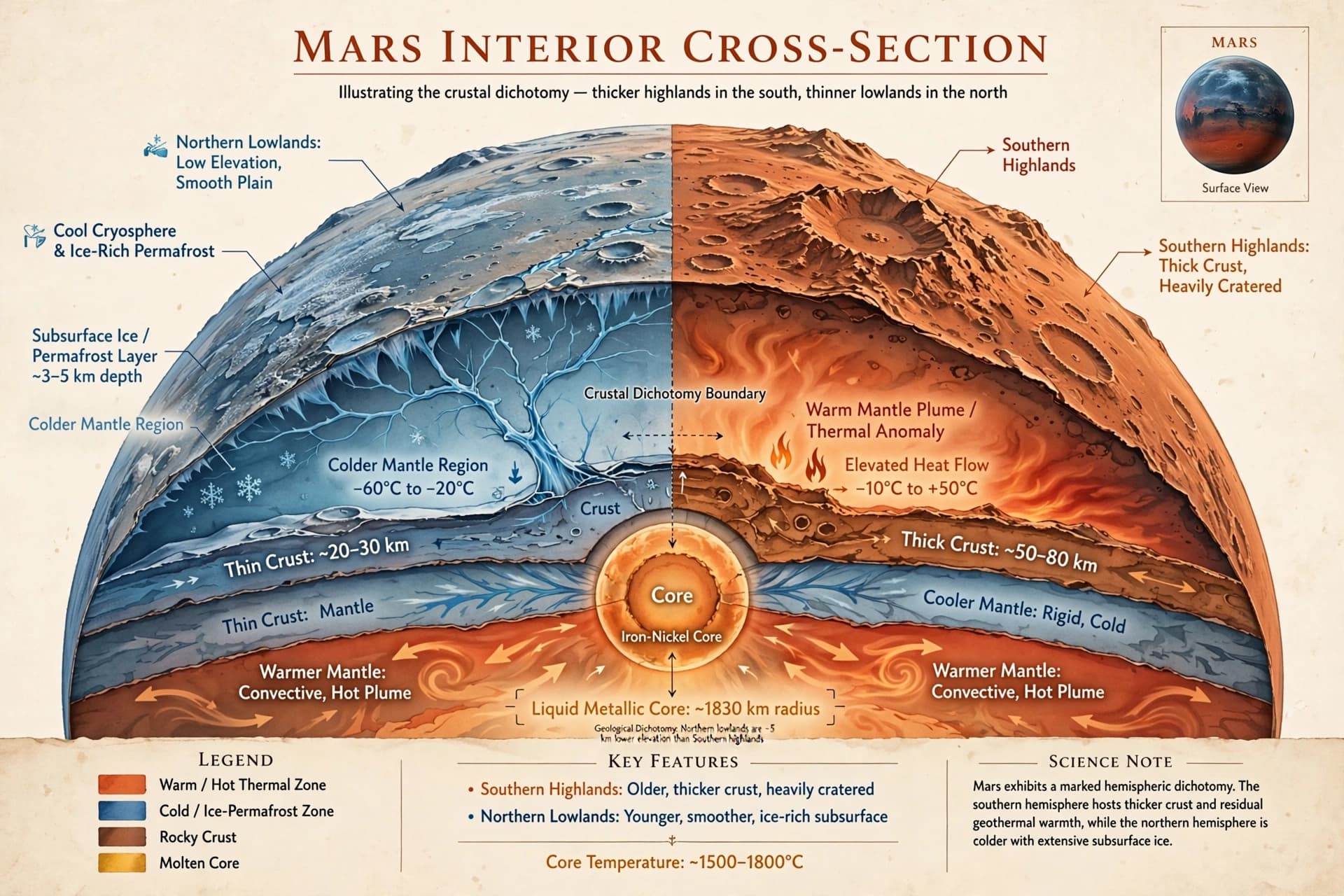
Mars is a divided planet. Its northern hemisphere is a broad plain that may once have held an ancient ocean; its southern hemisphere is old, rugged highland, pocked with craters and mountains. Astronomers have known this surface dichotomy for decades. But recent findings suggest the split does not stop at the ground. It reaches deep into the planet, where something is still, in a quiet way, running hot.
A research team led by Caltech alumnus Alexander Bourne reexamined Mars's interior using a technique called tidal tomography. They analyzed sixteen years of orbital data from Mars Global Surveyor, Mars Odyssey, and Mars Reconnaissance Orbiter, tracking how the sun's gravity gently tugs at the planet as its seasons shift, and inferring the interior's gravitational response from tiny disturbances in spacecraft speed. The logic is simple: if Mars's interior were uniform and symmetrical, its response to tidal forces would be predictable. If lateral differences in physical properties exist, the tidal response will deviate.
The deviation is real. The team found that the gravity response reveals a large temperature asymmetry: the mantle beneath the southern hemisphere is roughly 200 to 400 degrees Celsius hotter than the north, and may even be partly molten. Published in Nature, the result is the first time gravitational data has been used to infer a hemispheric temperature difference in the Martian mantle.
The finding is surprising because it suggests Mars's interior is not the "spherically symmetric" body textbooks assume. Bourne explained in a press release that scientists usually assume a planet's interior is largely spherically symmetric, but that may not be true, and that as more gravity data arrive, we can pin down the three-dimensional complexity of a planet's internal structure.
This thermal anomaly may explain other long-puzzling features of Mars. NASA's InSight lander detected that low-frequency marsquakes from the southern highlands attenuate faster, consistent with a hotter mantle there. The magnetic anomalies recorded in iron-rich minerals of the southern highlands may also relate to a once-hotter mantle that allowed a stronger magnetic field. As co-author Amirhossein Bagheri noted, understanding the north-south difference is essential to grasping Mars's hydrological history, including the formation of basins that may once have held water.
The origin of the anomaly is not yet settled. The team proposed several possibilities: an ancient giant impact may have reshaped Mars's interior; spontaneous convection in the southern mantle may persist today; or the thicker southern crust may act like a blanket, trapping radiogenic heat below. The most likely explanation may be a mix: early impacts left a structural legacy, and later thermal evolution amplified the asymmetry.
This discovery does not mean the Martian surface will grow warm. Heat from the deep mantle takes billions of years to reach the surface, and the planet's atmosphere remains thin and cold. But it opens a new window onto the red planet's evolution. Beneath those silent plains and ancient highlands, Mars's memory is still running hot.
Note: The images in this article are AI-generated and for reference only.
Sources: Caltech, Nature, National Geographic, Phys.org
Published by Banx Network. This article is part of the Banx decentralized media programme, powered by the BXE token on the XRP Ledger.