
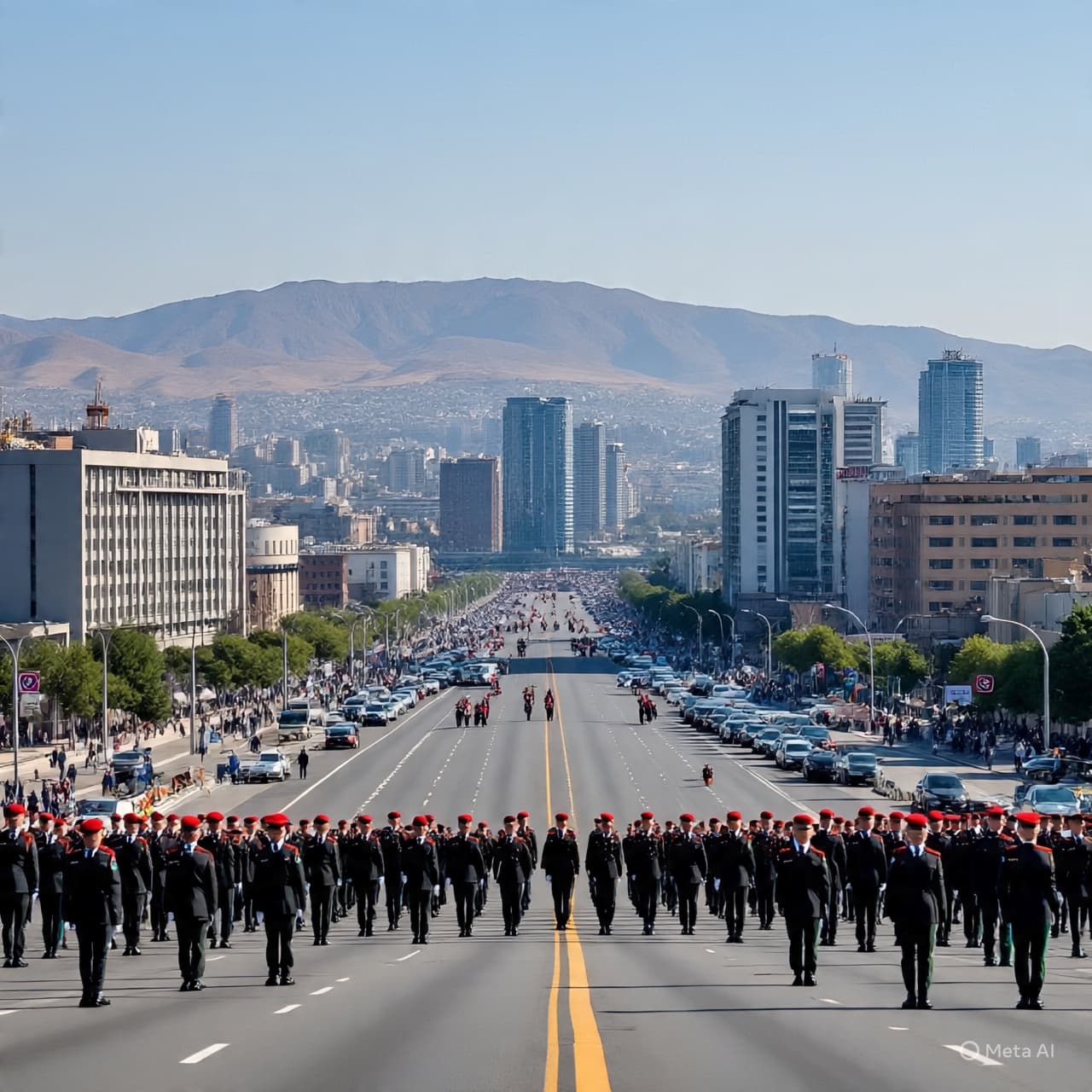
Morning in Tehran often begins with a quiet rhythm. Traffic moves steadily through wide boulevards, shopkeepers lift their shutters, and the distant mountains appear faintly through the city’s pale morning haze. Beneath this ordinary movement lies a complex structure of authority—institutions that shape the country’s direction, some visible in public life and others operating with a quieter presence.
Among them stands one organization that has come to embody both the defense of the state and the memory of its founding revolution.
The Islamic Revolutionary Guard Corps, widely known as the Revolutionary Guards, was created in the turbulent aftermath of Iran’s 1979 revolution. Its original mission was simple in theory but immense in practice: to protect the revolution and ensure that the new political order would survive the uncertainties of its early years.
Over time, the organization grew into something far larger than a conventional military branch. While Iran maintains a regular armed force, the Guards developed as a parallel structure—one that blends military command, ideological commitment, and political influence within a single institution.
Across Iran, the Guards’ presence extends into many layers of national life. Their responsibilities include overseeing missile programs, supervising elite military units, and coordinating security operations inside and beyond the country’s borders. Through specialized branches such as the Quds Force, the organization has also become a central actor in Iran’s regional strategy, supporting allied groups and shaping geopolitical dynamics across the Middle East.
The rise of the Guards reflects the unique structure of Iran’s political system. At the top of that system stands the country’s supreme leader, whose authority extends across military, religious, and political institutions. The Revolutionary Guards have long been closely aligned with that leadership, serving not only as a defensive force but also as a guardian of the state’s ideological foundations.
Yet their influence is not limited to security matters. Analysts often describe the Guards as an institution with significant economic reach as well. Over the years, companies connected to the organization have become involved in sectors ranging from construction and infrastructure to energy development. In a country where sanctions and geopolitical pressures have reshaped economic activity, these networks have played a role in sustaining strategic industries.
For many Iranians, the presence of the Guards appears in subtle ways—through infrastructure projects, military parades, or the quiet symbolism of uniforms during national commemorations. At other moments, their influence becomes more visible, particularly during periods of regional tension or domestic unrest.
The organization’s role beyond Iran’s borders has drawn global attention. Western governments, including the United States, have designated the Revolutionary Guards as a terrorist organization, citing their support for militant groups and involvement in regional conflicts. Iranian officials, in contrast, describe the force as an essential pillar of national defense and a safeguard against foreign threats.
These contrasting perspectives reflect the broader geopolitical landscape surrounding Iran. The Revolutionary Guards stand at the center of that landscape, linking domestic authority with international strategy.
Nearly half a century after their creation, the Guards remain deeply woven into the structure of the Iranian state. Their history mirrors the country’s own evolution—from the upheaval of revolution to the complexities of modern geopolitics.
And so, beneath the quiet routines of cities like Tehran, the institution continues its work: an organization born in revolution, shaped by conflict, and sustained by the belief that the state it protects must endure.
In that sense, the Revolutionary Guards are not merely a military force. They are part of the architecture of modern Iran itself—a structure built in turbulent times and still standing at the center of the nation’s political landscape.
AI Image Disclaimer These visuals were generated using AI and are intended as illustrative representations rather than authentic photographs.
Sources Reuters BBC News Al Jazeera The New York Times International Crisis Group
Published by Banx Network. This article is part of the Banx decentralized media programme, powered by the BXE token on the XRP Ledger.


