For decades, Pangaea has held the title of the ultimate supercontinent in the public imagination, a massive landmass that united much of Earth’s crust. However, its predecessor, Gondwana, may finally be receiving the recognition it deserves. New geological research suggests that Gondwana was not just a large southern landmass but a true supercontinent in its own right, encompassing approximately 80 percent of Earth’s continental land area during the Paleozoic Era.
The study, which analyzed thousands of volcanic rock samples and zircon crystals, reveals that Gondwana was significantly larger than previously estimated. Earlier models placed its size at around 64 percent of global land area, a figure that fell short of the arbitrary 75 percent threshold often used to define a supercontinent. The new data, however, pushes well past this mark, confirming that Gondwana was a colossal entity that dominated the Southern Hemisphere and extended far into the North.
This reclassification is more than a matter of semantic prestige. Understanding the true scale of Gondwana helps scientists reconstruct ancient climate patterns, ocean currents, and biological evolution. A landmass of this magnitude would have had a profound impact on global weather systems, likely contributing to the cooling trends that preceded the ice ages of the late Paleozoic. It also provides context for the distribution of fossils and mineral resources seen today across continents that are now widely separated.
The research identifies hidden fragments of Gondwana’s crust buried beneath Asia, Europe, and North America. These pieces, torn away during subsequent tectonic shifts, were once integral parts of the supercontinent. By mapping these deep-earth structures, geologists can trace the journey of continents over hundreds of millions of years, piecing together the dynamic puzzle of plate tectonics with greater precision.
Gondwana’s formation began around 600 million years ago, bringing together what are now Africa, South America, Antarctica, Australia, India, and Arabia. Its eventual breakup, starting in the Jurassic period, gave rise to the modern configuration of continents. Recognizing its status as a supercontinent underscores the cyclical nature of Earth’s geology, where landmasses collide and separate in an endless dance driven by mantle convection.
The implications for biodiversity are also significant. A supercontinent of this size would have created vast interior deserts and diverse coastal environments, driving the evolution of unique species. The fossil record from this period shows a explosion of life forms, many of which were adapted to the specific conditions of Gondwana. Understanding this context helps explain the origins of many modern ecosystems and the distribution of life on Earth.
As our understanding of Earth’s deep history improves, so too does our appreciation for the forces that shape our planet. Gondwana’s elevation to supercontinent status is a reminder that science is a process of continuous refinement. What we thought we knew is often just the beginning of a deeper truth, waiting to be uncovered by careful analysis and innovative thinking.
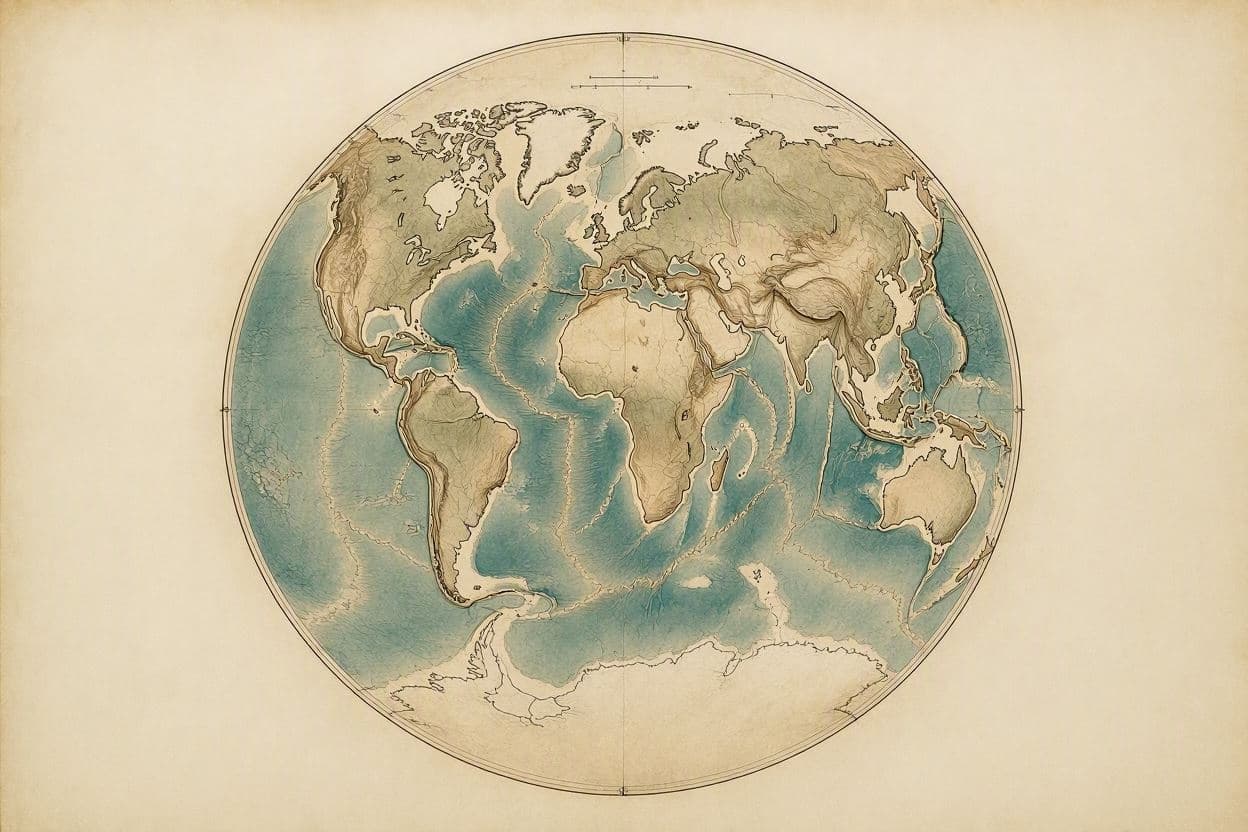
AI Image Disclaimer: The images used in this report are AI-generated visuals created to illustrate geological concepts and ancient geography.
Sources: Science Advances, Phys.org, Scientific American
Published by Banx Network. This article is part of the Banx decentralized media programme, powered by the BXE token on the XRP Ledger.