Far beyond the quiet constellations that hang above Earth’s night sky, the universe moves through slow, immense rhythms—stars aging, galaxies drifting, gravity pulling distant worlds into long cosmic dances. Most of these motions unfold over millions or billions of years, almost imperceptible against the backdrop of time. Yet occasionally, the calm is broken by an event so violent and luminous that it briefly outshines entire galaxies.
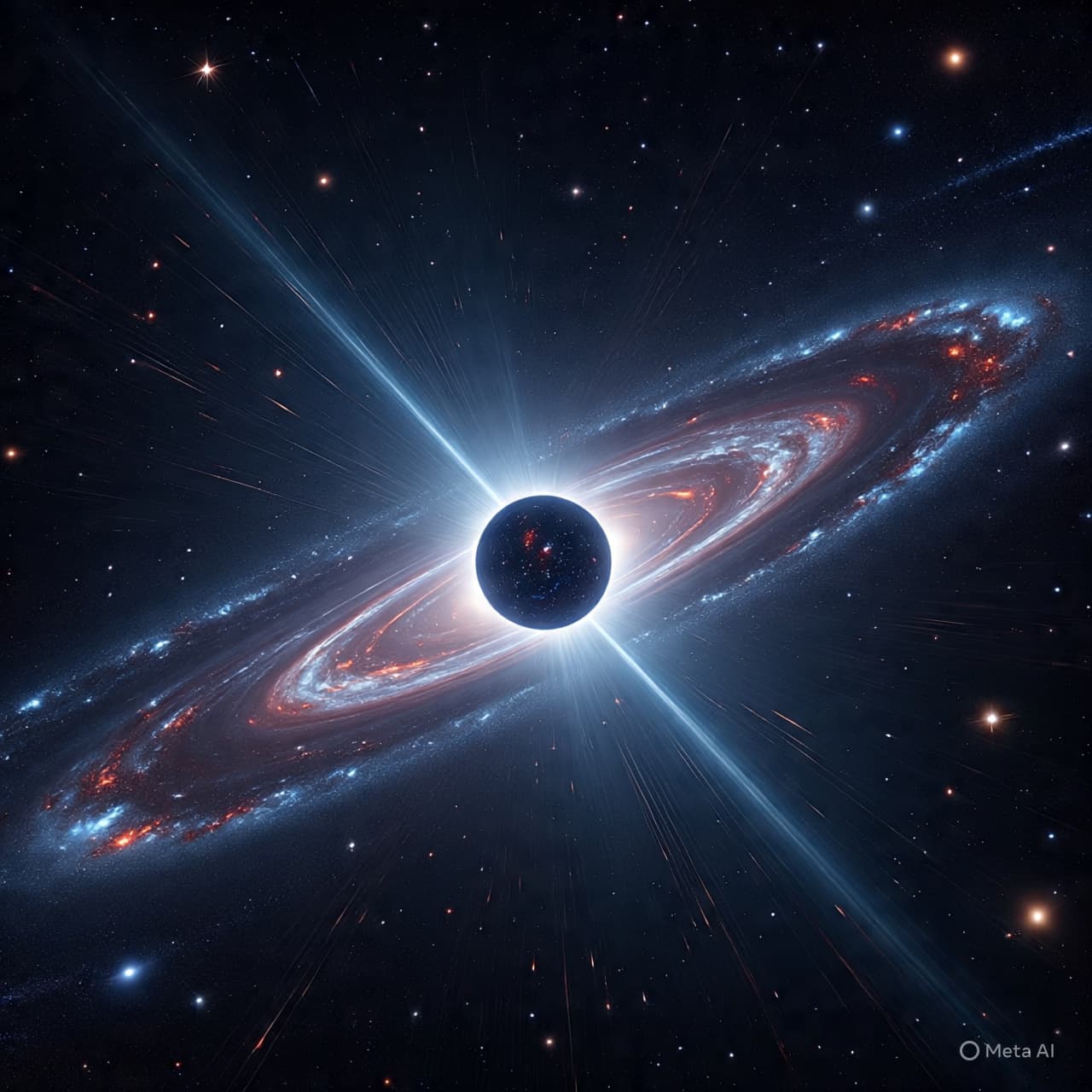
In one such distant corner of the cosmos, two neutron stars—ultra-dense remnants left behind when massive stars collapse—spiraled toward one another in a tightening orbit. When they finally collided, the impact released a burst of energy so intense that it traveled across space for roughly 8.5 billion years before reaching Earth. The signal arrived as a flash of gamma rays, one of the universe’s most powerful forms of radiation, detected by astronomers studying short gamma-ray bursts.
For astrophysicists, this fleeting signal became a clue to something deeper: the hidden origin of some of the universe’s most valuable elements.
Recent research examining the event known as GRB 230906A suggests that the neutron-star collision itself may have been triggered by an even grander encounter—the merging of galaxies. Using observations from space and ground-based observatories, scientists traced the explosion to a faint region embedded within a tangled system of interacting galaxies. Long streams of stars and gas stretched through the region like cosmic tides, remnants of galaxies slowly tearing at each other under gravity’s pull.
Within one of these tidal streams, astronomers believe a small dwarf galaxy formed from material stripped away during the galactic collision. Somewhere inside that faint cluster of stars, two neutron stars met their final moment.
The explosion that followed was more than an astronomical spectacle. It was also a forge.
When neutron stars collide, the violence of the impact creates conditions so extreme that atoms are rapidly bombarded with neutrons, a process known as rapid neutron capture. In those brief, chaotic seconds, heavy elements are assembled—gold, platinum, and other rare metals that cannot easily form in ordinary stars. The debris from the collision spreads these newly created elements into surrounding space, enriching galaxies with the raw ingredients that may one day become planets, minerals, and perhaps even the materials of future civilizations.
For decades, astronomers suspected neutron-star mergers were responsible for producing many of these heavy elements. But the recent observations add a new layer to the story: the cosmic environment in which such collisions occur may be shaped by the slow choreography of galaxies themselves.
Galactic mergers are among the largest structural events in the universe. When galaxies collide, their stars rarely crash directly into each other, but their gravitational fields stretch and distort vast clouds of gas and clusters of stars. These interactions can create dwarf galaxies, tidal streams, and new regions where stars form and evolve. Over time, some of those stars collapse into neutron stars, setting the stage for future collisions.
In this sense, the gold in a ring or the platinum in a circuit board may trace its ancestry not only to the death of stars, but to the migration of entire galaxies across the universe.
Even with this discovery, many questions remain. Because the explosion occurred so far away, scientists cannot yet determine precisely which elements were forged in that particular collision. Other cosmic events—such as neutron star–black hole mergers or rare stellar explosions—may also contribute to the universe’s supply of heavy metals.
Future observatories are expected to deepen the search. Instruments like the James Webb Space Telescope and the upcoming Nancy Grace Roman Space Telescope will help astronomers detect distant mergers in greater detail, while next-generation gravitational-wave detectors may reveal the ripples in spacetime created by these violent encounters.
For now, the discovery offers a quiet reminder of the universe’s long creative cycle. The metals buried in Earth’s crust and worn in human jewelry were not born in calm places. They began their journey in the collisions of stars and the slow merging of galaxies—events that unfolded billions of years before our planet existed, yet still echo faintly in the light reaching our telescopes today.
Published by Banx Network. This article is part of the Banx decentralized media programme, powered by the BXE token on the XRP Ledger.