Europe Steps Forward: From Political Support to Strategic Commitment The Paris Summit and the Rise of the “Coalition of the Willing”
At the heart of Europe’s response lies the Paris summit, where leaders from more than 30 countries—including EU members, the United Kingdom, Canada, and the United States—gathered to solidify their collective stance toward Russia. The summit marked a clear shift from symbolic solidarity to operational planning.
The so-called “Coalition of the Willing” aims to transform political pledges into enforceable security guarantees for Ukraine should a ceasefire be achieved. European leaders emphasized that any future peace without credible deterrence would merely postpone another Russian offensive.
This approach reflects a growing consensus: Ukraine’s security is inseparable from Europe’s own stability.
France and the United Kingdom Take the Strategic Lead
France and the United Kingdom emerged as the most assertive voices at the summit. Both countries publicly declared their readiness to deploy troops on Ukrainian territory as part of a post-ceasefire stabilization and deterrence force.
The proposed mission would not be a combat operation but a strategic “reassurance force,” designed to:
Deter renewed Russian aggression
Support Ukrainian defense restructuring
Anchor long-term European security commitments
This announcement represents a historic step. For the first time since the conflict began, Western powers are openly discussing boots on the ground—not as escalation, but as prevention.
European Unity, With Strategic Nuance
Despite broad unity, Europe’s response is not monolithic. Germany, while strongly supportive of Ukraine, remains cautious about deploying troops directly inside the country. Berlin favors logistical assistance, intelligence support, and regional force projection from NATO territory.
Other EU members, particularly in Eastern and Central Europe, view Russia’s actions as an existential threat and advocate for a stronger forward presence. These differences highlight a broader European debate: how to balance deterrence with escalation risk.
Nevertheless, the overall message remains clear—Europe is no longer willing to outsource its security decisions.
The United States: Architect of Strategic Coordination Washington’s Endorsement of Security Guarantees
The United States has played a critical behind-the-scenes role in aligning allies. Washington endorsed binding security guarantees for Ukraine and emphasized continued military assistance, intelligence sharing, and surveillance operations.
American officials framed the initiative as a necessary evolution rather than a provocation, arguing that ambiguity has emboldened Moscow in the past.
By supporting European leadership while maintaining strategic oversight, the U.S. is reinforcing a transatlantic model where responsibility is shared rather than centralized.
Canada’s Expanding Diplomatic Role
Canada’s participation in the Paris summit underscored its growing diplomatic influence within NATO and the broader Western alliance. Ottawa reaffirmed its commitment to Ukraine’s sovereignty and emphasized the importance of rules-based international order.
Canada’s stance reflects a broader alignment with European and American strategy, particularly on long-term deterrence and post-conflict security architecture.
Eastern and Central Europe: Frontline Realism
Countries closer to Russia’s borders continue to adopt a more pragmatic and urgent tone.
The Czech Republic confirmed the continuation of its internationally coordinated ammunition supply program for Ukraine, despite domestic budget pressures. Poland and the Baltic states have also signaled strong support for expanded Western commitments.
For these nations, the conflict is not theoretical—it is a direct test of NATO credibility and regional survival.
International Institutions: Principles Under Pressure
International organizations, including the United Nations, have reiterated calls for:
Respect for territorial integrity
Protection of civilians
Adherence to international law
However, these statements increasingly appear disconnected from realities on the ground. While they provide moral and legal framing, enforcement mechanisms remain limited.
This gap between principle and power has reignited debates about the relevance and reform of global institutions in an era of great-power competition.
Russia’s Response: Defiance and Strategic Messaging
Moscow has reacted with firm rejection. Russian officials have categorically dismissed any Western troop presence in Ukraine, labeling such plans as hostile and escalatory.
Domestically, Russian state media continues to project confidence, framing Western initiatives as signs of desperation rather than strength. The prevailing narrative suggests that time favors Russia and that Western unity will eventually fracture under economic and political pressure.
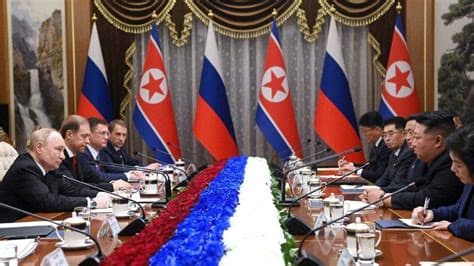
At the same time, Moscow has intensified diplomatic outreach to non-Western partners, seeking to counterbalance Western influence and reinforce a multipolar vision of global order.
The Global South and Emerging Divisions
Beyond Europe and North America, reactions are more fragmented.
Several countries in the Global South maintain neutral or cautious positions, viewing the conflict through the lens of sovereignty, non-intervention, and historical skepticism toward Western power.
Russia’s involvement in parallel geopolitical arenas—such as Latin America, Africa, and parts of Asia—further complicates the picture. These relationships highlight enduring North–South and East–West divides that shape international responses to the crisis.
Economic and Strategic Undercurrents
While military and diplomatic reactions dominate headlines, economic pressures play a critical role. Sanctions, trade realignments, energy markets, and fiscal strain inside Russia are quietly reshaping strategic calculations on all sides.
Western policymakers increasingly see economic endurance as a decisive factor in long-term confrontation, while Russia seeks resilience through alternative alliances and domestic restructuring.
Conclusion: A Turning Point in Global Security
The global political response to Russia’s latest moves marks a watershed moment. What began as reactive support for Ukraine has evolved into a broader effort to redefine deterrence, alliance responsibility, and international norms.
Western nations are shifting from declarative diplomacy to tangible commitments. Russia remains defiant, betting on endurance, division, and geopolitical fatigue.
As negotiations, military posturing, and diplomatic maneuvering continue, one reality is clear: the outcome of this confrontation will shape not only Ukraine’s future, but the architecture of global security for decades to come.
Published by Banx Network. This article is part of the Banx decentralized media programme, powered by the BXE token on the XRP Ledger.