At first light, Taipei 101 usually announces itself with stillness. The tower rises before the city fully wakes, its glass catching pale reflections of clouds that drift without urgency. From the ground, it appears immovable, designed not to be touched but observed—a symbol meant to be entered politely, by elevators and schedules, not by hands.
That assumption dissolved quietly.
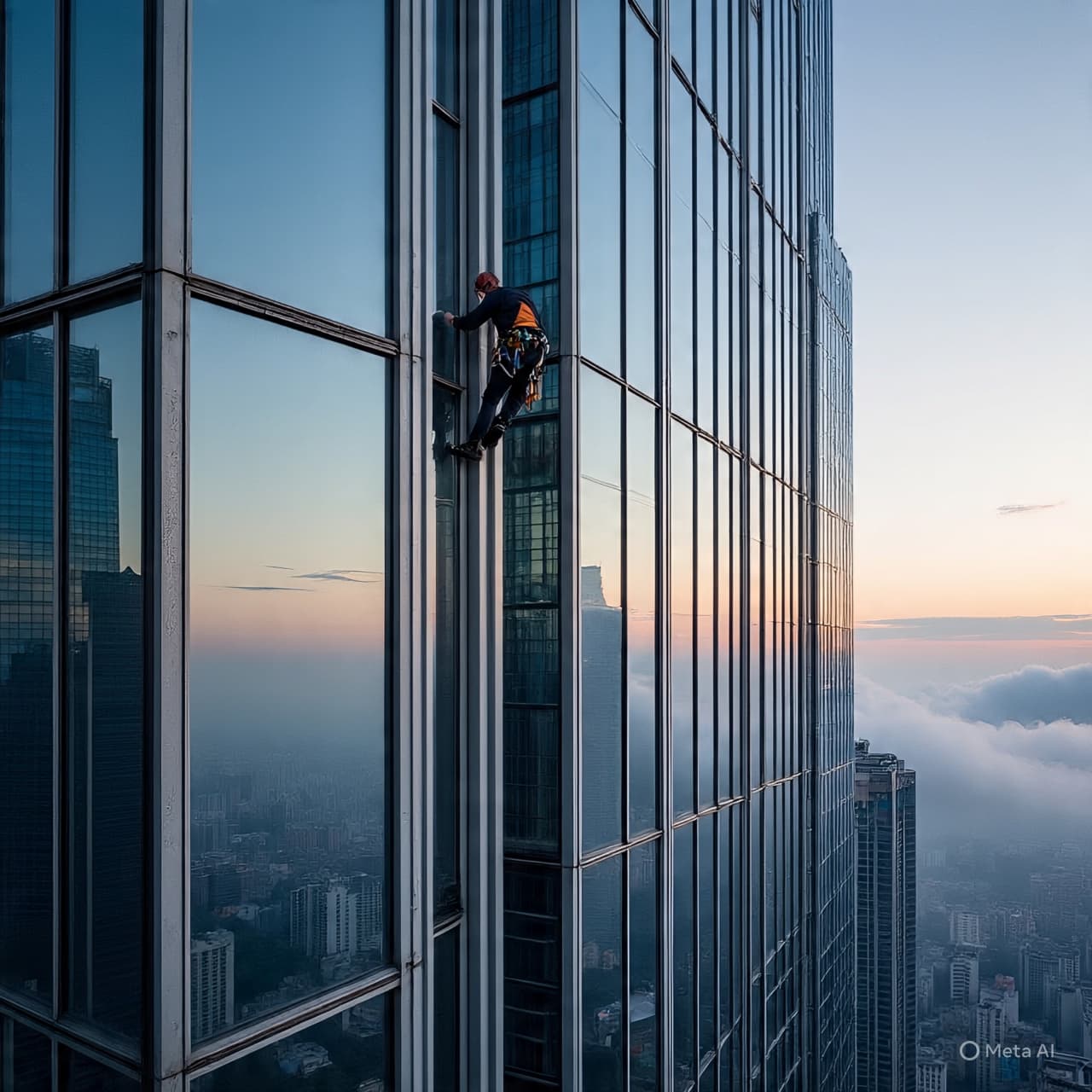
Without fanfare or spectacle, a lone climber began moving upward along the building’s exterior, tracing a path never intended for human passage. There were no ropes, no harnesses, no margins for correction. Just skin, balance, and the deliberate patience of someone who understands how thin the line between motion and stillness can be.
Alex Honnold has spent years redefining what “possible” looks like when stripped of safety nets. Rock faces, cliff walls, remote vertical landscapes—these are places where silence dominates and mistakes carry weight. Taipei 101 offered none of the irregular comfort of stone. Its surface was engineered, symmetrical, precise. Every ledge was measured. Every seam was intentional. The challenge was not nature’s unpredictability, but architecture’s indifference.
As he climbed, the city continued below him. Traffic flowed. Offices prepared for another ordinary day. From street level, the climber was at times barely visible—a moving punctuation mark against a rigid skyline. Yet for those watching closely, each meter gained carried an unspoken tension. Free solo climbing is not dramatic because of speed or aggression, but because of restraint. Progress comes through stillness as much as movement.
The ascent lasted roughly ninety minutes. Time stretched in unfamiliar ways, shaped not by clocks but by breath and focus. There were no shortcuts upward, only repetition: reach, weight, trust. The tower’s vertical spine, often associated with economic ambition and modern identity, briefly became something else—a testing ground for human concentration.
Taipei 101 has been climbed before, but always with equipment, with margins designed to forgive. This ascent offered none. It transformed the building from a destination into a question: what does it mean to move through spaces never meant for us, and to do so without forcing the moment to bend?
When the climber reached the summit, there was no theatrical gesture. No triumphal display. Just a pause—long enough to acknowledge the wind, the height, and the city stretching outward in all directions. From above, Taipei looked less like a machine and more like a living pattern, layered and continuous.
Soon after, the moment passed. The tower returned to its role as skyline constant, as backdrop to weather and commerce. Elevators resumed their quiet duty. Windows reflected the afternoon light. But the surface carried memory now—not visible, not permanent, yet undeniable.
For a brief window of time, Taipei 101 was not simply occupied. It was climbed. And in that act, the boundary between monument and human scale softened, reminding the city that even its tallest structures exist within reach—if only for those willing to move slowly enough to listen.
AI Image Disclaimer Illustrations were created using AI tools and are not real photographs.
Sources Reuters Associated Press Taipei Times AFP Netflix Tudum
Published by Banx Network. This article is part of the Banx decentralized media programme, powered by the BXE token on the XRP Ledger.