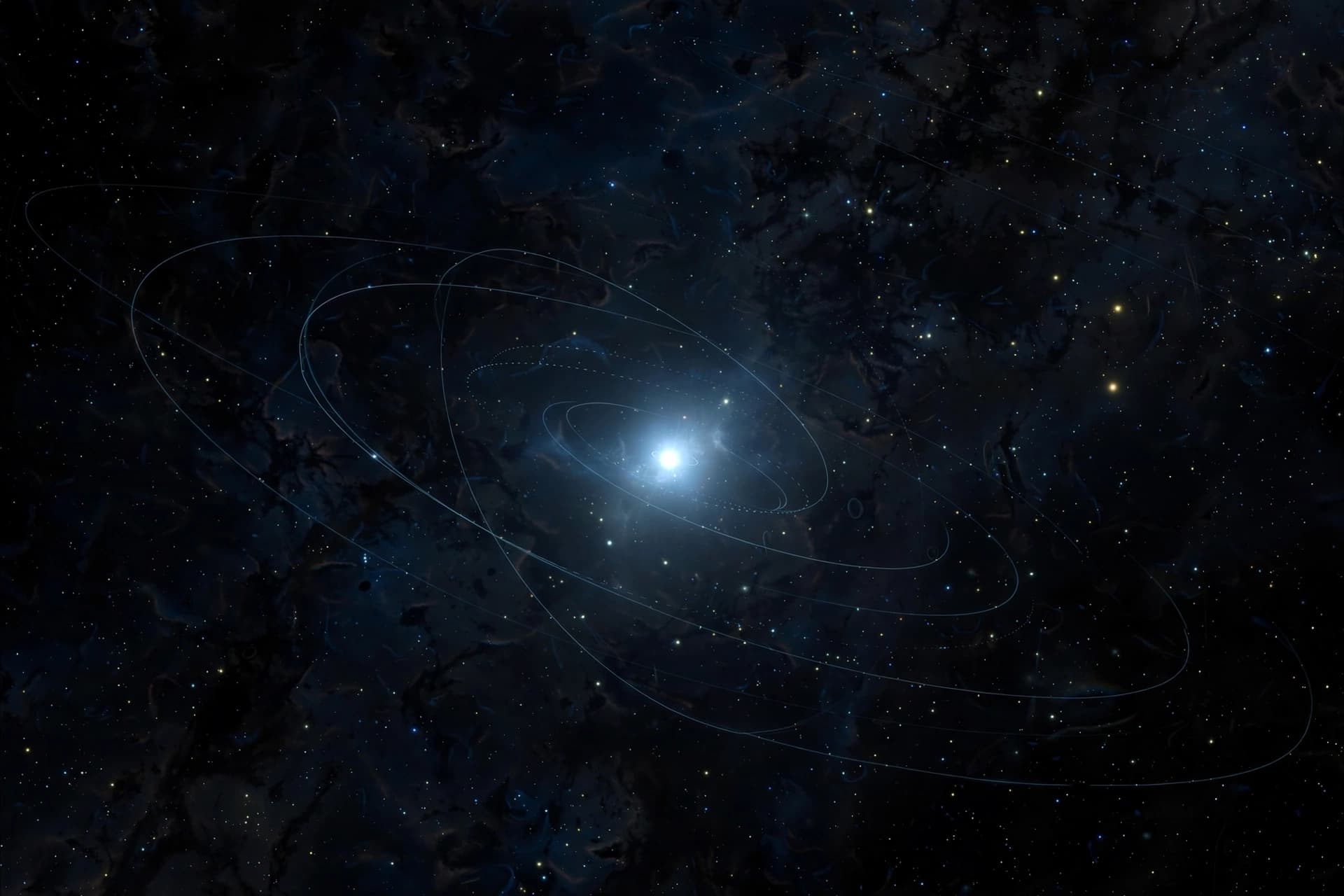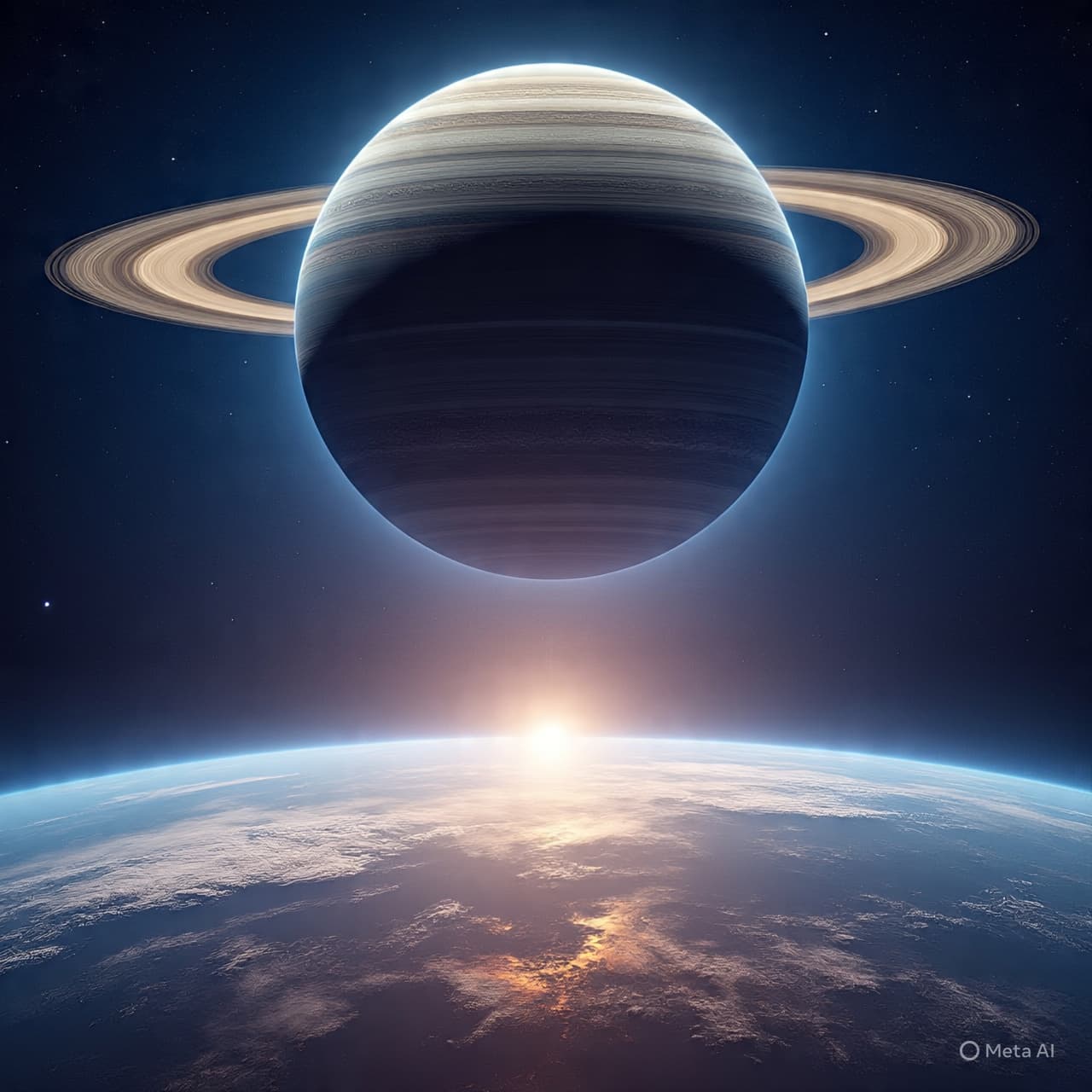
In the quiet reaches beyond our solar system, astronomers sometimes find worlds that seem to stretch the imagination just a little further than expected. Planets larger than Jupiter, orbiting far from their stars or in configurations that defy tidy models, drift into view like unanswered questions. They are called “super-Jupiters,” and their sheer scale has begun to gently unsettle long-held assumptions about how planetary systems form.
For decades, the formation of giant planets was explained through two principal frameworks. The first, core accretion, describes a gradual process: dust grains collide and clump, building a solid core that eventually gathers vast envelopes of gas. The second, gravitational instability, imagines a more rapid collapse of dense regions within a young star’s disk. Both pathways have their strengths. Yet the newest observations of colossal super-Jupiters appear to strain these explanations.
Some of these planets are more than ten times the mass of Jupiter, approaching the boundary where planets begin to resemble brown dwarfs—objects too large to be planets in the traditional sense, yet too small to ignite sustained nuclear fusion like true stars. Their mass alone invites questions. How does a forming system gather so much gas before the surrounding disk dissipates?
Complicating matters further, several super-Jupiters have been detected at extreme distances from their host stars, hundreds of astronomical units away. In such cold, distant regions, the density of material in a protoplanetary disk is typically too low for the slow build-up envisioned by core accretion. If gravitational instability is responsible, the conditions must be finely balanced—dense enough to collapse, yet stable enough to produce discrete planetary bodies rather than fragment into stellar companions.
Observations from space-based telescopes such as NASA’s missions and powerful ground-based observatories have sharpened the puzzle. Direct imaging techniques, which capture faint planetary light beside bright stars, have revealed young systems where super-Jupiters glow with residual heat from their formation. These images offer rare snapshots of planetary infancy, yet they also complicate theoretical predictions.
In some cases, the orbits of these massive planets are highly eccentric or inclined, suggesting turbulent histories. They may have migrated inward and outward, scattered by gravitational interactions with sibling planets or passing stars. Alternatively, they may have formed more like binary star companions, blurring the conceptual boundary between planet and star.
There is a subtle philosophical tension at work. Astronomy often seeks clean categories: planet, star, brown dwarf. Super-Jupiters inhabit the margins of these definitions. They prompt scientists to reconsider not only formation mechanisms but also classification itself. Is mass the defining factor, or origin? Should formation history outweigh size when assigning cosmic labels?
The puzzle also carries implications for our own solar system. Jupiter’s early migration likely shaped the distribution of smaller bodies, influencing the formation of Earth and its neighbors. Understanding how even larger giants form elsewhere may refine models of planetary evolution more broadly. In studying distant excess, we gain perspective on local balance.
Yet caution remains central. Planet detection methods carry uncertainties, and mass estimates can depend on models of age and brightness. As instruments improve and surveys expand, some early measurements may be revised. Others may reveal even more extreme examples, stretching theoretical frameworks further still.
For now, the discovery of colossal super-Jupiters stands less as a contradiction than as an invitation. It encourages refinement, not abandonment, of prevailing models. Science often advances in this quiet way—through anomalies that do not overthrow understanding but gently press against it.
The coming years, with next-generation observatories and improved computational models, are likely to deepen the conversation. Whether through refined simulations or additional discoveries, researchers will continue tracing how these massive worlds came to be.
In the vast architecture of the galaxy, super-Jupiters remind us that nature does not always follow our preferred scale. Sometimes it builds bigger, farther, and stranger than expected—leaving scientists not with certainty, but with better questions.
AI Image Disclaimer Illustrations were produced with AI and serve as conceptual depictions.
SOURCE CHECK
NASA Nature Science Scientific American Space.com
Published by Banx Network. This article is part of the Banx decentralized media programme, powered by the BXE token on the XRP Ledger.