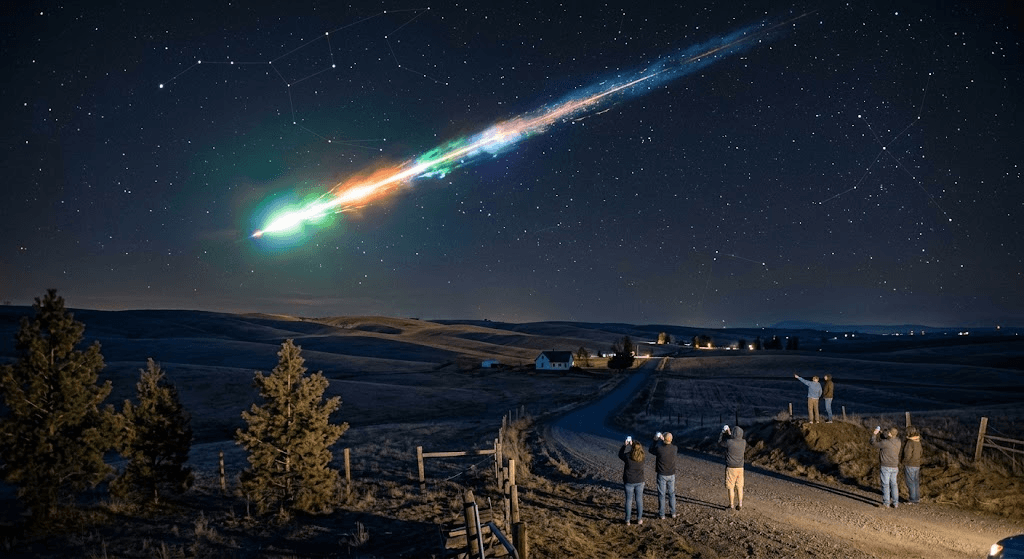
SPOKANE, Wash. — A massive fireball illuminated the night sky across large parts of North America early Friday, August 14, 2026, creating a spectacular streak of light and leaving thousands of onlookers in awe.
The brilliant celestial display occurred around 12:45 a.m. local time, generating widespread excitement as reports flooded in from across the Pacific Northwest, including Washington, Oregon, Idaho, and British Columbia, Canada.
Witnesses reported a blinding flash of light that transformed the pitch-black sky into day for nearly ten seconds. Security cameras, dashcams, and stargazers captured the intense meteor as it burned through Earth's upper atmosphere at an estimated speed of 25 miles per second, shedding incandescent fragments along its trajectory.
Astronomers confirmed that the fireball was exceptionally bright—outshining the planet Venus—and was accompanied in several communities by a low rumble and a distinct sonic boom.
"It put on a unbelievable show. People were out watering their lawns or checking doorbell cameras, and suddenly the entire horizon lit up like broad daylight."— An Astronomical Society Fireball Observer
Preliminary tracking data from meteor monitoring networks suggests the space rock entered the atmosphere at a steep angle, traveling from south to north before breaking apart at an altitude of roughly 50 miles. Experts noted that while the event coincided with the active Perseid meteor shower period, this specific fireball was an independent, denser meteoroid, likely composed of heavy rock or iron rather than fragile comet debris.
Researchers are currently analyzing radar data and trajectory models to pinpoint potential landing zones along the lower atmosphere, where surviving meteorites may have fallen to the ground.
Local authorities confirmed there were no reports of damage or injuries, leaving residents and space enthusiasts with a memorable view of one of nature’s most dramatic cosmic events.
The event has already drawn keen interest from amateur rock hounds and professional meteorite hunters, who are mobilizing search teams across rural eastern Washington and northern Idaho. Planetary scientists urge anyone who encounters potential dark, unusually dense fragments along the estimated strewn field to record the exact GPS coordinates and report their findings to local university observatories for laboratory confirmation.
Published by Banx Network. This article is part of the Banx decentralized media programme, powered by the BXE token on the XRP Ledger.