There is a particular defiance in arriving at a capital while the sirens are sounding—a visit that is not merely diplomatic but physical, that places a leader in the same airspace where drones are flying and bridges are being struck. On Sunday, German Chancellor Friedrich Merz arrived in Kyiv on an unannounced visit, his first since taking office, as the Ukrainian capital came under renewed Russian drone attack. The timing was deliberate, and the message was unmistakable.
Merz traveled with Economy Minister Katherina Reiche and a delegation of executives from German defense and energy companies, including Siemens Energy, Hensoldt, Diehl Defence, and the drone manufacturer Quantum Systems . In a statement after his arrival, he said he had come "because Ukraine needs all our support in the coming weeks," and warned that "if Russia is not stopped, its war machine will sooner or later turn against us" . He said he would tell President Volodymyr Zelensky that Ukraine "can continue to rely on our help" .
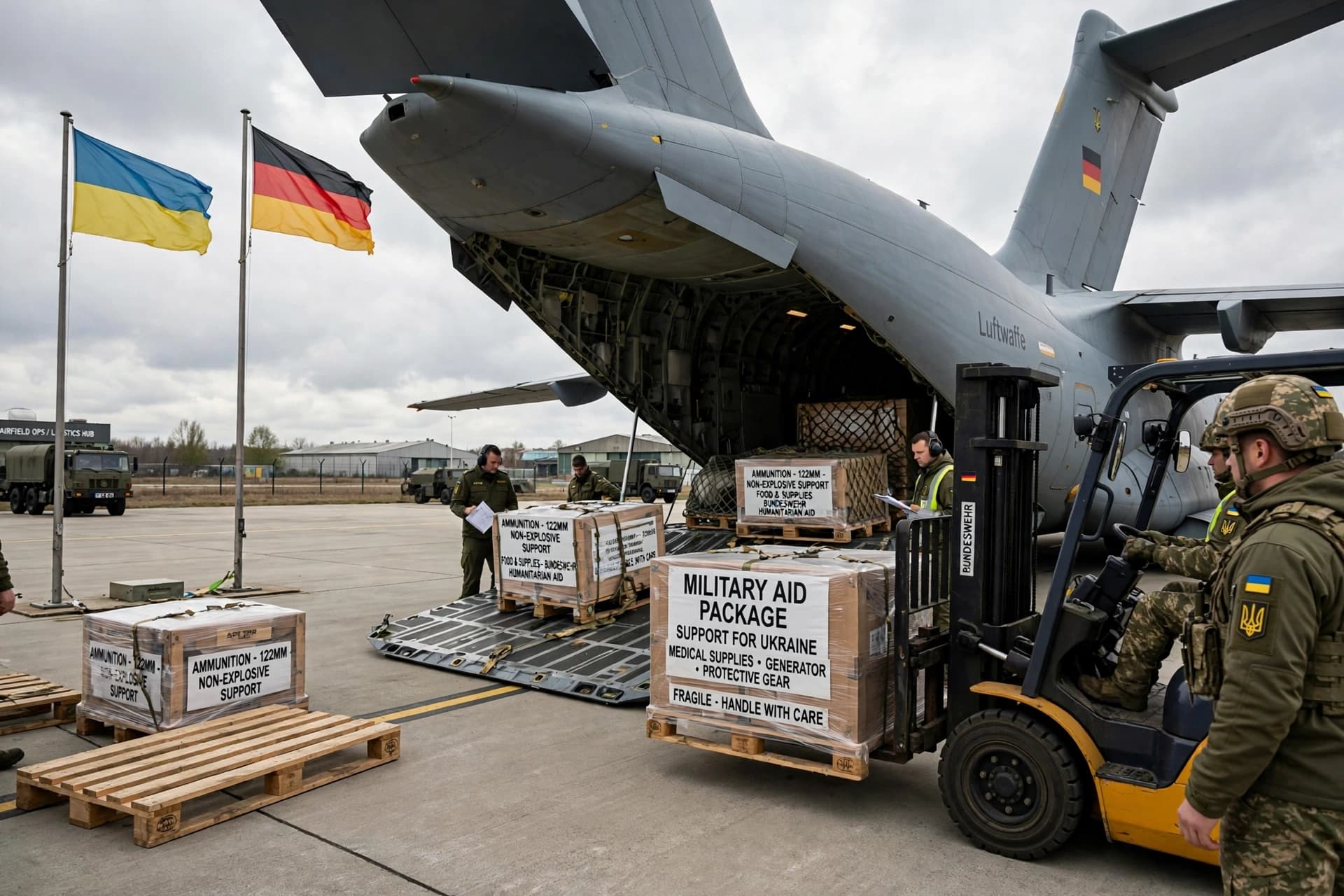
The aid package Merz announced is substantial: one billion euros in military assistance and an additional 350 million euros for repairing Ukraine's energy infrastructure, which has been systematically targeted by Russian strikes . But the centerpiece of the visit is a planned agreement on joint production of drones and missiles, including interceptor drones capable of countering the high-speed jet-powered drones Russia has been deploying against Ukrainian cities since the summer. Ukrainian officials have said the agreement will include weapons with a range exceeding 1,000 kilometers, which would expand Ukraine's ability to strike deep inside Russian territory .
The visit unfolded under heightened security. Air raid alerts sounded multiple times, and a Russian drone struck a bridge over the Dnipro River in Kyiv during Merz's time in the city . Merz and Zelensky visited the ruins of the Academy of Sciences, which had been hit by a Russian drone earlier in the week. "We will not be intimidated," Merz said, "nor will we be intimidated by a drone attack occurring at the very time of our visit" . He called on Russian President Vladimir Putin to "stop this senseless war," saying Germany was ready to talk about ending the conflict, but only once the weapons fell silent .
Kyiv Mayor Vitali Klitschko described the situation in the city as "extremely dramatic," warning that Kyiv risked being "torn to pieces" as Russia escalates its campaign against bridges, energy infrastructure, and civilian targets . Zelensky thanked Merz for what he called Germany's "consistent leadership" and said Russia must be stopped together . Merz also used the visit to urge Ukraine to accelerate reforms demanded by EU partners, particularly anti-corruption measures, as a condition for closer integration with the bloc .
The visit came a day after Russia's defense ministry warned foreign diplomats and nationals to leave Kyiv, a warning Merz's presence effectively disregarded. For Germany, the visit represents a reaffirmation of its role as one of Ukraine's largest supporters, and a statement that Berlin's commitment is not contingent on the absence of danger. For Ukraine, the aid package and the drone production agreement offer both immediate material support and a longer-term industrial partnership that could strengthen its defenses well beyond the current war. The sirens sounded. The bridge was struck. And the chancellor stayed.
AI Image Disclaimer: The visual elements in this article were created using AI generation tools and are intended for illustrative purposes only.
Sources: Reuters, Rti, Deutschlandfunk, RTE, VOV, CNA, TVR Info, RTSH
Published by Banx Network. This article is part of the Banx decentralized media programme, powered by the BXE token on the XRP Ledger.