
Key Highlights
- Incident:A fuel tanker explosion occurred on a Caracas expressway, killing the driver and injuring three civilians.
- Response:Emergency services deployed to manage the fire and assist the injured.
- Impact:The explosion caused significant traffic disruptions and raised safety concerns regarding aging vehicle fleets.
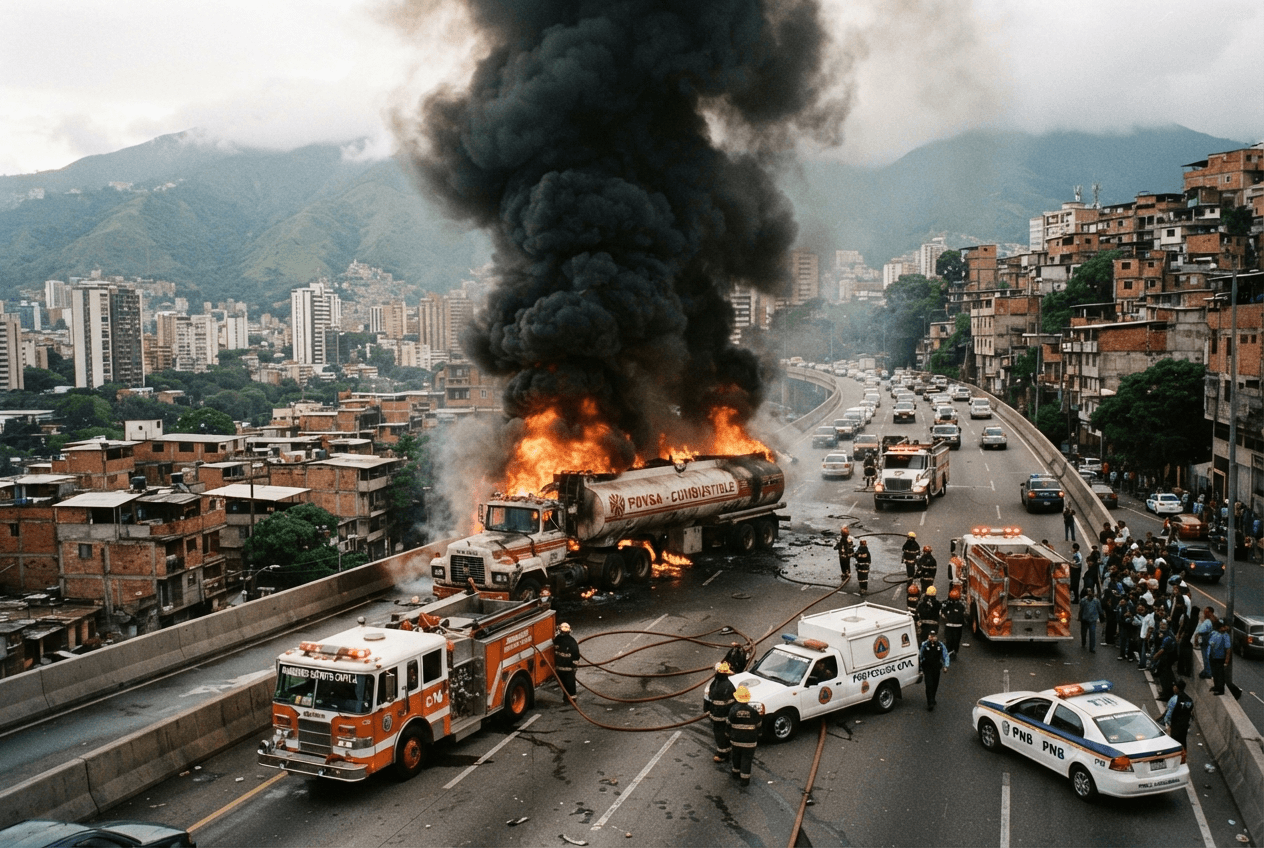
On Friday afternoon, a catastrophic explosion involving a fuel tanker truck rocked a primary expressway in Caracas, Venezuela, resulting in the immediate death of the driver and injuries to three nearby motorists. The incident unfolded as the tanker lost control while navigating a steep descent, crashing into a concrete retaining wall and rupturing its aluminum containment vessel. Eyewitnesses reported a thunderous detonation that rattled windows across three residential neighborhoods, with a thick plume of black smoke rising high above the city skyline.
Emergency response teams, including civil protection personnel and municipal firefighters, quickly arrived at the scene. They deployed chemical foam lines to combat the intense hydrocarbon fire that engulfed the vehicle and nearby cars. Medical teams treated three civilians who suffered severe smoke inhalation and secondary burns while attempting to escape their vehicles. Paramedics transported the injured to a municipal trauma center, escorted by police motorcycles to ensure swift access to emergency care.
Authorities confirmed that the tanker was carrying approximately nine thousand gallons of refined gasoline destined for a regional distribution depot. The explosion's heat was so intense that it warped metal street signs and melted electrical wiring along both directions of the elevated highway. Urban rescue squads established a five-block exclusion perimeter to mitigate the risk of secondary explosions from compromised fuel lines, while National Guard units set up barriers to keep onlookers at a safe distance from the hazardous site.
Environmental mitigation teams were deployed to spray neutralizing agents onto nearby storm drains to prevent the burning fuel from contaminating the municipal drainage systems. Engineers from the state electricity corporation arrived to inspect charred power lines that were left dangling precariously above the wreckage. As the situation unfolded, transport union representatives expressed concerns about the aging vehicle fleets and the scarcity of replacement parts, which they believe contribute to ongoing road safety issues across the country.
In the aftermath of the explosion, municipal transit officials implemented emergency detours to redirect thousands of stranded commuters through secondary urban avenues. This led to significant traffic congestion in surrounding commercial districts, exacerbated by the evening rush hour. Forensic recovery specialists awaited cooler temperatures before attempting to recover the driver's remains from the incinerated cabin, while environmental prosecutors opened a preliminary inquiry into the incident, examining maintenance logs and cargo weight certificates from the loading terminal.
Urban planning experts renewed their criticisms regarding the restrictions on heavy freight transport within municipal highway corridors during peak daytime hours, arguing that such regulations are necessary to prevent future tragedies. Municipal workers set up heavy lighting towers around the charred crater in preparation for overnight asphalt removal operations, while fire suppression crews continued to douse smoldering metal fragments to ensure no hidden pockets of fuel remained active. As of now, municipal transit authorities have not provided an estimate for when normal vehicle transit can resume on the damaged highway overpass.
Published by Banx Network. This article is part of the Banx decentralized media programme, powered by the BXE token on the XRP Ledger.



