For as long as paleontologists have been studying dinosaurs, fruit has been a conspicuous absence. Dinosaurs ate meat. They ate plants, ferns, cycads, conifers. They ate each other. But the fleshy, sugar-rich fruits of flowering plants—the peaches and cherries and berries that seem so abundant in the modern world—appeared to have no place at the dinosaurian table. The fossil record offered no evidence of a dinosaur specialized for fruit, and the assumption hardened into something like certainty. Now, a turkey-sized creature with a parrot-like skull and a set of jaws unlike anything seen before has overturned that assumption, and in doing so, has opened a window onto a relationship between dinosaurs and flowering plants that had remained hidden for 66 million years .
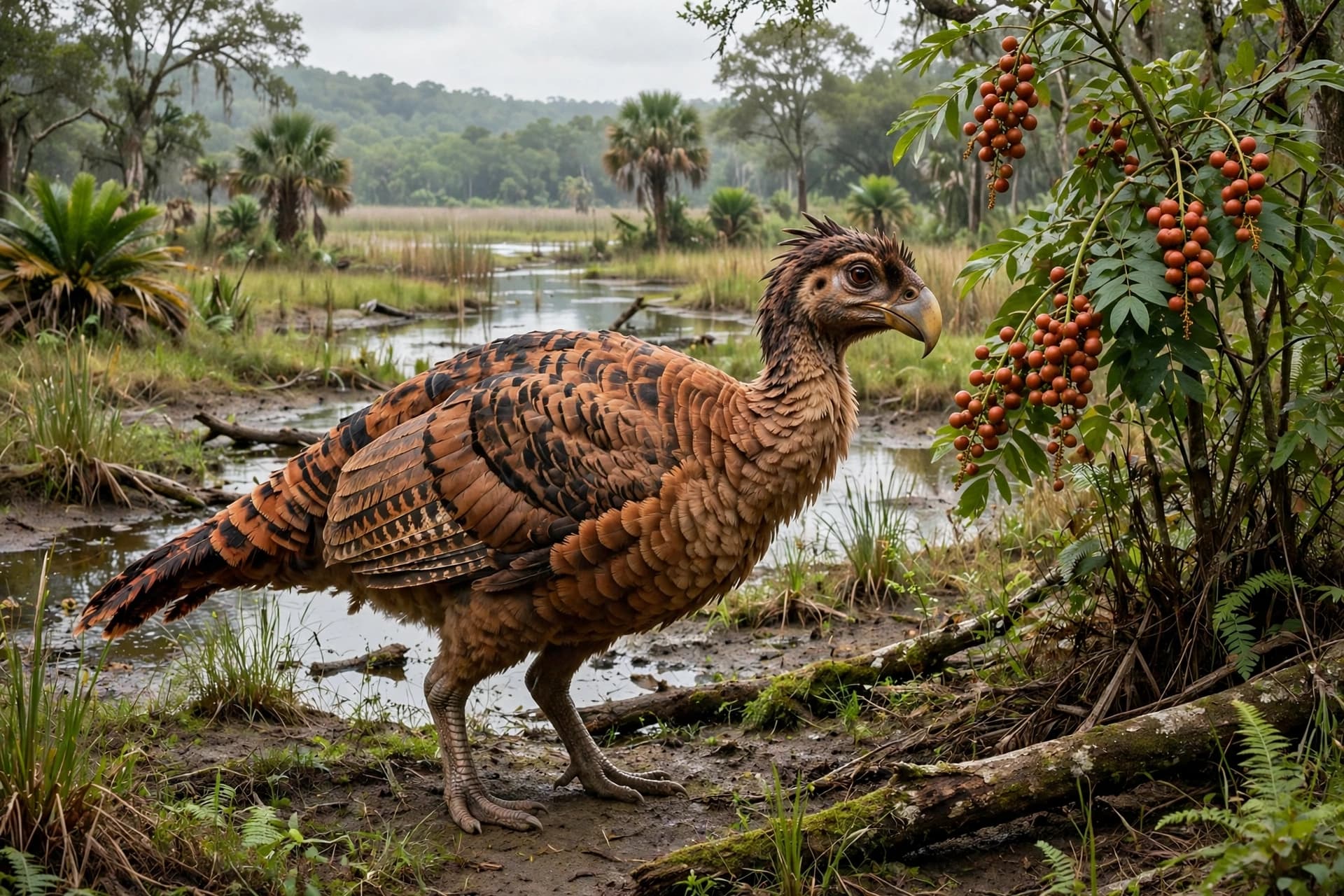
The species, named Infernogallus jamesi, is known from a nearly complete skeleton and isolated jaw and palate bones unearthed in the Hell Creek Formation of Montana and North Dakota. The name translates to "hell chicken," a nod to its bird-like appearance and the Hell Creek rock formation that yielded it—a formation famous for producing fossils of Tyrannosaurus, Triceratops, and Ankylosaurus . Infernogallus lived alongside those giants, a small, feathered theropod in a world of larger, more famous predators and herbivores.
The fossils tell a story of specialized feeding. The skull, reconstructed with CT scans, reveals a jaw mechanism unlike any known in dinosaurs. The lower jaw could move forward and backward, not just up and down, allowing a back-and-forth chewing motion. The beak carried a complex system of ridges and grooves suited to shearing and mashing soft vegetation. And the jaw muscles were arranged to power that horizontal grinding . The combination is unique. Modern birds and turtles have some of these features individually—the fig-eating vulturine parrot, the green sea turtle chewing soft sea grass—but no living animal possesses all three together .
The diet those adaptations served was fruit. Infernogallus was a frugivore, the first known among dinosaurs. Its beak and jaws were built to process the soft, fleshy fruits of angiosperms, the flowering plants that were diversifying and spreading during the Cretaceous. The available fruits likely included berries and drupes—the category that today includes peaches, cherries, olives, and mangoes . The dinosaur would have mashed the fleshy portions, separating them from the seeds, in a manner reminiscent of a modern parrot.
The discovery carries implications beyond the diet of a single species. Flowering plants emerged and diversified during the Cretaceous, transforming terrestrial ecosystems. Paleontologists have long suspected that dinosaurs must have responded to this new food source, but direct evidence was lacking. Infernogallus provides that evidence, showing that at least one lineage of theropods evolved specialized adaptations for exploiting fruit. The researchers suggest that caenagnathids, the group to which Infernogallus belongs, may have played a role in seed dispersal, carrying large seeds away from parent plants and helping the flowering plants spread . The link remains tentative, but the possibility is real.
There is a quiet wonder in this small, strange dinosaur. It was not a giant. It did not rule its ecosystem. It was, by the standards of its time, unremarkable in size—five feet long, twenty-five pounds, a creature that could be lost in the shadow of a T. rex. But its jaws tell a story of adaptation and opportunity, of a lineage of meat-eating ancestors that found a new niche in a changing world. The beaks that replaced teeth opened possibilities, and Infernogallus took one of them .
The fossil now rests at the Royal Ontario Museum, a small skeleton with a remarkable skull. It is a reminder that the age of dinosaurs was not a single, monolithic world of predators and prey, but a complex web of relationships, diets, and adaptations that we are still learning to see. Fruit, it turns out, was on the menu after all. We simply had not found the dinosaur that ate it.
Image Disclaimer: This article's accompanying image is an AI-generated illustration, not a photograph of the actual fossil specimen.
Sources: The Independent, Nature Communications, Stony Brook University, Royal Ontario Museum, Interesting Engineering, Reuters
Published by Banx Network. This article is part of the Banx decentralized media programme, powered by the BXE token on the XRP Ledger.