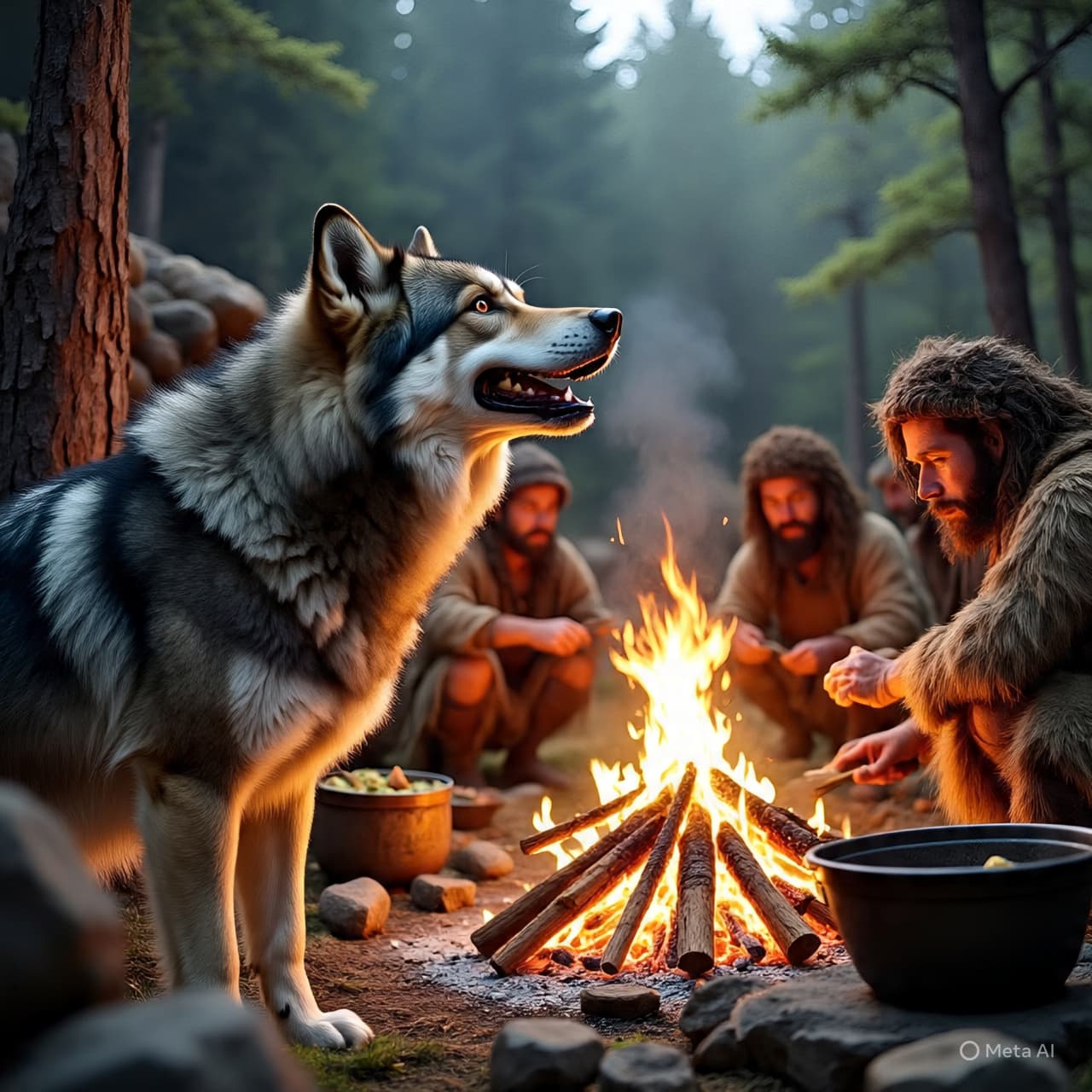
There is a quiet understanding that passes between a human and a dog—something unspoken, yet deeply familiar. It appears in the gentle wag of a tail, in the attentive gaze that seems to follow without question, and in the shared stillness that asks for nothing more than presence. This connection, often felt in the smallest of moments, may be far older than it seems.
A recent study suggests that the bond between humans and dogs dates back more than 15,000 years, tracing its origins to a time when both species were still learning how to live alongside one another. The findings offer a glimpse into a relationship that has endured across millennia, evolving from early cooperation into the companionship recognized today.
Researchers examining ancient remains and genetic evidence have pointed to this long history of domestication, where wolves gradually became what we now know as dogs. The process, thought to have unfolded over generations, likely began with proximity—animals drawn to human settlements, and humans finding value in their presence. Over time, this mutual benefit appears to have deepened into something more enduring.
The study highlights how this early relationship may have been shaped by shared needs. Dogs, with their heightened senses, could assist in hunting or alert communities to danger. Humans, in turn, provided food, shelter, and a degree of protection. In these exchanges, a foundation was laid—not only for survival, but for connection.
What is particularly striking is how this bond seems to have persisted and adapted through changing environments and societies. From ancient camps to modern homes, dogs have remained close to human life, their roles shifting but their presence constant. The study’s findings suggest that this continuity is not incidental, but rooted in a long history of coexistence.
Beyond practical roles, the relationship has also taken on emotional dimensions. Today, dogs are often regarded not merely as companions, but as members of the family. The study invites reflection on how such closeness may have been shaped over thousands of years—through shared experiences, mutual reliance, and gradual understanding.
Scientists note that domestication is not a single moment, but a process—one that involves both biological and behavioral changes. As dogs adapted to living with humans, traits such as sociability and responsiveness may have been naturally selected, reinforcing the connection between the two species. At the same time, humans may have developed a greater sensitivity to the cues and behaviors of their canine counterparts.
The research adds to a growing body of work exploring the origins of this relationship, though questions remain. The exact pathways of domestication, the regions where it first occurred, and the details of early interactions continue to be studied. Each new discovery contributes another piece to a story that is both ancient and ongoing.
In the present day, the bond between humans and dogs is often taken for granted, woven seamlessly into daily life. Yet the study offers a gentle reminder that this connection is not recent, but the result of a long, shared journey—one that has moved through time with quiet persistence.
As research continues, the picture may become clearer, though its essence may remain the same. The companionship seen today, in parks and homes and quiet corners of life, carries with it echoes of a past that stretches back thousands of years—a relationship shaped not only by necessity, but by something closer to understanding.
AI Image Disclaimer Visuals are created with AI tools and are not real photographs.
Source Check (Credible Media Outlets): BBC News The New York Times National Geographic Science Magazine Reuters
Published by Banx Network. This article is part of the Banx decentralized media programme, powered by the BXE token on the XRP Ledger.