In the quiet hum of life aboard a spacecraft — miles above the blue curve of our planet — every drop and scrap takes on a new weight of meaning. Here, waste isn’t merely something to be discarded; it is part of a whispered alchemy, a cycle that might one day transform the byproducts of human life into the very sustenance that keeps explorers alive. If Earth’s soil is a cradle of life, then perhaps the future of space agriculture will be built upon rediscovering nutrients where we least expect them — in what we leave behind.
For humans to live far from Earth for months or years at a time, bringing all the food they will ever eat is an impractical luxury. Instead, scientists are searching for ways to make a self-sustaining loop, where nothing useful is wasted and everything circulates — much like nature’s perennial seasons. In this vision, astronauts’ wastewater, treated sewage and other biological outputs become not refuse but raw material, a hidden reservoir of essential nutrients. A recent study in ACS Earth and Space Chemistry suggests that recycled human waste could actually liberate crucial plant nutrients from the barren soils of the Moon and Mars, slowly transforming those dry, dusty regoliths into something capable of supporting life.
Working in laboratories on Earth, researchers simulated the mineral dust of extraterrestrial soil and mixed it with treated waste streams. What they observed was a kind of chemical weathering — tiny mineral particles subtly altered, releasing nutrients such as sulfur, calcium and magnesium that plants need to grow. These processes are the first steps in turning sterile rock into fertile ground, hinting that future lunar and Martian farms might depend on closed-loop systems where every atom is cherished and reused.
Elsewhere, other teams are exploring biological bridges between waste and food. At Penn State University, researchers have experimented with microbes that break down human waste and convert carbon and nitrogen into edible biomass — a soft, reflective nod to the way life on Earth recycles organic matter through soil and microbes. These microbial pathways are more than clever engineering; they are echoes of natural cycles that in ordinary fields around the world feed crops from manure and compost.
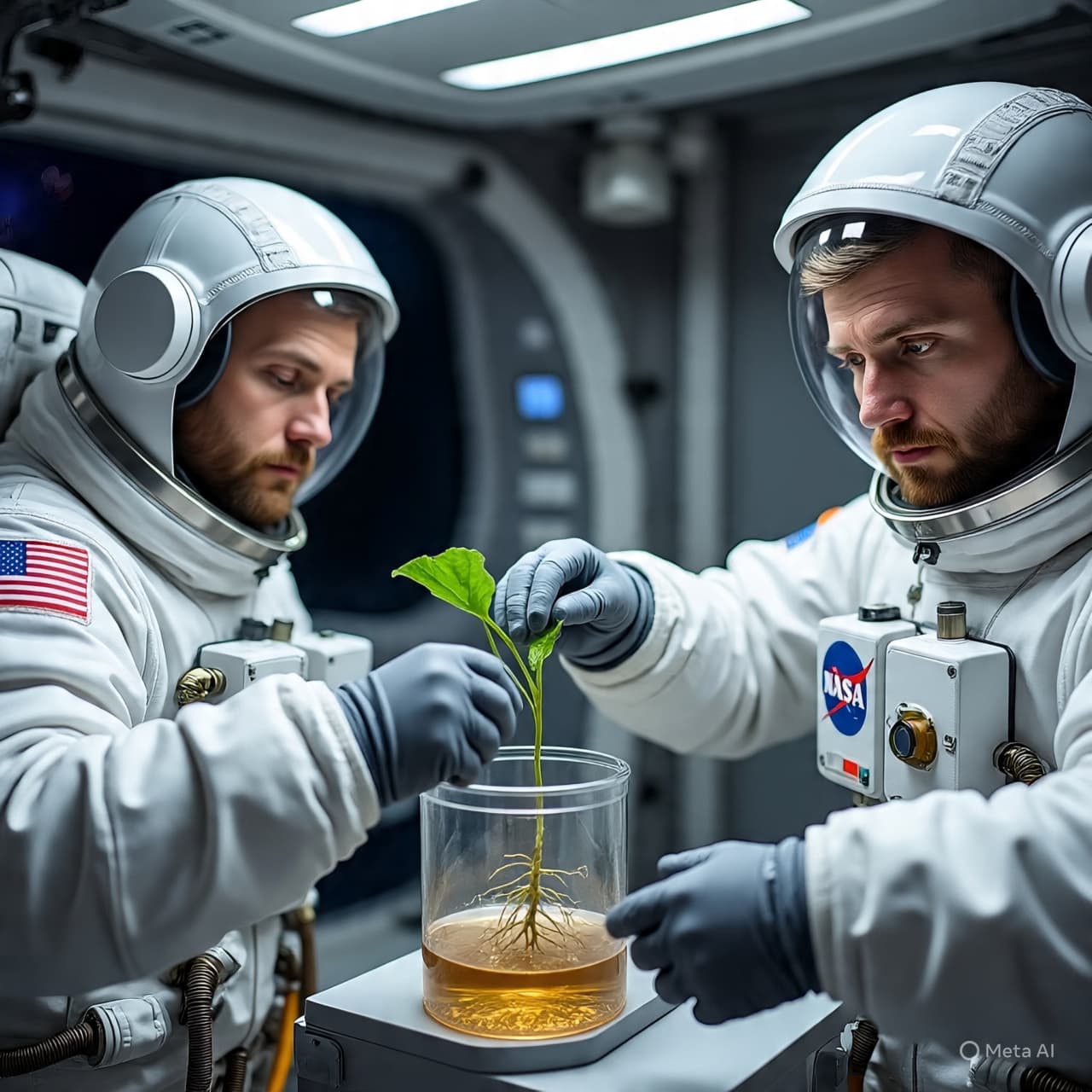
The broader effort to grow food in space is part of what engineers call a “bioregenerative life support system,” artificial ecosystems where plants, microorganisms and waste streams interact to produce food, oxygen and purified water, mimicking Earth’s biosphere. This gentle collaboration between biology and technology acknowledges that in the hostile expanse of space, survival will depend on circularity rather than abundance — on turning what was once discarded into nourishment.
Yet the path ahead is not without its challenges. Extraterrestrial soils behave differently from Earth’s fertile loams, and human waste must be carefully treated to strip pathogens before it can safely nourish plants. Still, by reimagining waste as a form of resource, scientists are drawing closer to making space agriculture a reality — one where meals are grown not just from imported seeds and supplies, but from the very threads of human life woven into closed systems of renewal.
As missions to the Moon, Mars and beyond take shape, the notion that “nothing is wasted” will be both a practical necessity and an elegant reflection of how life persists — even when far from home.
AI Image Disclaimer “Images in this article are AI-generated illustrations, meant for concept only.”
Sources (Listed Per Role) Discover Magazine, Earth.com, Penn State University research, NASA/bioregenerative life support overview, Space Farms overview.
Published by Banx Network. This article is part of the Banx decentralized media programme, powered by the BXE token on the XRP Ledger.