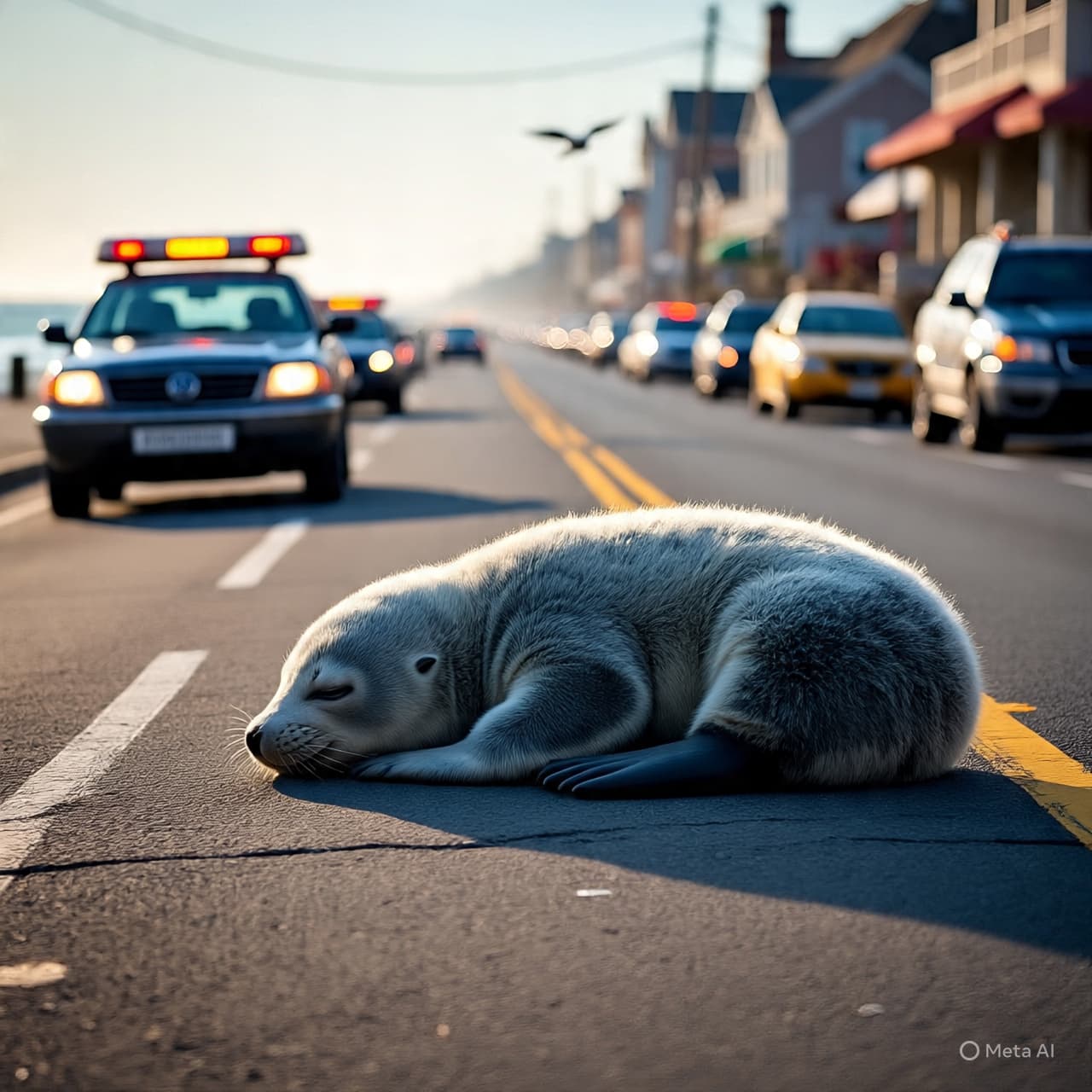
The morning traffic along the Jersey Shore tends to follow a familiar rhythm — delivery trucks edging toward boardwalk cafés, joggers tracing the shoreline, gulls circling with casual authority. But on this particular stretch of road, the day slowed to an unexpected pause. In the middle of the street, far from the tide’s reach, a young gray seal pup had decided that asphalt would do just fine for a nap.
Drivers stopped. Police redirected traffic. Phones lifted to capture the improbable scene: a small, dappled marine mammal stretched across warm pavement as if it were a sunlit sandbar. For a time, the seal seemed untroubled by the commotion, resting quietly while responders formed a protective perimeter.
Marine mammal rescue teams were called to the scene, and officers closed off the roadway to ensure the animal’s safety. According to local authorities, the pup appeared fatigued but not visibly injured. Experts noted that young seals occasionally wander inland while exploring or resting, particularly during pupping season when juveniles begin navigating coastal environments independently.
Gray seals are native to the northeastern United States and are increasingly common along Mid-Atlantic beaches. After decades of recovery following historical hunting pressures, their populations have grown steadily, leading to more frequent human–seal encounters in coastal communities. While sightings on beaches are routine, appearances in residential streets remain unusual.
Wildlife officials advised onlookers to keep their distance. Seal pups often haul out on land to conserve energy, and human interference can cause stress or disrupt natural behavior. Though their rounded faces and large eyes can invite sympathy, they are wild animals with specific care requirements best handled by trained responders.
After assessing the animal’s condition, rescue personnel gently secured the pup using specialized equipment designed to minimize stress and injury. It was then transported for evaluation and, if necessary, rehabilitation before eventual release back into the ocean.
For residents, the interruption offered a moment of collective curiosity — a reminder that coastal life blurs the boundary between town and tide. Streets built for cars briefly became habitat, if only for an hour.
By midday, traffic resumed and the seal’s resting place returned to ordinary pavement. Yet the image lingered: a quiet marine visitor, temporarily at ease amid painted lane markers and storefronts.
Officials later confirmed that the pup was stable and under observation. Once cleared by veterinarians, it is expected to be returned to suitable shoreline habitat.
Along the Jersey Shore, the ocean is never far away. Sometimes, it arrives in the most unexpected ways — pausing traffic, drawing a crowd, and then slipping gently back toward the water.
Published by Banx Network. This article is part of the Banx decentralized media programme, powered by the BXE token on the XRP Ledger.