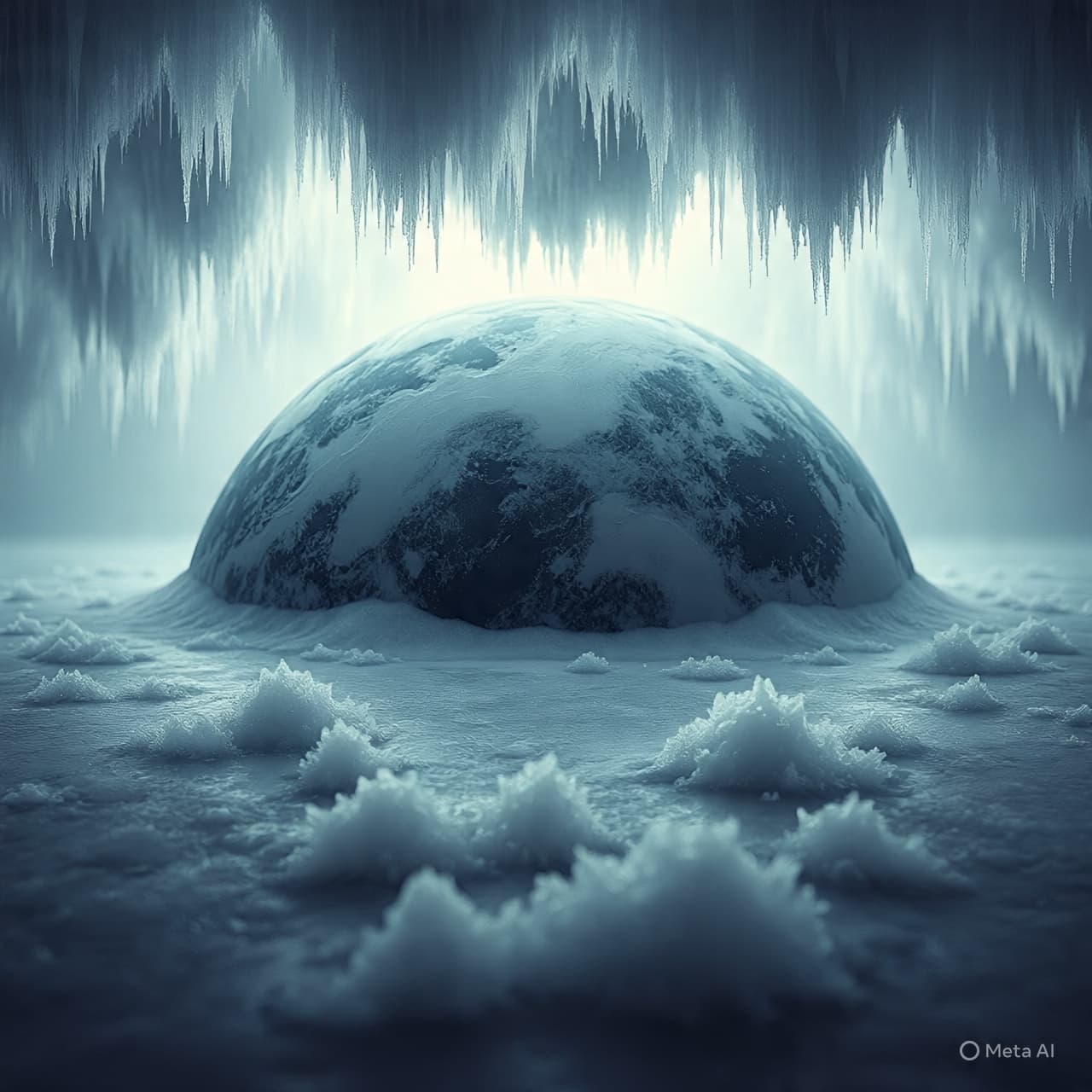
A long time before human voices traced lines across maps or even understood the rhythm of the seasons, Earth itself once entered a vast and unyielding winter. It was an era we now call Snowball Earth, a time hundreds of millions of years ago when ice sheets reached nearly to the equator and the world looked from space like a gleaming orb of white. The idea that sunlight’s reflection on bare ice could trap a planet in a deep freeze has long been part of climate science’s lexicon, but new thinking suggests there was an additional, hidden player in that ancient chill — salt left behind on sea ice that may have helped sweep the planet even further into frost than we had imagined.
Salt and ice are old companions. When seawater freezes, the crystalline lattice of ice refuses to accept dissolved salts, leaving behind pockets of brine that are richer in salt than the surrounding water. Over vast reaches of the ancient oceans, as ice spread outward under sun that shone more weakly than today’s, these brine pockets would have been left behind as bright, white salt crystals on the ice surface once the ice itself sublimated — turning straight from solid to vapor under an unforgiving sky.
In this way, salt may have acted like a subtle amplifier — a salt‑albedo feedback — adding a layer of reflective brightness to Earth’s frozen shell and assisting a world already teetering on the brink of deep freeze. When conditions in early glaciation were such that large swathes of ocean became ice‑covered, the salt residue left behind could have boosted the planet’s overall reflectivity, trapping less solar heat and spurring even more ice growth. It is a delicate dance between light and surface, one in which even modest changes can cascade into dramatic shifts in climate rhythm.
To explore how significant this effect might have been, climate modelers have developed simulations that include this salt‑albedo feedback alongside more classic forces like the ice‑albedo mechanism that scientists have studied for decades. The results hint that once this salty mirror began to spread, it could have helped push the climate system deeper into the cold than previously simulated, reinforcing the feedback loop of ice, reflectivity, and cooling that defines Snowball Earth events.
These insights do not overturn the broader understanding of Earth’s ancient frigid episodes, but they add texture and nuance to it. The story of Snowball Earth has always been one of interconnected systems — sunlight and ice, greenhouse gases and continental movement, ocean circulation and atmospheric dynamics — all playing their parts in a colossal planetary performance. The idea that salt crystals on ancient sea ice may have provided an additional push toward global glaciation invites us to consider just how finely balanced these systems can be, and how small changes in surface properties can ripple outward to shape the fate of a world.
In the quiet mathematics of reflectivity, in the painted curves of climate models and in the enormity of ice that once cloaked our planet, there is a reminder that Earth’s deep past is written not only in rocks and fossils, but in the subtle interplay of light, salt and cold. It is a testament to the unexpected threads that can link the microscopic to the planetary, and to the enduring intrigue of a climate story that young scientists continue to unfold with care and wonder.
AI Image Disclaimer
Visuals are AI-generated and serve as conceptual representations.
Sources (News Outlets Only)
Phys.org Interesting Engineering
Published by Banx Network. This article is part of the Banx decentralized media programme, powered by the BXE token on the XRP Ledger.