At the edge of a grey Oregon sea, a long-dormant tradition stirred once again — carried on wind and wave, memory and mourning. A stranded young humpback, hundreds of miles from ancestral waters, became more than a tragedy. It became a bridge across time — connecting generations of the Siletz tribe to a heritage interrupted, and offering a delicate chance to honor the life taken by the ocean’s unforgiving currents.
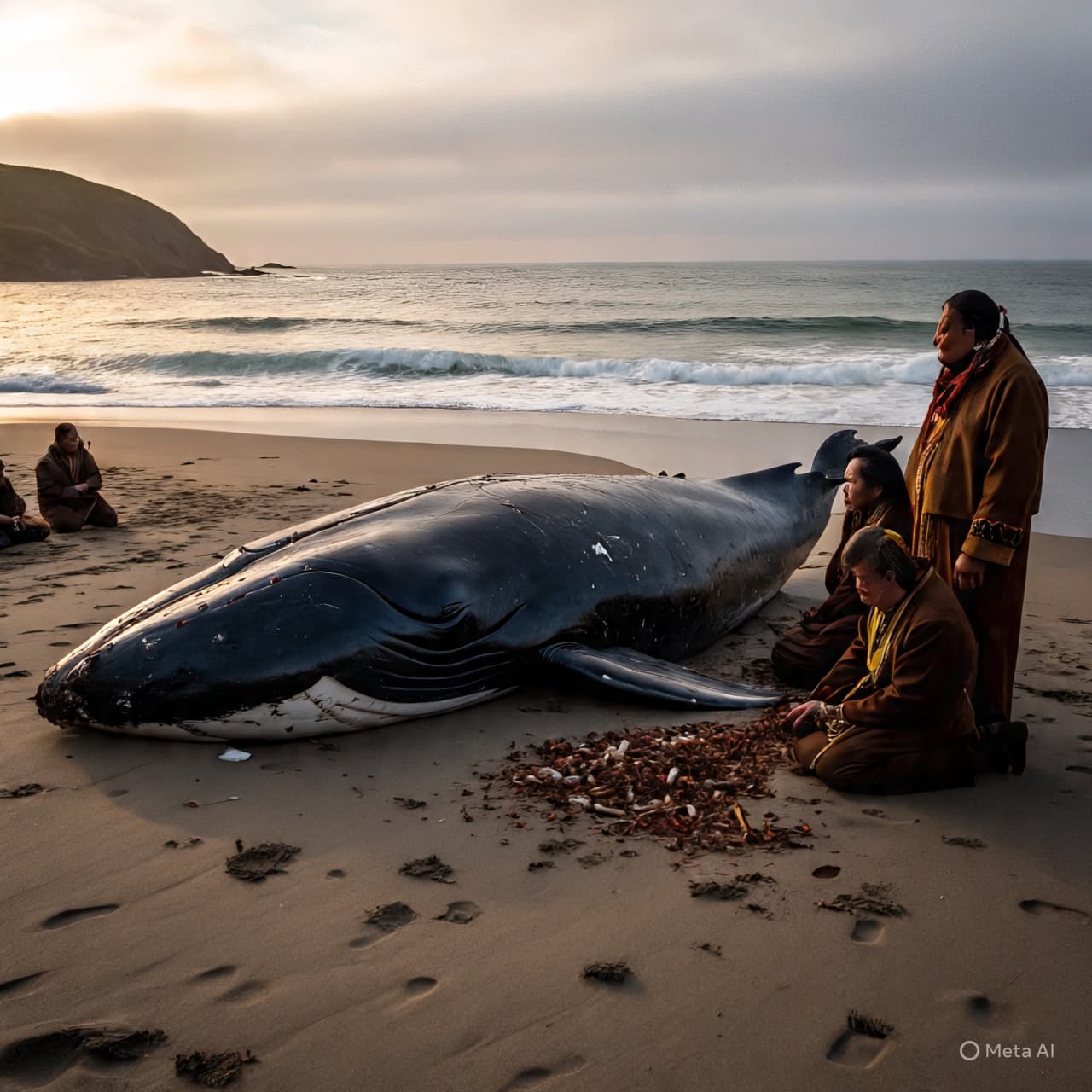
When the whale washed ashore near Yachats, Oregon in mid-November, efforts to save it — from state officials, scientists, and rescue teams — stretched across two days. But when survival proved impossible, the Siletz were invited to respond. With reverence, prayers, and ancient respect for what the sea gives and takes, tribal members carried out a harvest ceremony, marking the first whale harvest by the Siletz in generations.
Under a slowly sinking sun and rising tide, the community gathered. Tobacco was laid, voices whispered in thanks, and knives were raised not in violence, but in ritual — honoring the whale’s life by returning it to their lineage and memory.
Because the whale had been euthanized under scientific protocols, its meat was deemed unsafe to consume. Instead, the tribe salvaged blubber, bones, the skull, and baleen — parts that carry both cultural meaning and practical value. Blubber may be rendered to oil, bones could become tools or symbolic items, baleen might be crafted into regalia, and the skull and skeletal remains preserved for teaching or display.
For many of the Siletz — especially elders and younger members present side-by-side — the harvest became a moment of reconnection. Traditions once suppressed, rights long torn by forced relocations and shifting laws, resurfaced in a single evening on a quiet beach. It wasn’t just about reclaiming heritage — it was about remembering what was lost, and perhaps what can be restored.
As scientists from Oregon State University Marine Mammal Institute work through necropsy and study of the whale’s remains, the tribe moves forward with respect and caution — blending cultural values with ecological responsibility. What remains will not be wasted, but honored. What once was a silent loss may now seed future traditions, teachings, and renewed identity.
In the quiet aftermath, there is no triumphalism. There is only a shared pause — a recognition of loss, of survival, and of a community’s quiet hope. It is a story of an ending, yes, but also of remembrance — of cycles, of respect, and of the bones of history slowly re-assembling.
AI Image Disclaimer: “Visuals are created with AI tools and serve as conceptual depictions, not actual photographs.”
Sources: The Washington Post, The Oregonian / OregonLive, KPTV News, OPB / Oregon Public Broadcasting, Marine Mammal Institute / Oregon State University
Published by Banx Network. This article is part of the Banx decentralized media programme, powered by the BXE token on the XRP Ledger.