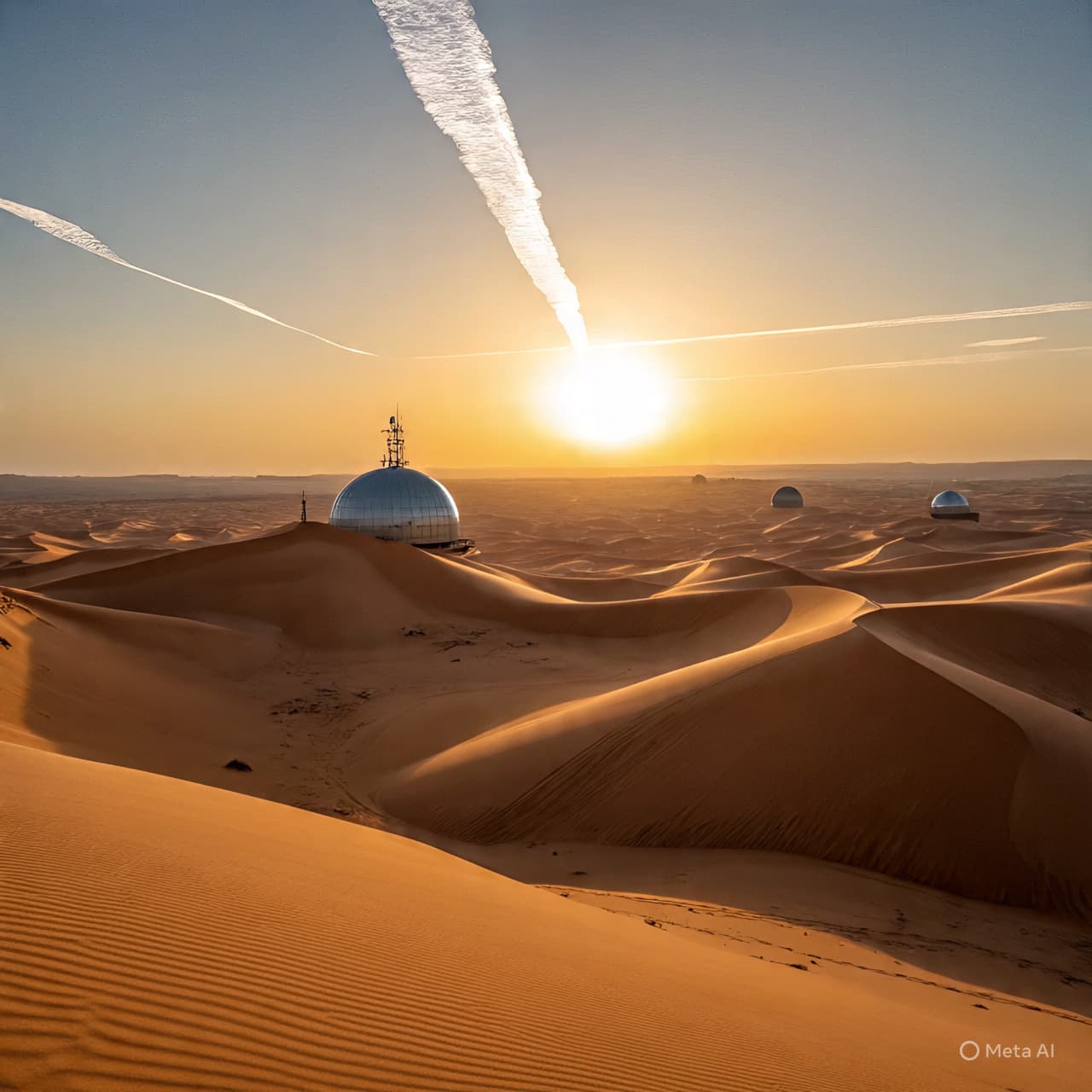
In the early light of a slowly warming morning, the desert’s quiet breath seemed unbroken — an expanse where sky and sand share a timeless stillness. Ships far out to sea cut gentle trails across the horizon, their passage almost unnoticed amid the hush. But history often writes itself in sudden strokes, and as the sun settled above the dunes, the day bore news that seemed to ripple through the air like windblown sand.
Across the broad sweep of the Middle East, an extraordinary wave of military motion was reported, one that touched cities and deserts, seas and skies alike. Reports emerged that coordinated military strikes by the United States military and Israel had struck deep into the heart of Iran, targeting strategic sites and officials, including the residence of the nation’s Supreme Leader, Ayatollah Ali Khamenei. Israeli sources indicated that Khamenei, long a figure at the center of Iran’s political and religious governance, had been killed in the operation, though Iran’s foreign ministry disputed those reports, insisting he remained “safe and sound.”
The strikes, described by American and Israeli leaders as part of a broader effort to address what they framed as persistent threats, seemed to fracture the calm of the region in a matter of hours. The airwaves carried news of explosions, of defenses rising against incoming barrages, and of governments issuing statements from capitals and command centers. Iran responded, according to multiple sources, with its own volleys of missiles and drones, sending arcs of fire toward a swath of neighboring nations — from Israel itself to Saudi Arabia, Qatar, and beyond.
In cities like Doha, smoke was reported on the skyline as air defenses worked to intercept missiles, a sight that seemed to underscore the fragility of peace in places where sand meets sea. Nearby, allied nations urged calm and restraint even as internal mechanisms shifted into heightened alert. Shelters were advised, and officials moved to reassure their populations as distant thunder echoed through strategic corridors.
This cascade of action followed a period of diplomatic tension in which talks aimed at curbing nuclear ambitions faltered, leaving channels of negotiation stretched thin. In the hours after the initial strikes, world leaders called for emergency sessions of international bodies, emphasizing the risks of further escalation. Some expressed support for efforts claimed to diminish regional threats; others warned that such military campaigns might widen the circle of conflict, with costs that could spill beyond borders.
For the people who live day to day in the heart of these lands, the shift from ordinary routine to a reality punctuated by alerts and counsel can feel sudden. Markets buzz with concern, travelers adjust plans, and families monitor screens for the next development. In regions where ancient history lingers in every stone and street, the present often folds into collective memory with remarkable speed, layering new stories over old.
And yet, amid alarms and announcements, questions remain: the precise toll of the strikes, the fate of those at the center of power in Tehran, and the direction of the many strands now woven into a single day of upheaval. What is certain is that the stillness has changed. In its place, there is a complex sound — the blending of diplomatic warnings, military signals, and human hope — echoing across plains, mosques, and avenues alike.
As night falls again over the sands of the Middle East, that sound continues to carry, whispering of consequences yet to be fully gleaned and of horizons shifting toward an uncertain dawn.
AI Image Disclaimer Visuals are AI-generated and serve as conceptual representations, not actual event photographs.
Sources (Credible News Outlets) Reuters The Guardian ABC News Al Jazeera Wall Street Journal
Published by Banx Network. This article is part of the Banx decentralized media programme, powered by the BXE token on the XRP Ledger.