There is something humbling about dust. It settles unnoticed on windowsills, drifts through sunlit rooms, gathers in corners where light thins. We brush it away without a second thought. Yet in the wider architecture of the universe, dust is not debris. It is inheritance. It is memory in particulate form.
A new wave of astronomical research draws a delicate line between the smallest known building blocks of cosmic dust and some of the largest, most luminous stars in existence. The story begins not in quiet interstellar clouds, but in the blazing interiors of massive stars—those titans that live fast, burn fiercely, and end in cataclysmic supernovae.
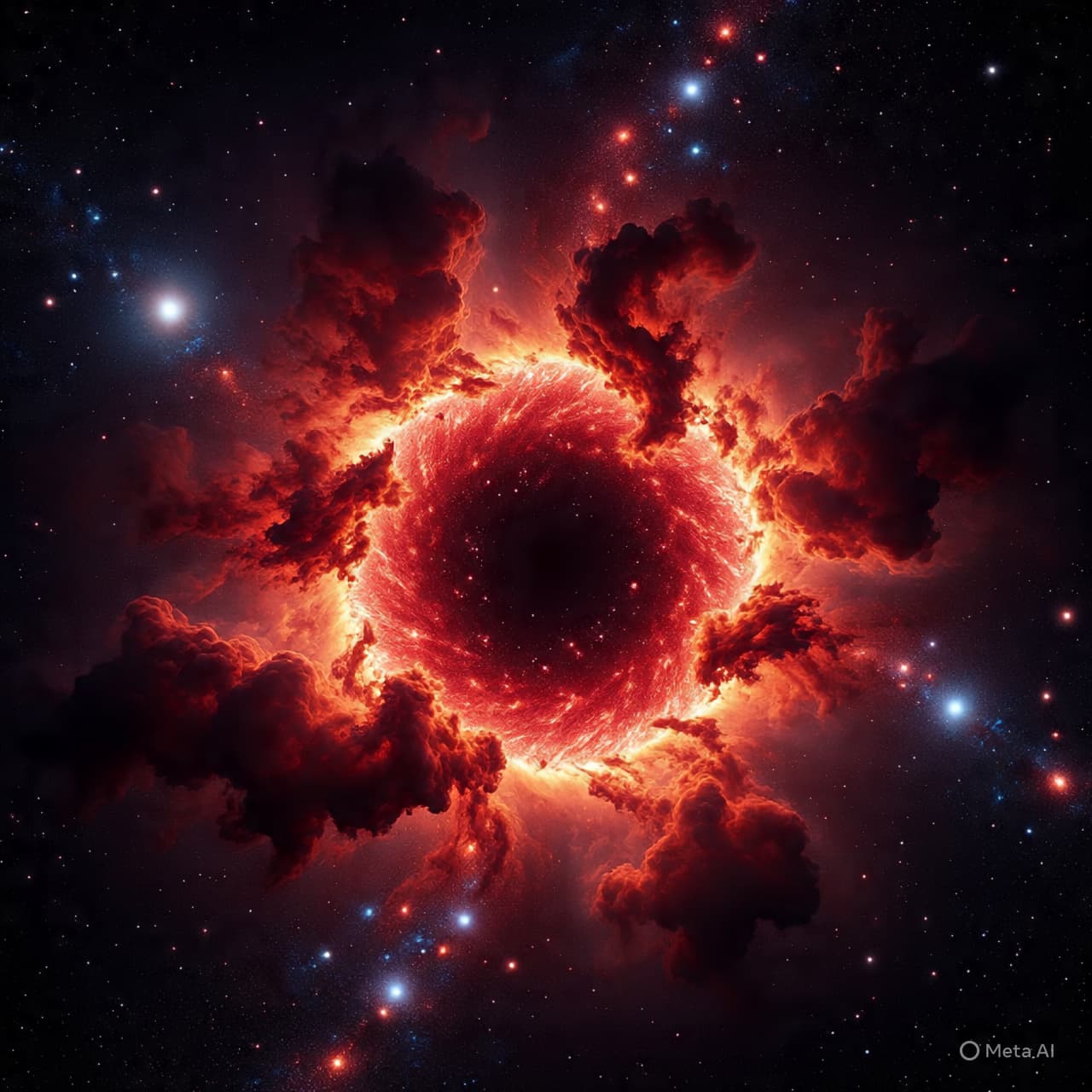
Massive stars, many times heavier than our Sun, act as cosmic foundries. Deep within their cores, nuclear fusion forges heavier elements—carbon, oxygen, silicon, iron. When such stars approach the end of their lives, they shed their outer layers through powerful stellar winds or explode in brilliant supernova events. In those violent expulsions, newly formed elements are flung into surrounding space. As the ejected material cools, atoms begin to bond. Tiny solid particles—dust grains—condense from the expanding gas.
Recent observations, supported by infrared space telescopes and laboratory analysis of presolar grains found in meteorites, have traced specific isotopic signatures back to these massive stellar origins. Some of the dust grains recovered from primitive meteorites are older than our solar system itself. Their atomic fingerprints match conditions expected in supernova ejecta or the winds of red supergiant stars. In this way, the smallest measurable solids on Earth carry chemical echoes of stars that died billions of years ago.
Infrared astronomy has been crucial in revealing this link. Dust, though small, glows faintly in infrared light when warmed by nearby radiation. Observatories operated by NASA and the European Space Agency have mapped dust formation in stellar nurseries and supernova remnants, detecting how fresh grains coalesce in the aftermath of stellar death. What once seemed too fragile to survive such violence is now understood to be surprisingly resilient. In some cases, significant quantities of dust endure the shockwaves of supernova explosions, later seeding interstellar clouds.
These dust grains are not merely byproducts. They are catalysts. Within cold molecular clouds, dust provides surfaces where simple molecules can combine into more complex forms. It shields emerging stars and planets from harsh radiation. Over time, dust aggregates into pebbles, rocks, planetesimals—eventually forming worlds. The Earth itself is, in part, assembled from the ash of massive stars.
The connection between the largest stars and the tiniest grains reshapes how astronomers think about cosmic cycles. Massive stars influence galaxies through radiation, gravity, and explosive endings. Yet their legacy is also granular. They contribute directly to the raw materials of future star systems. In mapping dust formation and survival, scientists are tracing the continuity between destruction and creation.
There is a quiet symmetry here. The universe does not separate grandeur from minuteness. The most colossal stars, visible across vast intergalactic distances, leave behind particles smaller than a grain of sand—particles that drift, gather, and eventually become the scaffolding of planets and life.
In the end, the research offers neither spectacle nor alarm, but perspective. It suggests that scale can be misleading. What appears insignificant may hold the record of immense events. And what burns brightest may find its most enduring expression in something nearly weightless—a tiny grain of dust, carrying the history of a star.
AI Image Disclaimer Visuals are created with AI tools and are not real photographs.
Sources NASA ESA (European Space Agency) ScienceDaily Phys.org Nature
Published by Banx Network. This article is part of the Banx decentralized media programme, powered by the BXE token on the XRP Ledger.