
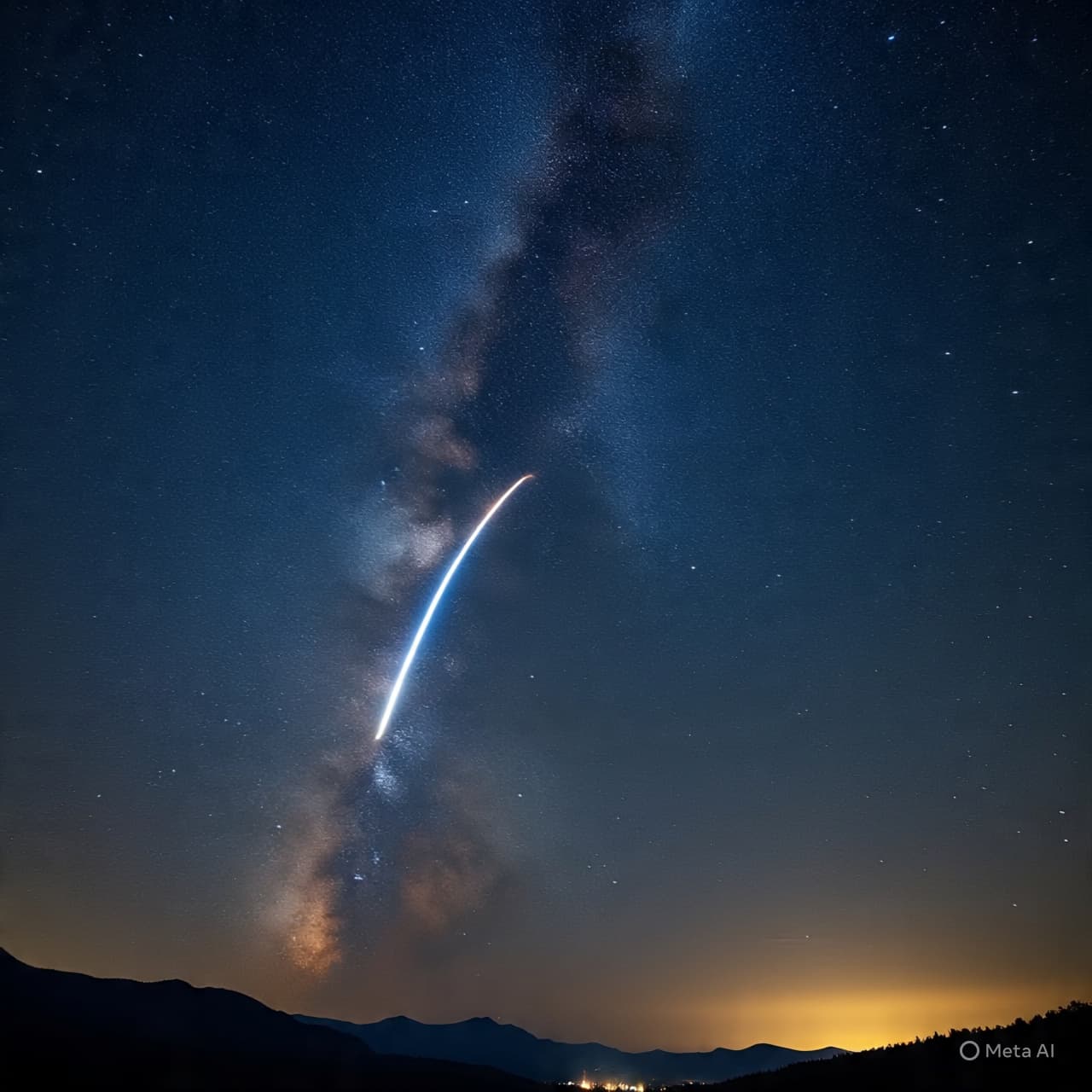
There are moments when the sky, usually so distant and indifferent, feels suddenly close—as if something vast has briefly crossed the boundary between elsewhere and here. It happens without warning, without announcement. A streak of light, a fracture of brightness, and then the quiet returns, leaving only fragments and questions behind.
High above the Earth, beyond the reach of ordinary weather, a six-tonne meteor entered the atmosphere at extraordinary speed—measured at around 72,420 kilometers per hour. For a brief span of seconds, it became visible, its descent marked by intense heat and friction, a luminous passage through layers of air that resisted its arrival. What began as a solid mass in space was quickly transformed, its surface burning, breaking apart, scattering into smaller pieces as it traveled downward.
Events like this unfold more often than they are noticed. Every day, countless fragments of cosmic debris enter the atmosphere, most no larger than grains of sand, dissolving entirely before they can reach the ground. But objects of this size—measured in tonnes rather than grams—are far less common, their presence carrying both scientific interest and a quiet reminder of the vastness that surrounds the planet.
As the meteor descended, much of its mass was likely lost in the process of ablation, the intense heating that causes outer layers to vaporize and peel away. What remains after such a journey is often only a fraction of the original body, scattered across a wide area in what scientists refer to as a strewn field. In many cases, the fragments that reach the surface are small, cooled remnants of something that once moved at unimaginable speed.
For researchers, each event offers a fleeting opportunity. Meteorites—those pieces that survive the fall—can carry within them records of the early solar system, preserved in compositions that have changed little over billions of years. They are, in a sense, messages written long before Earth took its current form, arriving unannounced and often unnoticed.
There is also a human dimension to these encounters. Witnesses sometimes describe a sudden brightness in the sky, a flash that turns night into a momentary day, followed by a delayed sound—like distant thunder—caused by the object’s passage through the atmosphere. These sensory details linger, not as fear, but as something closer to awe, a reminder of forces that operate far beyond daily experience.
Despite its size and speed, the likelihood of significant damage from such an event remains low. The Earth’s atmosphere acts as a protective barrier, absorbing much of the energy carried by incoming objects. Only in rare instances do larger bodies survive intact enough to create notable impact sites.
In this case, early observations suggest that the meteor largely disintegrated before reaching the ground, though searches may continue for any surviving fragments. Scientists will analyze available data—trajectory, brightness, velocity—to better understand its origin and composition, adding another small piece to the broader study of near-Earth objects.
And then, as quickly as it arrived, the event begins to settle into memory. The sky returns to its usual stillness, its vast distances once again concealed by the ordinary rhythm of day and night. Yet somewhere, perhaps scattered across a quiet landscape, small remnants remain—cooled, silent, and carrying with them the trace of a journey that began far beyond what can be seen.
Published by Banx Network. This article is part of the Banx decentralized media programme, powered by the BXE token on the XRP Ledger.


.jpg&w=3840&q=75 "Blake Lively Awarded $400,000 in Legal Fees After Justin Baldoni Lawsuit Dismissed")