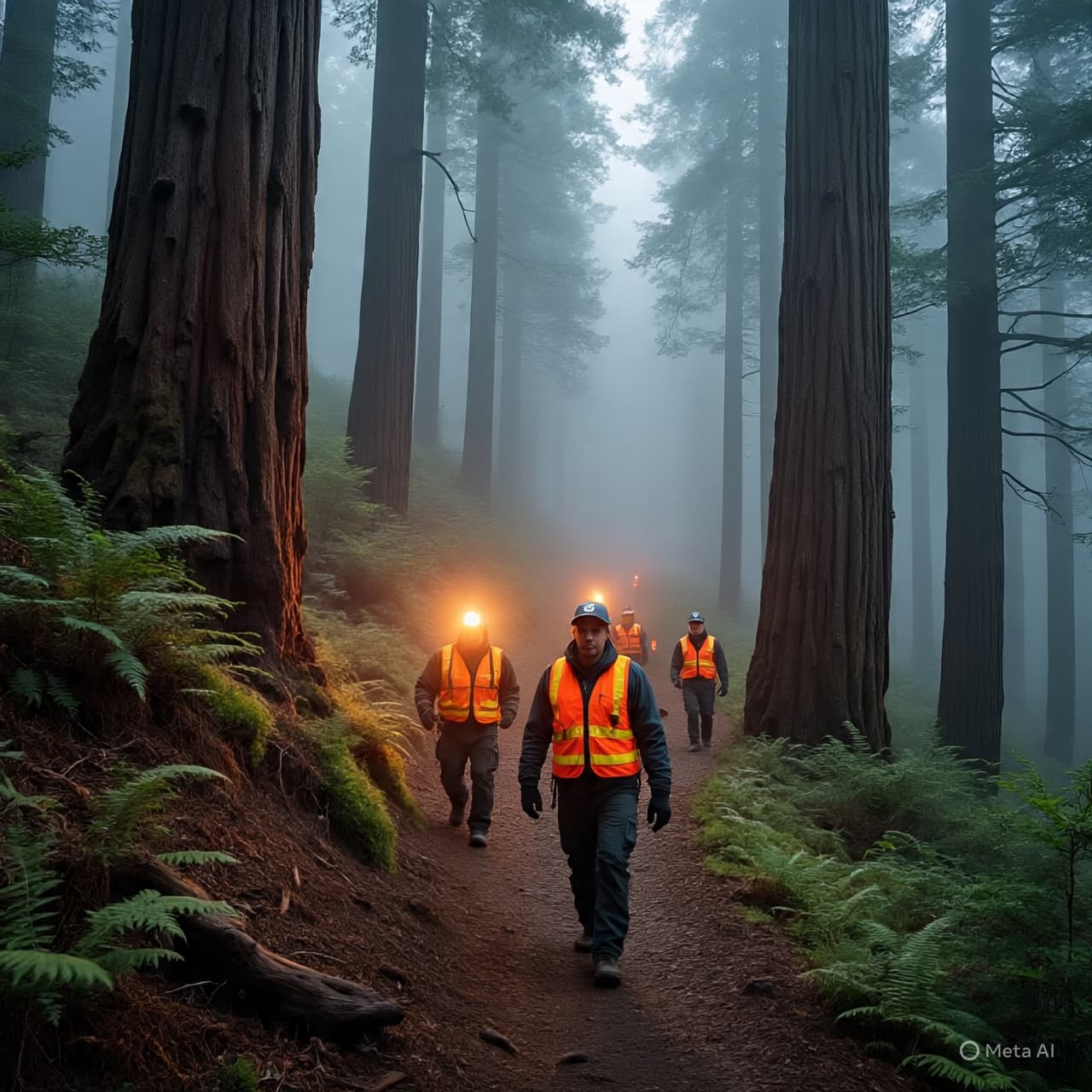
In the hush of the Northern California wilderness, where towering redwoods stretch like sentinels into misty skies, a single SOS signal cut through the darkness. It was the quiet plea of a 19-year-old hiker, isolated and shivering, calling for help amid storm-driven winds and relentless cold. For seven hours, rescue teams traced that digital lifeline, weaving through tangled trails and shadowed forests, guided by both technology and determination. When they finally found him, the signs of hypothermia were evident—a stark reminder that nature, beautiful and serene by day, can be unforgiving at night.
The Redwood Creek Trail and Bald Hills area, often celebrated for its scenic beauty, had turned treacherous. Rain lashed the trails and fog blanketed the landscape, reducing visibility and chilling the body faster than a simple layer of clothing could protect. As the hiker’s SOS signal pulsed into emergency networks at 2:30 a.m., the Humboldt County Sheriff’s Office, along with search-and-rescue personnel, canine units, and drone teams, mobilized swiftly. In those hours, each decision, each step, relied on precision and care, guided by the principle that time, in such conditions, is critical.
Hypothermia, silent and insidious, can steal warmth and clarity before one realizes the danger. The young hiker’s foresight to activate his emergency device was crucial. It allowed rescuers to narrow their search and focus resources efficiently, turning what could have been a tragedy into a story of survival. Emergency responders praised the combination of preparedness, technology, and teamwork that brought him to safety.
Upon discovery, he was immediately wrapped in thermal blankets and transported to a local hospital, where medical staff addressed his hypothermic state. Though weakened, his condition stabilized thanks to rapid intervention. The ordeal also serves as a reminder to hikers: preparation, knowledge of the terrain, and having reliable communication tools can make the difference between peril and safe return.
Beyond the physical rescue, this event highlighted human resilience and coordination. Teams navigated dense forest and icy streams, the technology hummed in rhythm with hope, and the young hiker’s calm presence under duress allowed him to endure until help arrived. It was a quiet victory against the elements—a testament to what planning, courage, and community can achieve, even when nature feels vast and indifferent.
As the forest returns to its usual calm and the fog lifts, the story lingers: a reminder that wilderness is both inspiring and exacting, that vigilance saves lives, and that even a small digital signal can shine like a beacon across hours of darkness.
AI Image Disclaimer Illustrations were produced with AI and serve as conceptual depictions, not real photographs.
Sources PEOPLE TVP World
Published by Banx Network. This article is part of the Banx decentralized media programme, powered by the BXE token on the XRP Ledger.