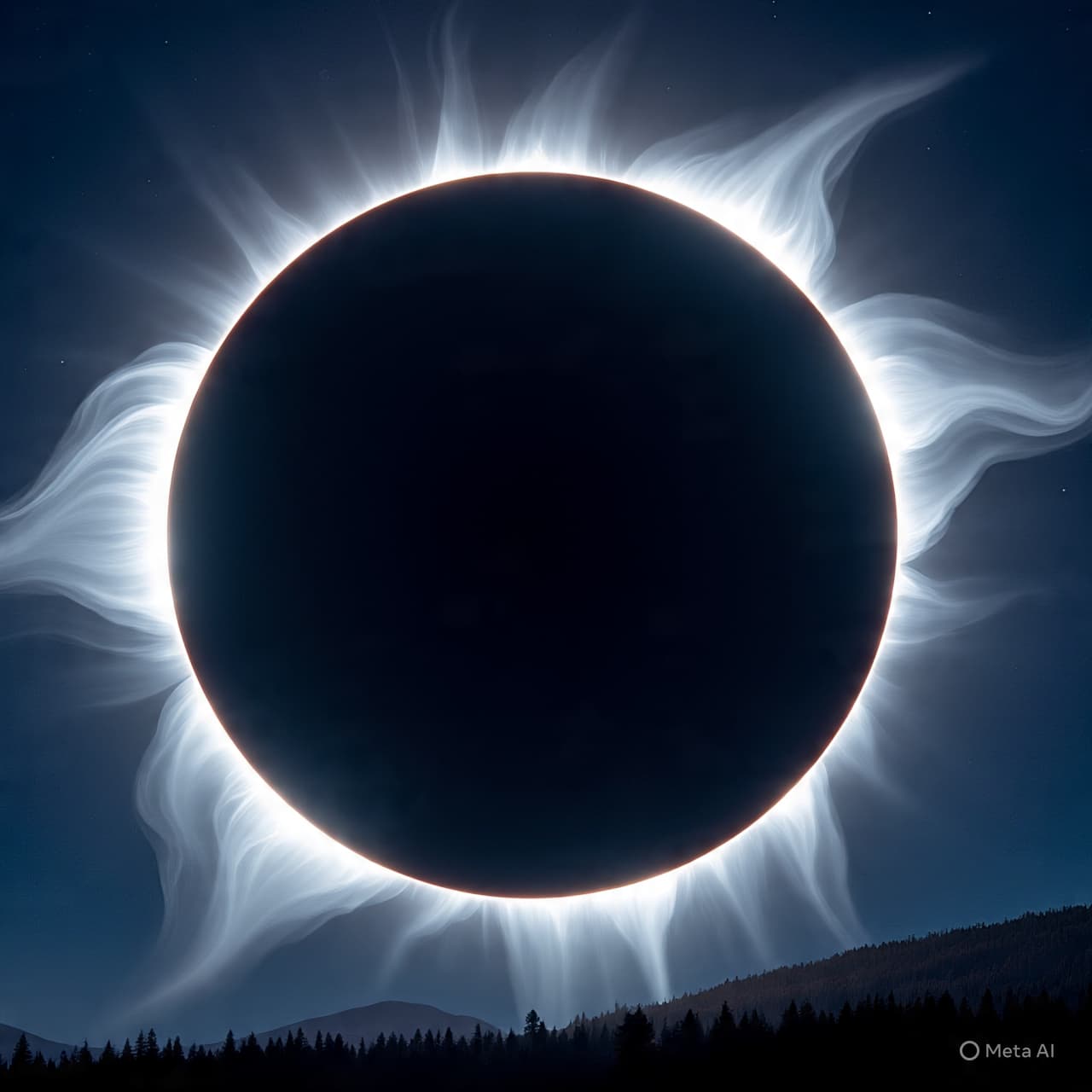
There are moments in nature that catch us in the quiet between breaths — where the ordinary rhythm of life pauses and a deeper sense of wonder unfolds. The total solar eclipse on April 8, 2024, was one such moment for millions of people across North America. As the Moon slipped between Earth and Sun, daylight softened and the Sun’s ethereal corona appeared like a delicate halo, stirring awe and curiosity in equal measure. What happened next was not just shared memory, but shared science.
Long after the path of totality faded into evening skies, the echoes of that moment continued in the form of data. Volunteers from across the United States participated in a remarkable coordinated effort led by NASA’s Eclipse Megamovie citizen science project, deploying cameras and observatories to capture images of the Sun’s corona during totality. In doing so, they transformed a fleeting natural spectacle into a vivid scientific resource — one that is now reshaping our understanding of the Sun’s dynamic outer atmosphere.
The project’s newly released dataset represents the cumulative contributions of 143 volunteer‑led “observatories,” mobile teams and individual skywatchers equipped to take precise photographs and calibration frames at key moments during the eclipse. Over 52,000 total images were uploaded, spanning more than an hour and a half of observations. These photographs, organized into a searchable database, allow researchers around the world to track how features of the solar corona — including jets and plumes — evolve over time.
Unlike traditional astronomical observations made from fixed facilities, this distributed network of observers captured the event from many locations along the eclipse’s path. Volunteers were not just witnesses but active participants, capturing calibrated white‑light images that go well beyond casual snapshots. A subset of 28 observatories recorded enough clear data with varied exposures to produce fully calibrated high‑level images that are especially valuable for scientific analysis.
What makes this effort especially significant is how it bridges scientific inquiry and public engagement. Citizen scientists — from amateur astronomers to educators and students — journeyed into the path of totality with cameras and curiosity, contributing to an archive that professional researchers can now use to explore solar phenomena that are otherwise difficult to observe. The corona, the Sun’s outermost atmosphere, is normally obscured by the brightness of the solar disk; only during total eclipses can its fine structures be seen in detail with white‑light imaging.
Researchers hope to use the dataset to study patterns such as how solar jets — narrow streams of plasma — originate and change over time, and how plumes in the corona develop. These coronal features are key to understanding the Sun’s magnetic environment and its influence on space weather, which can affect satellites, communications and power systems on Earth. Having time‑sequence images from multiple observers enhances scientists’ ability to analyze these dynamic processes.
The open, accessible nature of the database holds promise beyond immediate research. Educators, students, and amateur astronomers can explore the data by observatory name or location and download images for their own investigations. This kind of resource democratizes scientific observation, inviting anyone with interest and patience to engage with the cosmos in a meaningful way.
In moments of natural wonder, it is easy to feel like a silent observer. But the work of hundreds of volunteers shows how shared curiosity can translate into shared discovery — transforming a singular event in the sky into a rich archive that will support scientific inquiry for years to come.
NASA’s Eclipse Megamovie project has now made public a comprehensive dataset from the April 8, 2024 total solar eclipse, with contributions from 143 unique observatories and over 52,000 photographs. The archive includes calibrated and raw images of the solar corona, enabling researchers worldwide to study solar features and phenomena captured during totality.
AI Image Disclaimer Visuals are created with AI tools and are not real photographs.
Sources NASA Science Editorial Team — “New Volunteer Data from 143 Observatories Unveils the 2024 Total Solar Eclipse.”
Published by Banx Network. This article is part of the Banx decentralized media programme, powered by the BXE token on the XRP Ledger.