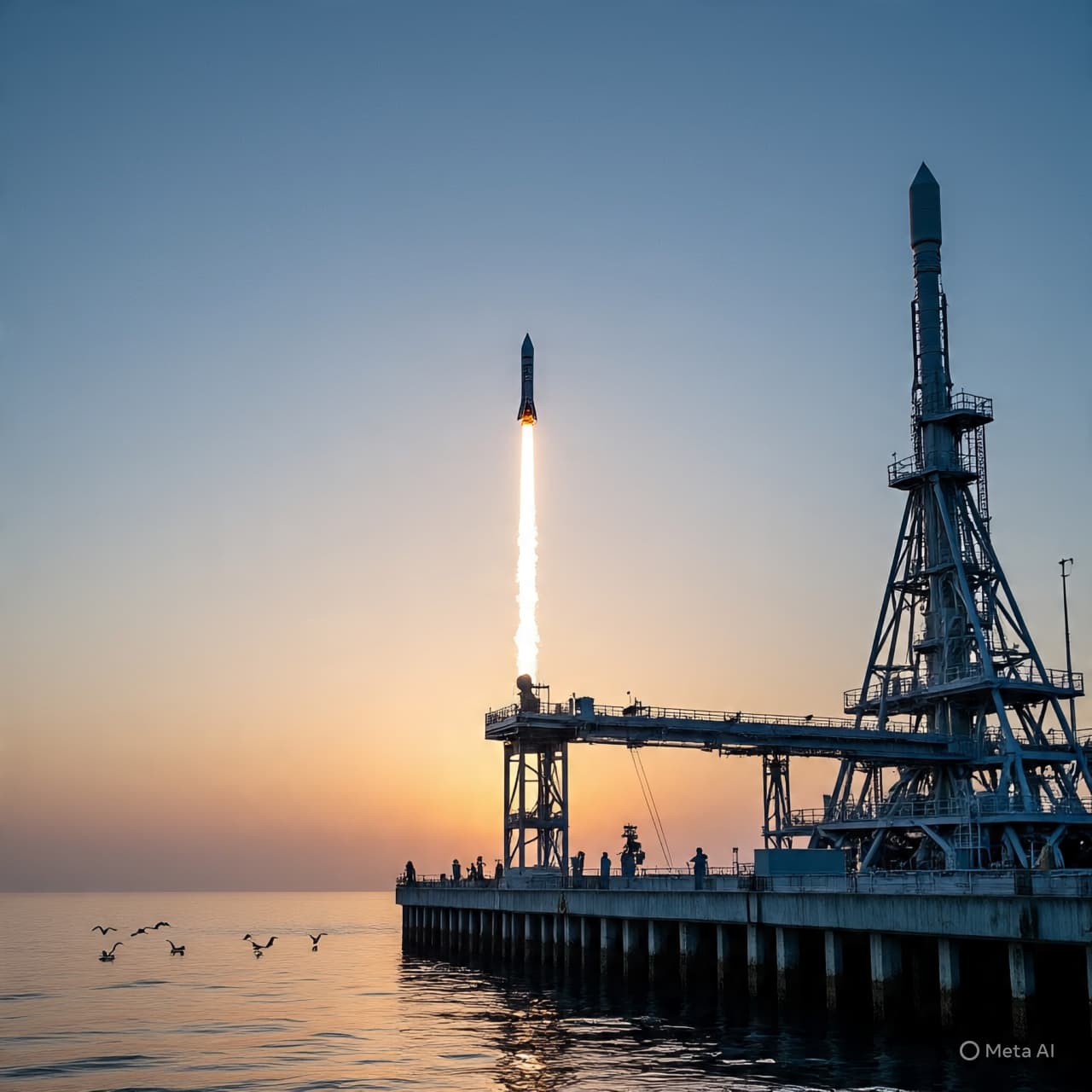
The year opened not with ceremony, but with motion—steel rising from water, flame briefly touching sky, and then quiet returning to the sea. Off China’s coast, a rocket lifted from a floating platform, its trajectory drawing a clean line between ocean and orbit, between the familiar and the expanding architecture above it.
The launch marked China’s first orbital mission of 2026. A Ceres-1 Y7 rocket, operating from a sea-based launch site, successfully placed four satellites into orbit. The payload consisted of Tianqi satellites, part of a growing telecommunications constellation designed to extend data connectivity and signal coverage. The sequence was efficient and contained, the kind of precision that leaves little behind except telemetry and wake.
Sea-based launches occupy a particular space in modern spaceflight. They allow flexibility in latitude, reduce overland risk, and quietly reshape how and where launches occur. For China, the method reflects a broader pattern: diversification of launch capabilities alongside steady expansion of satellite networks. The ocean becomes not an obstacle, but an extension of infrastructure.
The Tianqi constellation has been developed to support narrowband communications, often associated with industrial data transmission, remote monitoring, and machine-to-machine connectivity. Each additional satellite adds redundancy and reach, filling gaps that geography alone cannot solve. From orbit, the planet appears continuous; from the ground, coverage is built one launch at a time.
Ceres-1 itself represents another strand of this evolution. As a commercially oriented launch vehicle, it reflects the growing role of private-sector participation within China’s space ecosystem. Compact, responsive, and increasingly routine, such rockets blur the line between state ambition and market cadence, where launches become scheduled operations rather than singular events.
The significance of the mission lies less in spectacle than in accumulation. Four satellites are not transformative alone, but together they contribute to a lattice steadily forming above the Earth. Communications constellations grow quietly, their presence felt not through visibility but through reliability—signals arriving where they previously faded.
As the rocket’s exhaust dispersed over open water, the moment passed quickly. Yet its implications remain suspended overhead, part of a year beginning with intent rather than announcement. In that opening act, China’s space program did not pause to look back. It simply added another layer to the sky.
-
### AI Image Disclaimer
Visuals are AI-generated and serve as conceptual representations.
---
### Sources
China Aerospace Science and Industry Corporation Chinese commercial launch providers Space industry analysts
Published by Banx Network. This article is part of the Banx decentralized media programme, powered by the BXE token on the XRP Ledger.
.jpg&w=3840&q=75 "Man Tapes Ears to His Head in Bizarre Attempt to Enter Poland With False Passport")