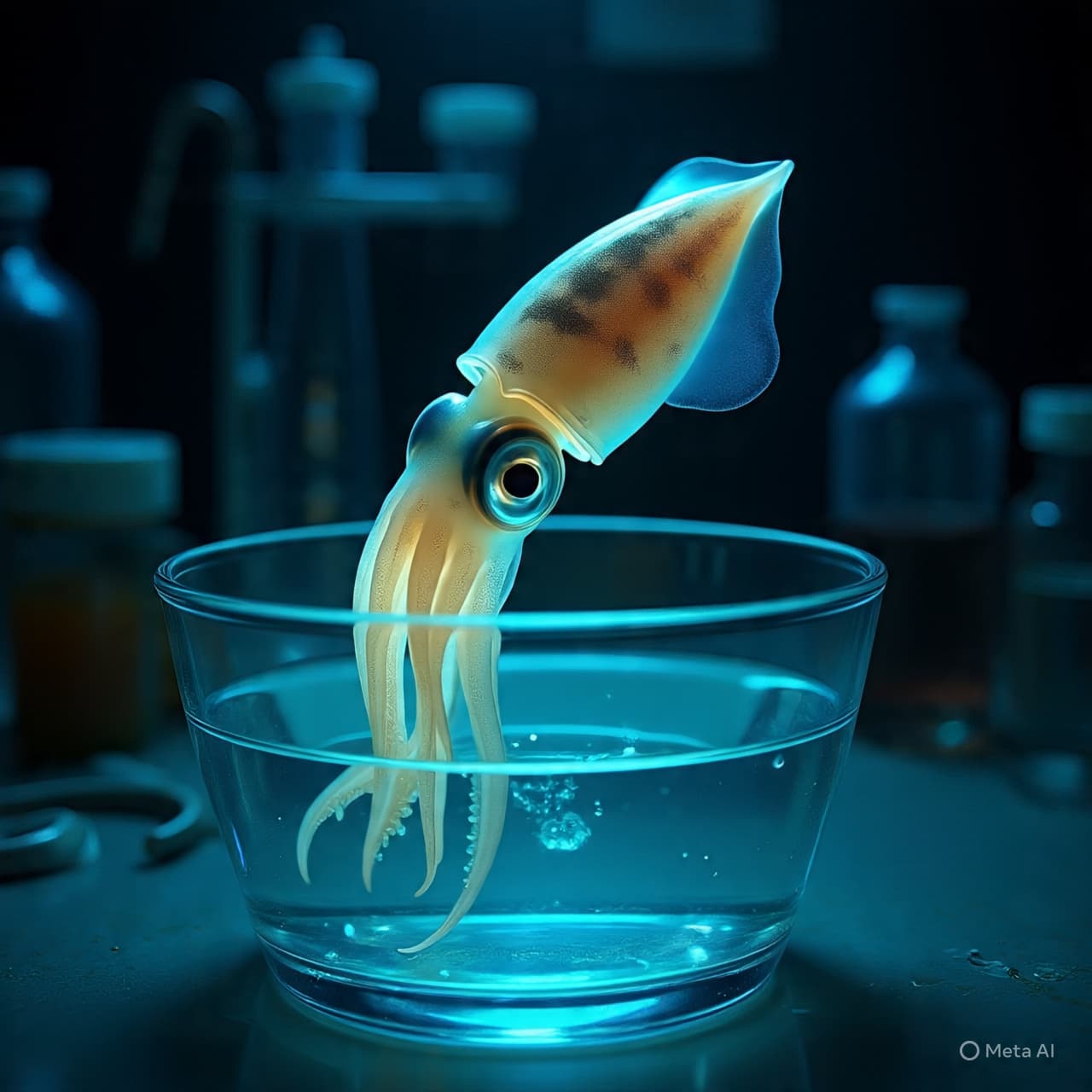
In the soft half-light of a shallow reef at dusk, the sea seems to hold its breath as day yields to night. Beneath the surface, in the shifting currents of Hawai‘i’s coastal waters, a tiny cephalopod prepares for its first encounter with the world. Newly hatched, the bobtail squid drifts in the plankton, its translucent body a whisper of motion against the blue. It has not yet learned to hide, to hunt, or to move with the quiet assurance of its elders. What it does possess, however, is a remarkable invitation—a chemical beacon that calls to an invisible partner in the vast sea.
This partner is not another squid, nor a passing fish, but a bioluminescent bacterium known as Aliivibrio fischeri. These microscopic organisms, carried in the seawater, respond to the young squid’s call and make their way into a specialized organ within the squid’s mantle. There, in this delicate chamber, they will settle, multiply, and begin to emit light. It is a glow that seems to belong to the squid, but it is a shared gift, born of cooperation between two very different forms of life.
The light serves a purpose beyond wonder. As the squid ventures into the darkness of night, the gentle luminescence from its internal partners helps erase its shadow against the moonlit surface. This camouflage, known as counter-illumination, reduces the risk of predation, allowing the squid to forage in relative safety. But the role of the bacteria extends deeper than survival tactics; their presence is woven into the very development of the squid’s light organ. Without them, the organ remains undeveloped, its tissues unfinished, like an unplayed instrument awaiting sound.
Scientists have long studied this remarkable partnership not only for what it reveals about these two species, but for what it teaches us about the broader tapestry of life. In this simple, binary relationship—one host and one microbial partner—researchers can observe how organisms shape one another’s biology, how chemical signals and cellular structures align across domains of life. The squid does not inherit its light-producing guests from its parents; each generation must recruit them anew from the sea. This ritual of acquisition and integration is both fragile and profound, a reminder that life’s stories are often written in collaboration rather than isolation.
There is a quiet rhythm to the daily cycle that follows. Each morning, as the sun rises, the squid expels much of its bacterial population back into the water, a ritual that resets the partnership and disperses the luminous microbes into the environment. By nightfall, the remaining symbionts have repopulated their niche, ready once again to illuminate the squid’s nocturnal wanderings.
In the interplay of light and dark, of host and microbe, we find a reflection of life’s interdependence—a subtle choreography that unfolds beyond human sight yet shapes the very form and function of an animal’s being.
Researchers report that the bioluminescent bacterial partner Aliivibrio fischeri is essential for the development of the light organ in the Hawaiian bobtail squid and plays a key role in its camouflage and survival.
Visuals are AI-generated and serve as conceptual representations.
Sources Phys.org Nature Reviews Microbiology Wikipedia (Developmental Symbiosis)
Published by Banx Network. This article is part of the Banx decentralized media programme, powered by the BXE token on the XRP Ledger.