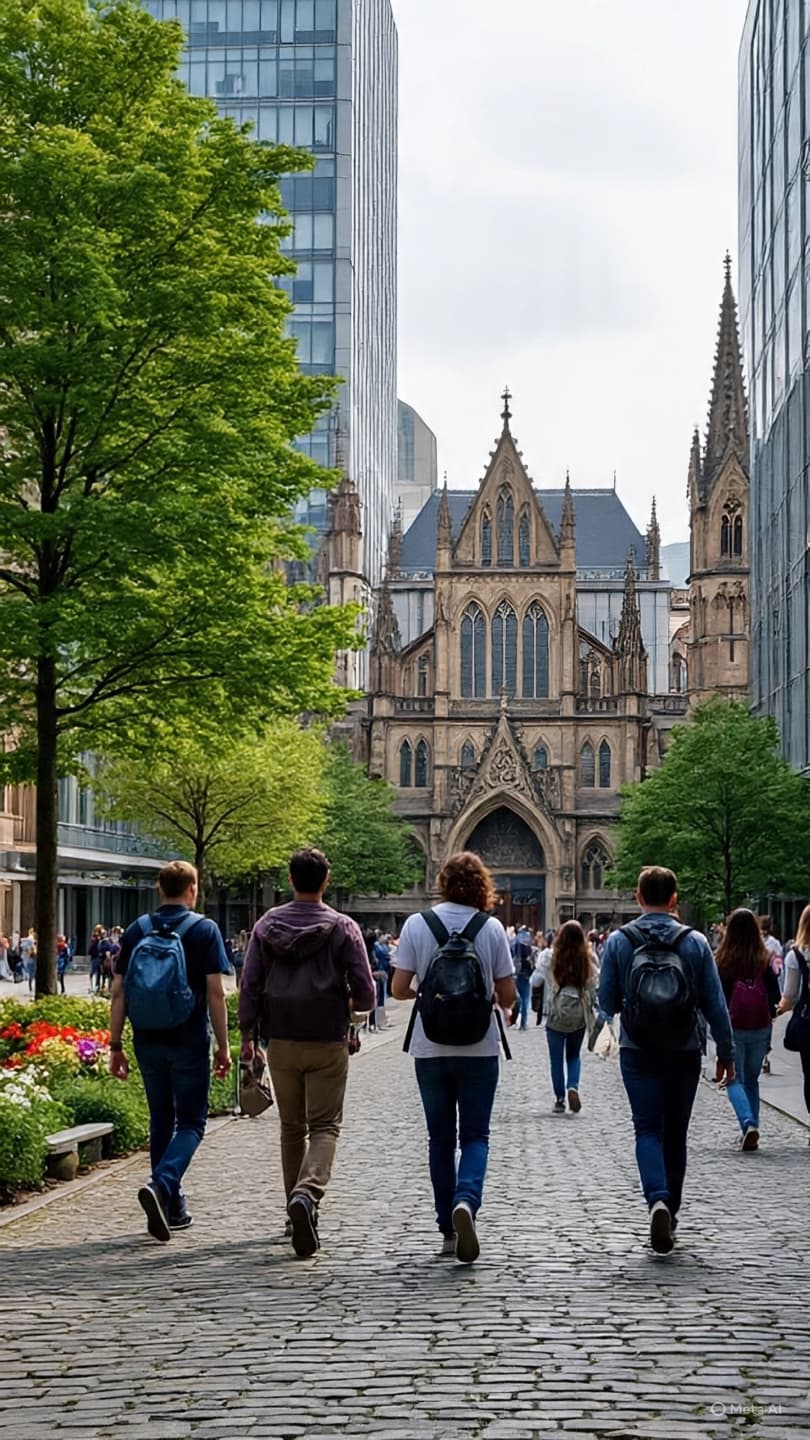
In the early light of a European morning, when lecture halls are still quiet and libraries hold the hush of unwritten ideas, there is a sense that learning itself is a kind of migration—of thought, of ambition, of possibility. Across borders, students imagine futures not yet formed, tracing distant paths that begin with a single opportunity to step beyond the familiar.
Recently, Germany has once again opened such pathways, announcing a range of fully funded scholarships designed to welcome international students into its universities. The offer is both practical and symbolic: financial support that includes monthly stipends—reported in some contexts as reaching the equivalent of around KSh 75,000—alongside coverage for tuition, travel, and living expenses. It is a structure that aims to remove barriers, allowing education to be approached not as a privilege, but as a shared horizon.
At the center of many of these programs is DAAD, an institution long associated with academic exchange and global collaboration. Through its initiatives, students from across continents are invited into Germany’s academic landscape, where disciplines range from engineering and environmental sciences to the humanities and public policy. The scholarships often prioritize postgraduate study, though opportunities extend across different levels and fields.
For many applicants, the appeal lies not only in financial support, but in the broader experience it suggests. German universities are known for their research focus and relatively low or nonexistent tuition fees, even for international students. Cities like Berlin, Munich, and Heidelberg offer environments where history and innovation coexist—where centuries-old architecture frames conversations about emerging technologies and global challenges.
Yet behind the announcement lies a quieter narrative about movement and exchange. Each scholarship represents a story not yet written: a student leaving home, carrying language, memory, and expectation into a new context. There is anticipation, but also uncertainty—the adjustment to unfamiliar systems, climates, and rhythms of life. These transitions, though personal, form part of a larger pattern in which education becomes a bridge between worlds.
The financial dimension remains central. By providing monthly allowances, often calibrated to meet living costs, the scholarships aim to ensure that students can focus on study rather than survival. Housing, health insurance, and travel stipends are frequently included, reflecting an understanding that access to education extends beyond tuition alone.
Applications, as always, bring their own cadence. Deadlines approach with quiet urgency, documents are gathered and translated, and statements of purpose attempt to capture years of aspiration in a few measured pages. Selection processes remain competitive, shaped by academic merit, professional experience, and the alignment of candidates’ goals with program priorities.
As the announcement circulates, it reaches students in classrooms, in internet cafés, in shared apartments where futures are discussed late into the night. For some, it will remain a distant possibility; for others, it may become a turning point.
In clear terms, Germany’s fully funded scholarship programs—particularly those administered by DAAD—offer international students financial support that can include monthly stipends equivalent to up to KSh 75,000, alongside comprehensive coverage of study-related costs. Applications are open across multiple disciplines, with varying deadlines and eligibility criteria.
Beyond the figures and forms, however, the initiative rests on something less tangible: the quiet belief that knowledge, when shared across borders, can reshape both individual lives and the spaces they eventually return to.
AI Image Disclaimer Visuals are AI-generated and serve as conceptual representations.
Sources : DAAD Deutsche Welle BBC News Reuters Study in Germany Official Portal
Published by Banx Network. This article is part of the Banx decentralized media programme, powered by the BXE token on the XRP Ledger.
.jpg&w=3840&q=75 "Blake Lively Awarded $400,000 in Legal Fees After Justin Baldoni Lawsuit Dismissed")