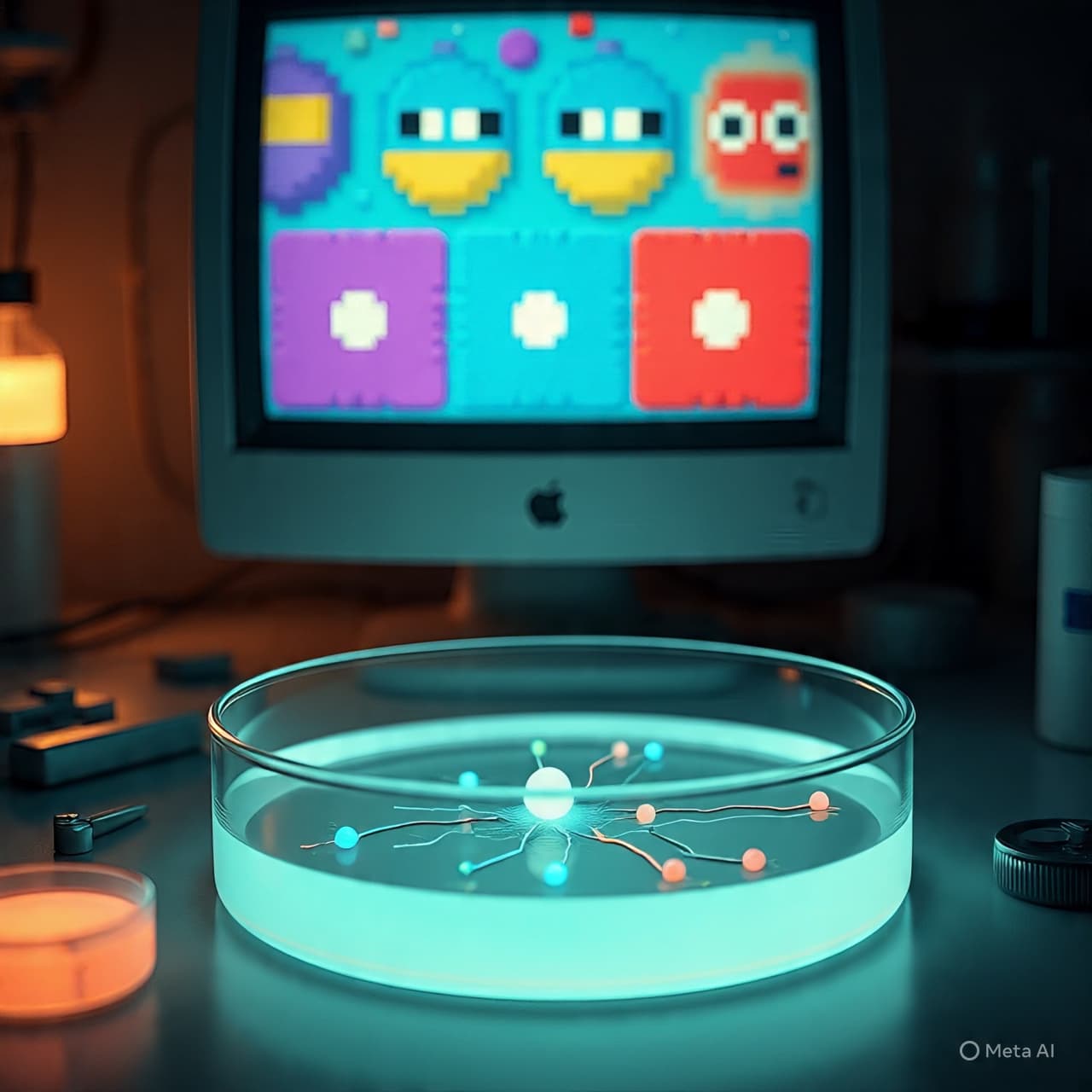
In laboratories where glassware and computer screens share the same quiet space, a new kind of experiment is unfolding—one that blurs the boundary between biology and computing. Instead of silicon chips and circuits alone, researchers are now working with living cells, exploring whether fragments of human brain tissue can perform tasks that resemble computation.
Recently, scientists reported a striking demonstration: a computer system built partly from human brain cells has been trained to play the classic video game Doom.
The achievement is not about gaming itself. Rather, it offers a glimpse into a developing field sometimes described as biological computing, where networks of living neurons interact with digital systems. In these experiments, scientists grow small clusters of human brain cells—often called brain organoids—in laboratory conditions. These organoids form simple neural networks capable of transmitting electrical signals, similar in basic principle to the activity that occurs inside the brain.
To connect these biological networks with machines, researchers place the cells on arrays of electrodes that can both measure and stimulate neural activity. Electrical signals generated by the cells are translated into digital inputs, while feedback from the computer can influence how the neurons respond. Over time, this loop allows the biological network to adapt its behavior based on the results it produces.
In the case of Doom, the system did not “see” the game the way a human player would. Instead, the game environment was simplified into signals that represented basic information about movement or obstacles. The neurons responded with electrical patterns that the computer interpreted as commands—actions like moving or turning within the game.
Through repeated interaction, the system gradually improved its responses.
Scientists often compare the process to a very primitive form of learning. Neural networks, whether biological or artificial, can adjust their activity when exposed to feedback. If a particular signal leads to a better outcome in the game environment, the network tends to reinforce the pathways that produced it.
The experiment therefore illustrates something broader than gameplay: the possibility that living neural tissue can interact with digital environments in ways that resemble adaptive computation.
Researchers emphasize that these biological systems remain extremely simple compared with a human brain. Organoids used in laboratories contain far fewer neurons and lack the complex structures that support consciousness or perception. Their activity represents basic signal processing rather than thought or awareness.
Even so, the field is attracting growing interest.
Biological computing could offer advantages in areas where traditional electronics face limitations. Neural tissue is naturally efficient at recognizing patterns, adapting to new inputs, and processing information in parallel. Some scientists believe that hybrid systems combining biological and digital components could eventually open new directions for artificial intelligence research.
At the same time, the work raises ethical and philosophical questions. As scientists explore increasingly sophisticated interactions between living cells and machines, discussions about oversight, responsibility, and scientific boundaries become more important.
For now, the image of brain cells playing a decades-old video game remains a symbolic milestone.
Doom, first released in the early 1990s, has long served as a benchmark for computing experiments—from early graphics cards to unconventional platforms such as calculators and household devices. The game’s simple mechanics and real-time action make it a useful test for new technologies.
Now it has found its way into another unexpected environment: a laboratory dish containing living neurons.
The experiment suggests that the frontier of computing may not lie solely in faster chips or more powerful algorithms. It may also emerge from the complex biological systems that inspired computing in the first place.
Somewhere between silicon and biology, a new kind of machine is beginning to learn.
Published by Banx Network. This article is part of the Banx decentralized media programme, powered by the BXE token on the XRP Ledger.