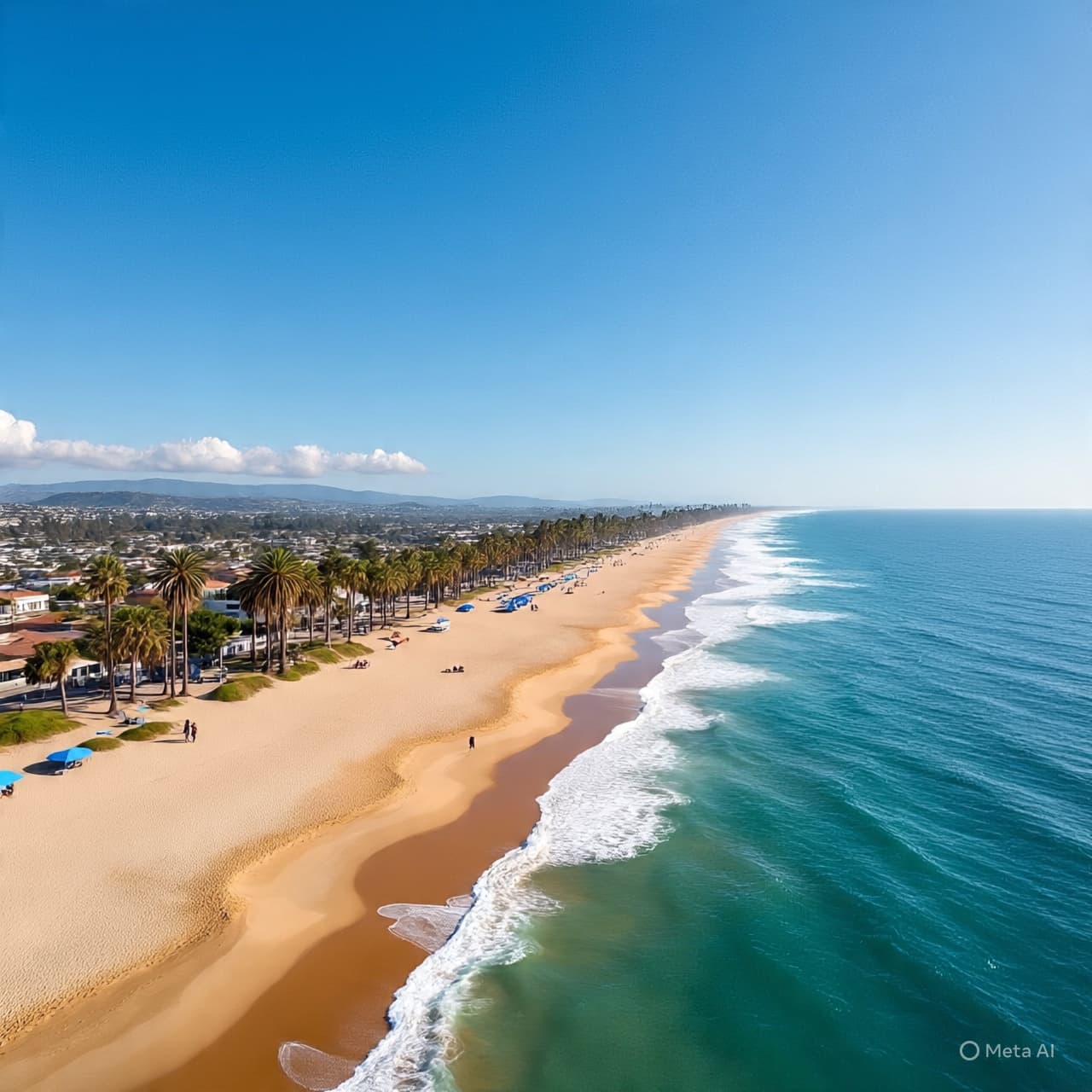
Along the edge of surf and sky in Ventura County, where the Santa Clara River drifts toward the Pacific and the wind carries the salt of long distances, the shoreline has been quietly rewriting itself. For decades, the common refrain along California’s coast has been one of erosion — cliffs softening, tides pressing inward, beaches narrowing year by year. Yet in this particular stretch of Southern California, the story has taken on a different rhythm.
A recent scientific study examining decades of satellite imagery has found that parts of Ventura County’s coastline are among the fastest growing beaches in Southern California. The research, conducted by coastal scientists analyzing shoreline data dating back to the mid-1980s, reveals that several beaches near Ventura and Oxnard have widened significantly over the past 40 years.
The findings run counter to the broader narrative of steady coastal loss. While many areas along California’s coast have indeed experienced erosion, nearly half of Southern California’s beaches in the study showed measurable widening. Ventura County’s stretch stood out for sustained expansion, with some beaches gaining substantial horizontal width as sediment accumulated along the shore.
The explanation lies not in a single cause but in a layered interplay of natural and human influences. The Santa Clara River, one of the region’s last largely unchannelized rivers, continues to deliver sediment during heavy rains. Longshore currents redistribute that sand along the coast. At the same time, harbor structures and jetties — particularly around Channel Islands Harbor and Ventura Harbor — interrupt and redirect sediment flow, trapping sand in certain areas and encouraging beach growth down-drift.
From above, the effect is subtle but undeniable. Where waves once met a narrower strip of sand, there is now a broader expanse — a gradual outward shift that has unfolded over decades rather than seasons. Walkers on the beach might not sense the incremental advance year to year, but satellite records capture the shoreline’s slow outward breathing.
The study’s authors note that this widening does not erase the reality of erosion elsewhere. In Malibu and other parts of Los Angeles County, beaches have continued to narrow. The Southern California coast remains a mosaic of gains and losses, shaped by storms, sediment supply, infrastructure, and rising sea levels.
For Ventura County, however, the research suggests a net increase in beach area since the 1980s. Scientists estimate that across Southern California, the coastline has collectively gained hundreds of acres of beach over four decades, much of it concentrated in areas influenced by sediment convergence and engineered coastal features.
The broader implication is not that the coast is immune to change, but that change is complex. Beaches are not static margins; they are living boundaries between land and sea. Sand moves in patterns guided by wind, river, and tide — sometimes retreating, sometimes advancing — always in motion.
In practical terms, the study concludes that portions of Ventura County contain some of the fastest-widening beaches in Southern California based on long-term satellite measurements. Researchers emphasize that ongoing monitoring will be critical to understanding how these patterns evolve in the decades ahead.
AI Image Disclaimer Illustrations were created using AI tools and are not real photographs.
Sources (Media Names Only) University of California News U.S. Geological Survey Nature Communications Los Angeles Times Ventura County Star
Published by Banx Network. This article is part of the Banx decentralized media programme, powered by the BXE token on the XRP Ledger.