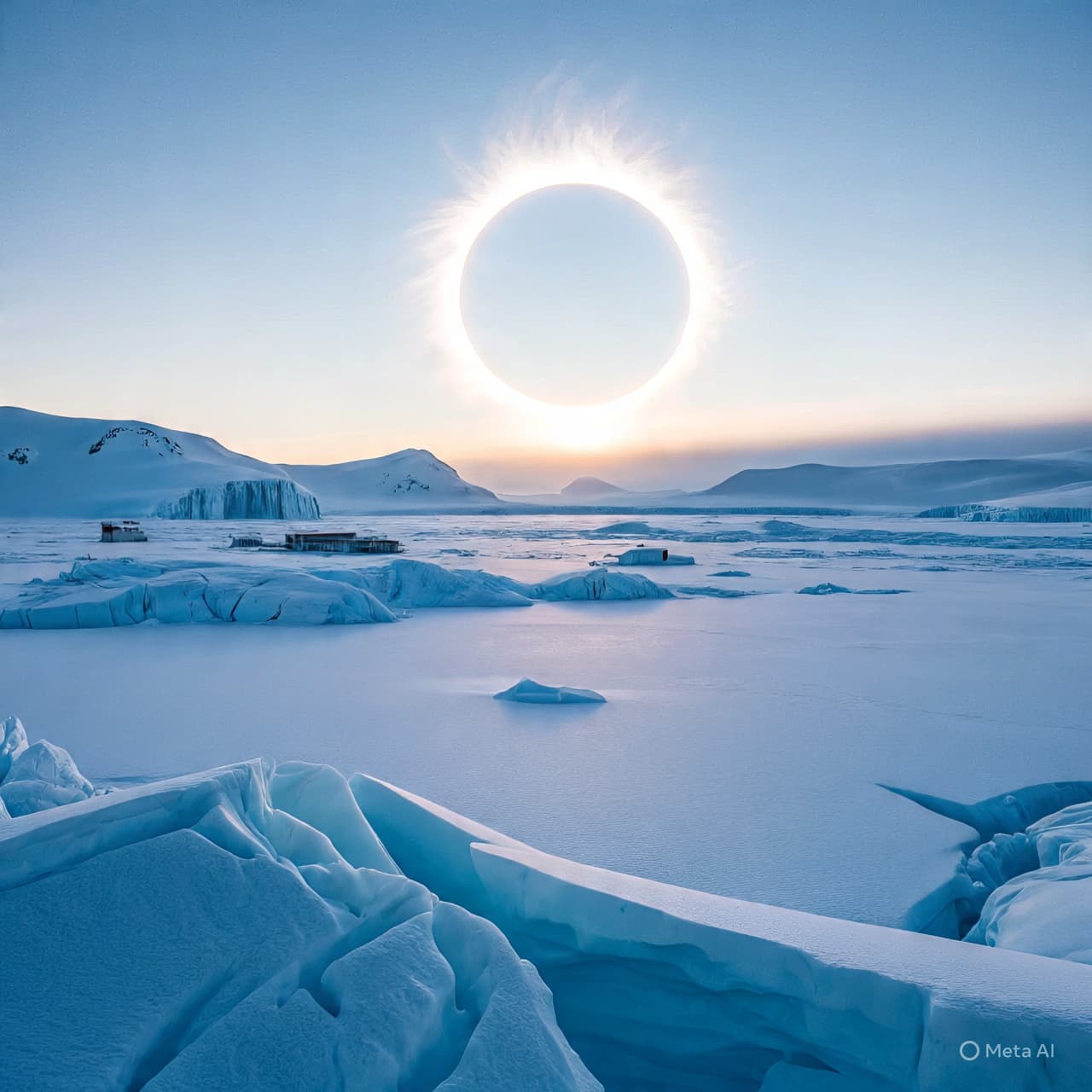
There are moments when the sky seems to pause, when its endless motion briefly becomes visible to the human eye. Not in thunder or storm, not in violence or spectacle, but in a quiet rearrangement of light. On this day, the sun rose as it always does, yet did not remain as it usually appears. It became something edged, something shaped—its brilliance no longer whole, but curved into a luminous circle, as if the sky itself had drawn a fine line of fire around its face.
Far to the south, where ice stretches beyond horizon and wind sculpts the silence, the moon drifted into alignment with the sun. But it did not arrive close enough to fully cover it. Instead, it settled slightly apart, leaving a glowing rim of light visible around its dark edge. The result was an annular eclipse—what many have come to call a “ring of fire”—a phenomenon less about darkness than about outline, less about absence than about form.
In Antarctica, where only a few research stations stand against vast fields of white and stone, the effect was most complete. The sun appeared as a perfect circle of fire, suspended above frozen الأرض and open sea. For a brief window of time, geometry and gravity aligned so precisely that light itself seemed to take on shape. There were no crowds, no city silhouettes, no traffic noise—only instruments, scientists, and the slow movement of shadow across ice.
Elsewhere in the southern hemisphere, the experience was softer. The sky dimmed without fully darkening. The sun thinned but did not disappear. Across parts of southern Africa and South America, daylight shifted into a gentler hue, as if the afternoon had exhaled. The change was subtle, more atmospheric than dramatic—a quiet interruption rather than a rupture.
Annular eclipses carry a different emotional register than total eclipses. The world does not fall into night. Birds do not retreat. Cities do not dim. Instead, light remains, but altered—ringed, framed, reshaped. It is not disappearance, but transformation. The sky continues to glow, yet no longer in its usual way.
For those far from the eclipse path, the experience arrived through screens and streams, through images of glowing circles and distant ice fields. The sky, though distant, felt shared. The event belonged not to one place, but to the planet’s quiet mechanics—the slow, precise choreography of orbit and distance that unfolds far above daily life.
Astronomers have long described these moments as predictable, calculable, inevitable. And yet, when they arrive, they still feel intimate. The sun and moon, objects of myth and measurement alike, briefly rearrange themselves into something unfamiliar. The ordinary becomes briefly ceremonial. The sky becomes a shape instead of a space.
As the moon continued its path and the circle of fire thinned back into full daylight, the world returned to its usual geometry. Ice remained ice. Streets remained streets. Time resumed its familiar pace. But for a moment, the sky had offered a different order—a reminder that above the routines of human life, a quieter, older motion continues, indifferent to borders and calendars, shaping light itself.
The annular solar eclipse was most fully visible from Antarctica, with partial phases observed across parts of the southern hemisphere, marking the first solar eclipse event of 2026.
AI Image Disclaimer
Visuals are AI-generated and serve as conceptual representations.
Sources (Media Names Only)
Space.com Sky at Night Magazine The Economic Times Newsweek Associated Press
Published by Banx Network. This article is part of the Banx decentralized media programme, powered by the BXE token on the XRP Ledger.