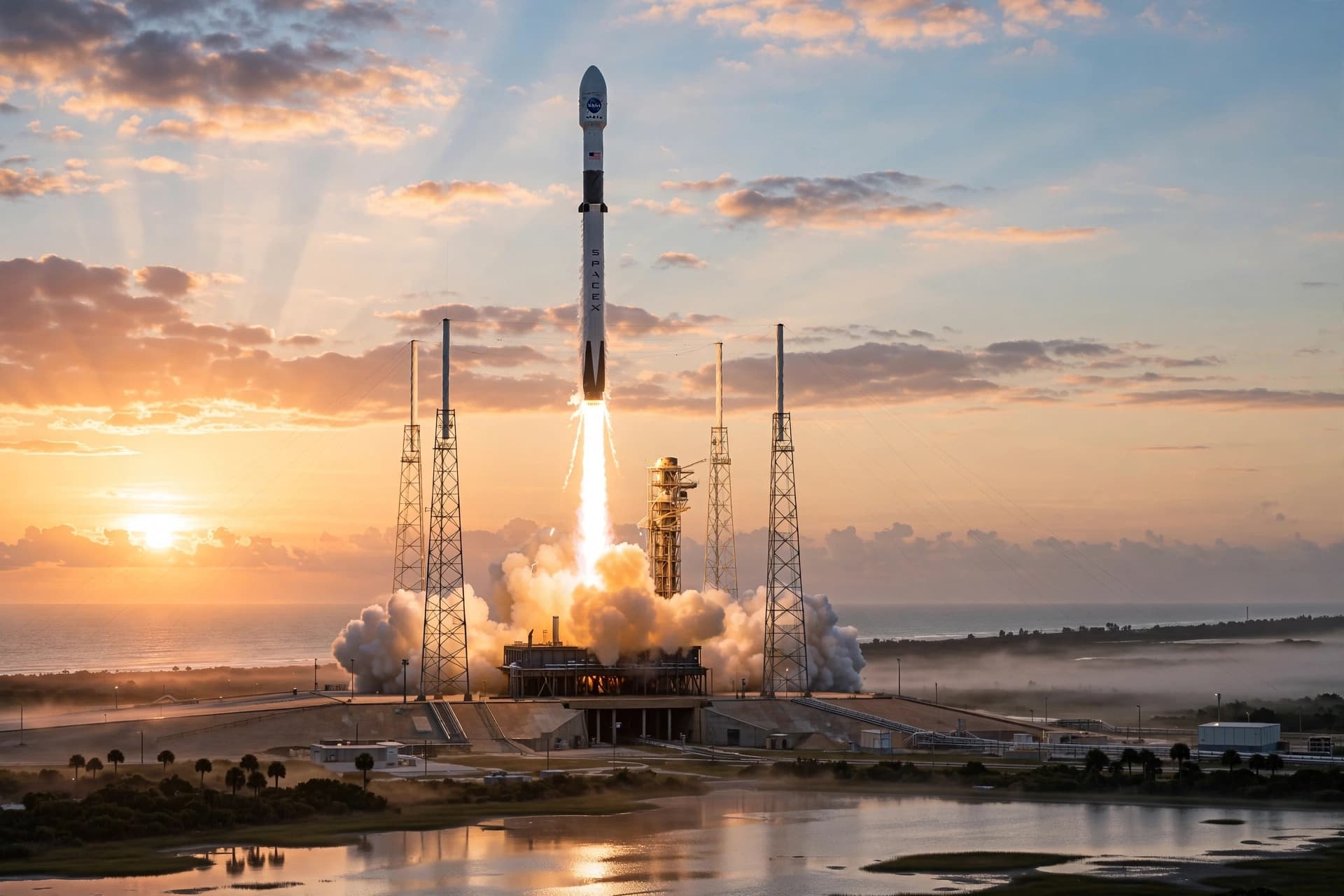
There is a particular kind of anticipation that fills a launch control room when the countdown reaches its final seconds. The engines ignite, the rocket lifts, and for a brief moment, the weight of the world seems to fall away. On Thursday morning, a Falcon 9 rocket rose from Space Launch Complex 40 at Cape Canaveral, carrying four astronauts toward the International Space Station. The journey ahead would be measured not in days, but in hours—a rapid transit that has become a quiet hallmark of a new era in human spaceflight.
The crew of NASA's SpaceX Crew-13 mission includes NASA astronauts Jessica Watkins and Luke Delaney, Canadian Space Agency astronaut Joshua Kutryk, and Roscosmos cosmonaut Sergey Teteryatnikov. Liftoff occurred at 11:10 a.m. EDT, and the Dragon spacecraft separated from the Falcon 9's second stage shortly afterward, its nosecone opening as it began its pursuit of the orbiting laboratory.
This mission will mark the fastest launch-to-docking for a U.S. spacecraft in the history of the International Space Station. The Dragon is scheduled to dock autonomously at approximately 7 p.m. EDT, less than eight hours after leaving the ground. Once docked, the crew will join the Expedition 75 team, bringing the total number of people aboard the station to eleven, representing NASA, the Canadian Space Agency, the European Space Agency, and Roscosmos.
The speed of this transit reflects years of refinement in orbital mechanics and spacecraft navigation. Rather than spending days phasing toward the station, the Dragon was launched into a trajectory that allows it to catch up quickly, a precision that reduces the time crew members spend confined in the spacecraft and allows science operations to begin sooner.
Once aboard, Watkins, Delaney, Kutryk, and Teteryatnikov will begin a long-duration science mission. They will conduct experiments and technology demonstrations intended to support future missions to the Moon and Mars, while also contributing to research that benefits life on Earth. The work is incremental and often unglamorous—maintenance, data collection, the slow accumulation of knowledge—but it is the foundation on which exploration is built.
For Watkins, the mission marks a return to orbit. She previously spent 170 days aboard the station during her first mission, becoming the first Black woman to complete a long-duration stay. Her role as commander of Crew-13 places her at the center of a mission that is both routine and remarkable, a reminder that spaceflight has become a regular part of human activity while remaining extraordinary in its demands.
The Dragon spacecraft itself is a reusable vehicle, designed to carry up to seven people and equipped with automated navigation and docking systems. Astronauts can take manual control if necessary, but the nominal approach relies on the spacecraft's own capabilities, monitored by ground teams and the crew alike. After the mission concludes, the capsule will return to Earth under parachutes, splashing down in the ocean.
As the Dragon closes the distance to the station, the crew prepares for the final approach—pressure checks, systems verification, the careful choreography that precedes the opening of the hatch. When the hatch swings open, they will float into a module they have seen in training and simulations, but which remains, for every crew, a place of firsts. The work of Expedition 75 continues, and four more people have arrived to join it.
AI Image Disclaimer: The images in this article were created using artificial intelligence and are for illustrative purposes only.
Sources: NASA, Space.com, UPI, Anadolu Ajansı
Published by Banx Network. This article is part of the Banx decentralized media programme, powered by the BXE token on the XRP Ledger.