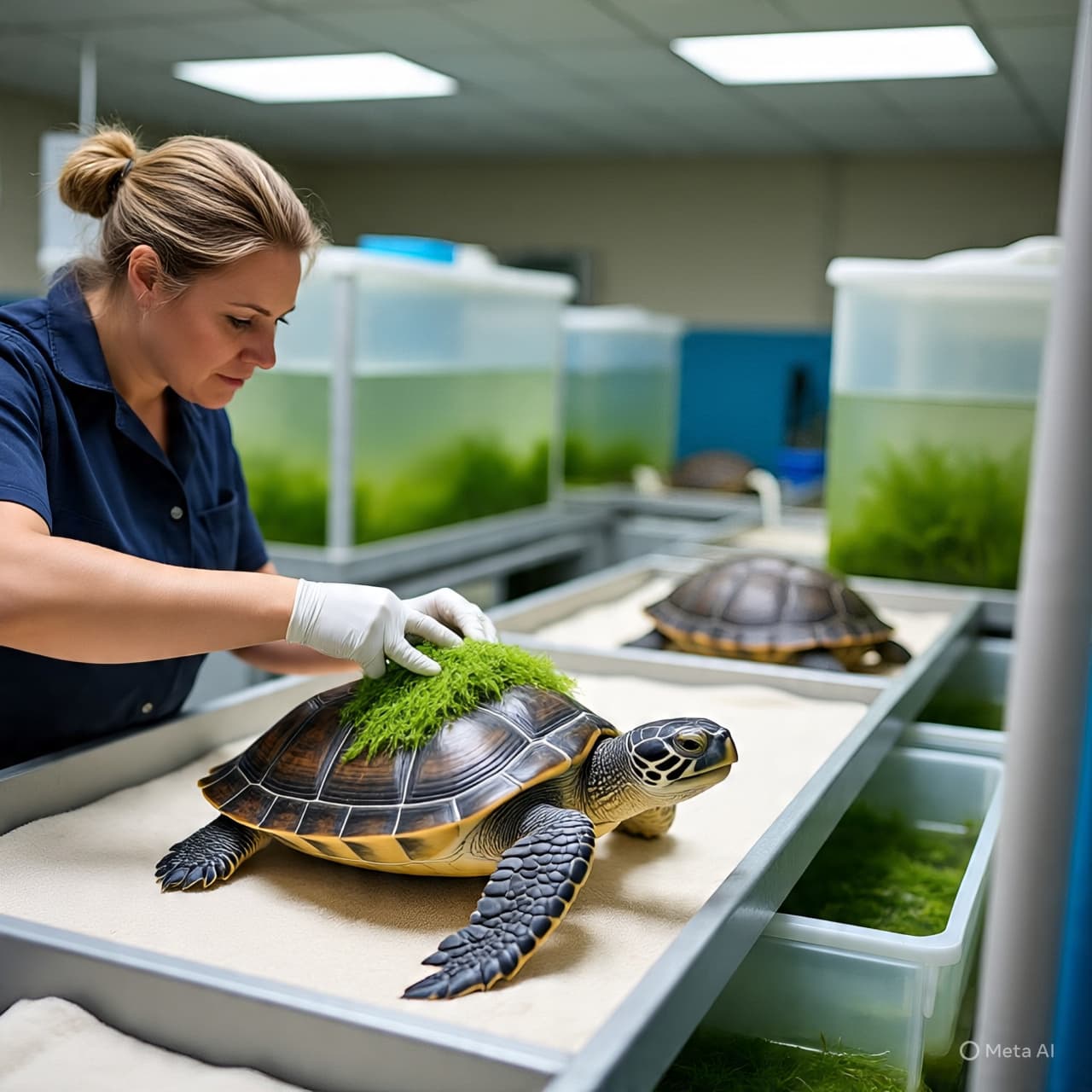
There are moments in nature that feel almost like illusions—scenes that seem to blur the line between the familiar and the unexpected. An injured arriving at a rescue center would not, in itself, be unusual. But this one carried with it something more—a striking, almost surreal covering that turned concern into curiosity.
When the turtle was brought in, rescue staff were immediately taken aback. Its shell and parts of its body appeared to be draped in what looked like strands of red “hair,” giving it an appearance that felt more imagined than real. Yet, beneath the unusual exterior was a very real explanation rooted in the complexities of marine ecosystems.
The red “hair” was not hair at all, but a dense growth of algae and other marine organisms that had accumulated over time. In healthy conditions, sea turtles often carry small amounts of such growth on their shells, part of a natural balance within the ocean. However, excessive buildup can signal that something is wrong.
In this case, the extent of the growth suggested that the turtle had been unable to move or swim effectively for a prolonged period. When turtles are injured, weak, or otherwise compromised, they may spend more time stationary, allowing algae to attach and spread more extensively than usual. What appears unusual at first glance, then, becomes an indicator of underlying distress.
For rescue teams, this visual clue is more than a curiosity—it is a diagnostic signal. The condition of a turtle’s shell can reveal much about its recent history, from mobility issues to environmental exposure. Removing the algae is not merely a matter of cleaning, but part of a broader rehabilitation process aimed at restoring the animal’s strength and ability to survive in the wild.
There is also a subtle reflection within this encounter. The ocean, vast and often unseen in its details, leaves traces on the creatures that inhabit it. Sometimes those traces are delicate, almost invisible. At other times, they are vivid and unmistakable, as in this turtle’s case.
As the turtle begins its recovery, the unusual red covering becomes part of its story—a sign not only of hardship, but also of the attention and care that followed. For those who encountered it, the moment serves as a reminder that even the most unexpected appearances often carry deeper meanings, waiting to be understood.
AI Image Disclaimer (Rotated): Images in this article are AI-generated illustrations, meant for concept only.
Source Check (Credible Media Identified):
BBC National Geographic The Guardian NOAA Smithsonian Magazine
Published by Banx Network. This article is part of the Banx decentralized media programme, powered by the BXE token on the XRP Ledger.