There is a soft wonder in watching light travel across the vast tapestry of space, whispering stories from times long before humans ever looked up to ask their first questions about the stars. In the dance of galaxies and cosmic dust, some signals — faint and fleeting — barely reach us at all. Yet, recently, astronomers have noticed a persistent whisper from deep space: a beam so narrow, so steady, and so unusual that it has been likened to a cosmic laser unfolding its tale across more than 8 billion light‑years of time and space. This remarkable signal invites reflection on how the universe preserves echoes of far‑off events and brings them into our gaze many aeons later.
The signal, observed using the MeerKAT radio telescope in South Africa, appears as an exceptionally thin and bright line in the radio spectrum — unlike typical broad‑band noise from distant galaxies. What makes it shine so clearly over such immense distances is a phenomenon known as a hydroxyl megamaser, in which molecules of hydroxyl in a galaxy’s interstellar gas amplify radio waves in a way similar to how lasers amplify light. These cosmic masers are associated with particularly gas‑rich, turbulent environments, often triggered when galaxies interact or merge, stirring clouds of gas and setting the stage for intense molecular emission.
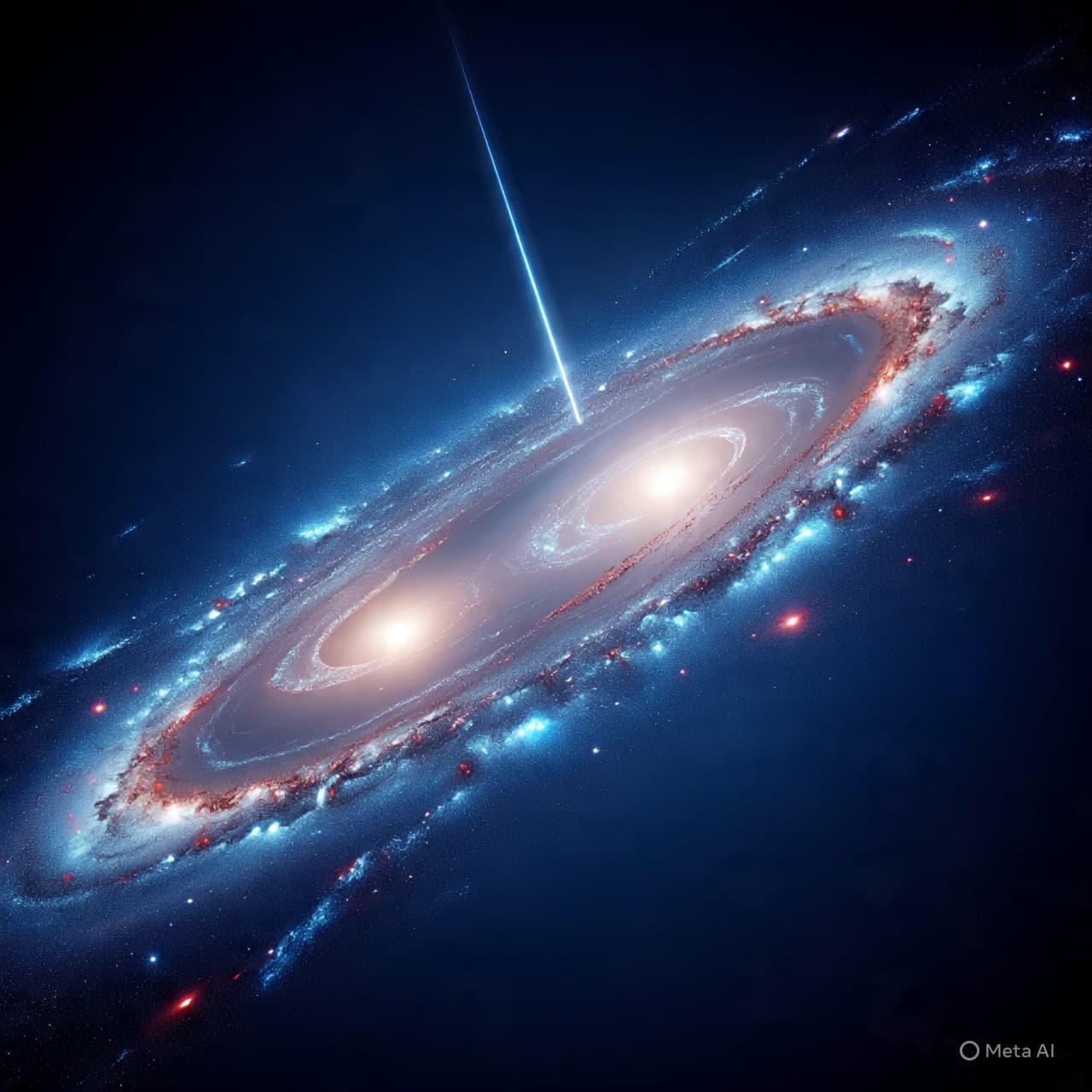
In this case, the galaxies driving the signal appear to be in the throes of a violent collision, a cosmic embrace that compresses and excites gas in such a way that it generates an extraordinarily powerful maser — so strong that, despite the universe’s expansion and the staggering distance, its signal continues to register in telescopes on Earth. This makes it one of the most distant and luminous megamasers ever detected, offering a rare glimpse into galactic life when the universe was less than half its current age.
The steady nature of the signal sets it apart from many other distant cosmic radio emissions that fade or fluctuate. Scientists describe it as a “mega‑laser” or “gigamaser” because of its remarkable intensity and narrow spectral profile, which stands out sharply against the cosmic backdrop. Such measurements help researchers learn not just about the peculiar physics of the maser itself, but also about the conditions within the merging galaxies — how gas is distributed, how star formation might be ignited, and how gravity plays its part in sculpting the universe’s grand architecture.
This discovery is also important because it pushes the boundary of what astronomers can detect at such vast cosmic distances. Signals from the early universe are often faint and blended with other sources, yet this megamaser’s clarity offers a pristine beacon through which scientists can test models of galaxy evolution, gas dynamics, and even the impact of gravitational lensing by intervening galaxies that can magnify or distort distant light.
In this unfolding exploration, the universe reveals itself not only as a realm of immense scale but as a place of enduring structures — cosmic choirs whose notes can be heard billions of years after they were first sung.
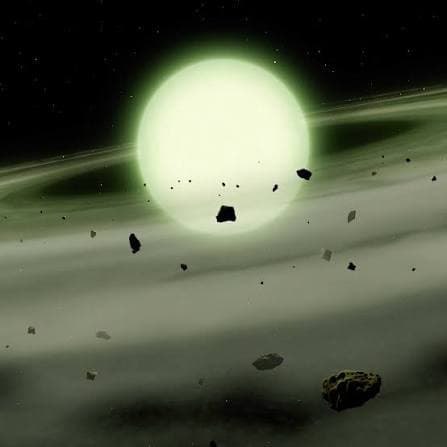
AI Image Disclaimer (Rotated Wording) “Illustrations were produced with AI and serve as conceptual depictions.”
Sources (News Media) Earth.com Daily Galaxy Live Science Universe Today GKTODAY
Published by Banx Network. This article is part of the Banx decentralized media programme, powered by the BXE token on the XRP Ledger.