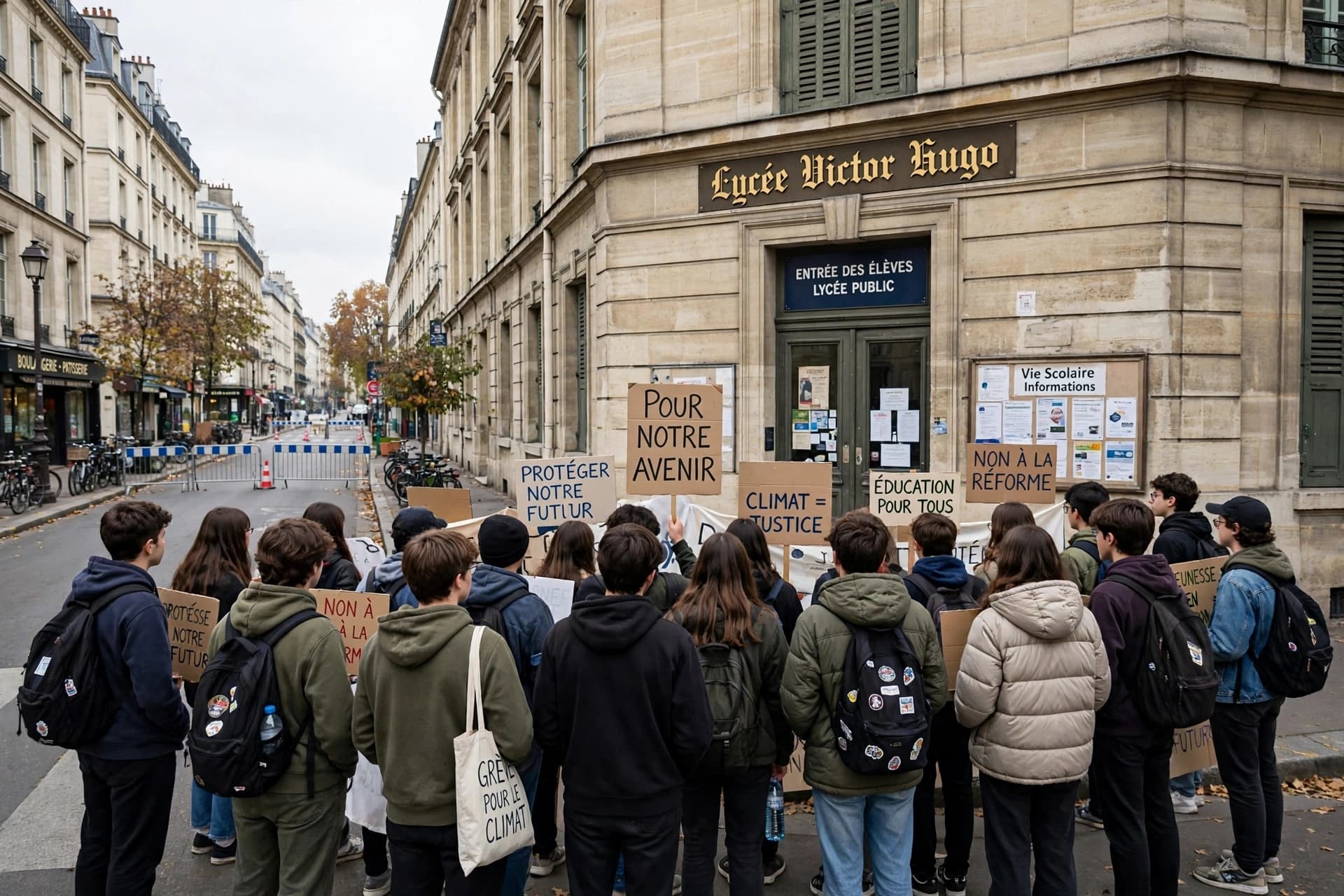
Across France, school gates have become the meeting point of a wider national unease. What began as student demonstrations over education conditions has spread from the Paris region to cities across the country, bringing classrooms, teachers, police and government officials into an increasingly difficult confrontation. By Thursday, October 1, Prime Minister Sébastien Lecornu had called a crisis cabinet meeting and asked ministers to cancel planned travel so they could focus on the unrest.
The demonstrations began with complaints about long school hours, shortages of teachers, overcrowded classrooms and deteriorating facilities. Students have also raised concerns about difficult conditions during periods of extreme heat. Those grievances have remained at the center of the movement even as some protests have developed into clashes, property damage and fires around schools.
Police said hundreds of demonstrations, blockades and related incidents were taking place around high schools. More than 160 schools had been shut down as a result of the protests, while access to roughly 30 university campuses was also blocked in cities including Paris and Marseille. Authorities reported hundreds of arrests and dozens of injuries among students, teachers, police and firefighters.
Some of the most serious incidents involved burning trash containers, damage to public infrastructure and attempted arson at schools. In Nantes, authorities said damage at one school was extensive enough to keep it closed for about a month. In Marseille, there were reports of attempts to start fires inside schools, while incidents involving public transportation were also reported in other cities.
The government's response has itself become part of the dispute. Riot police have been deployed, while the Interior Ministry announced an internal investigation following allegations that some students were injured by police crowd-control projectiles. The government has also advised some schools to move classes online when necessary to protect students and staff.
The protests are unfolding against a particularly sensitive political backdrop. France is preparing for a presidential election in 2027, and political parties have begun interpreting the unrest through competing political lenses. The government has accused the left-wing France Unbowed party of encouraging the demonstrations, while party leader Jean-Luc Mélenchon has rejected accusations of promoting violence and criticized what he described as an excessive police response. These remain competing political claims rather than established findings about the origin of every protest incident.
Education Minister Édouard Geffray is scheduled to meet representatives of students, parents and education workers as the government seeks a response to the underlying complaints. That effort places two separate challenges side by side: maintaining public safety when demonstrations become violent, while also addressing the education problems that brought many students into the streets in the first place.
For now, the French government faces a protest movement whose scale has expanded faster than its political response. The coming days will show whether dialogue can regain space alongside public-order measures, but authorities have already made clear that protecting students, teachers and schools is an immediate priority.
AI Image Disclaimer: The accompanying visual is AI-generated and intended for illustrative purposes only.
Sources: Reuters, Associated Press, The Guardian, Al Jazeera, ABC News
Published by Banx Network. This article is part of the Banx decentralized media programme, powered by the BXE token on the XRP Ledger.