
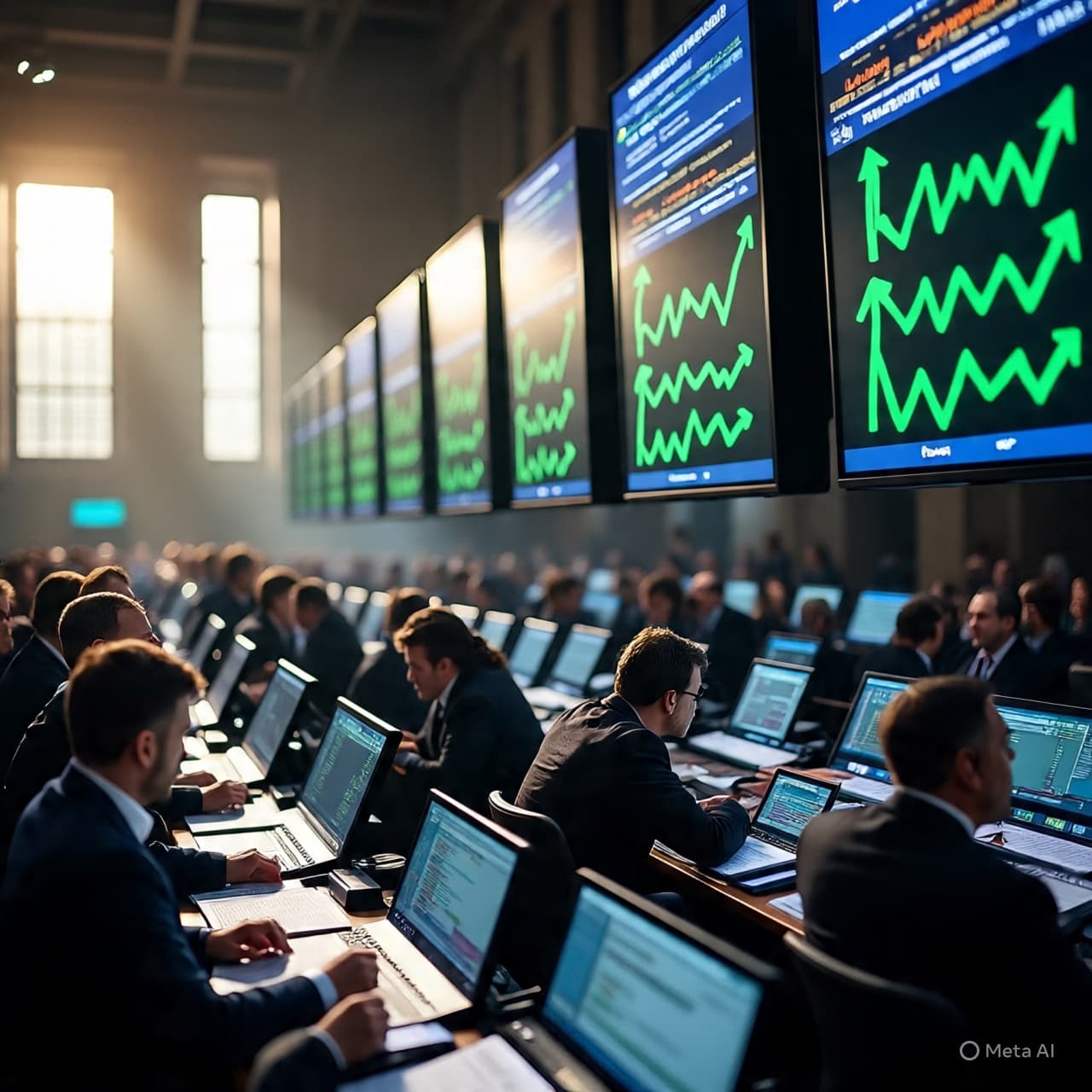
Morning arrives on Wall Street with a certain choreography. Screens flicker awake before the sun fully reaches the glass facades of Lower Manhattan. Traders sip coffee as futures tick quietly upward, green arrows replacing yesterday’s caution. The market does not shout its intentions; it reveals them in increments, in fractions of a percent that gather into momentum.
Today, the major indexes are climbing again. The S&P 500, the Dow Jones Industrial Average, and the Nasdaq Composite have all opened higher, extending a rally that has been building in recent sessions. The reasons are not singular, but layered—like currents converging beneath the surface of the sea.
Investors are responding first to fresh economic data suggesting that inflation may be easing more steadily than feared. Recent reports on consumer prices and producer costs have shown moderation compared with the sharp increases of prior years. For markets that have spent months parsing every decimal point in inflation readings, even modest cooling can feel like a release of tension. Lower inflation hints at the possibility that the Federal Reserve may hold rates steady—or even consider cuts later in the year—rather than tightening further.
Bond yields, which often rise when investors anticipate higher interest rates, have edged lower. That subtle shift matters. When yields retreat, borrowing costs appear less daunting, and equities—particularly growth-oriented technology stocks—become more attractive by comparison. The Nasdaq, heavily weighted toward tech companies, tends to respond swiftly to such movements, its gains reflecting renewed appetite for risk.
Corporate earnings have also offered reassurance. Several large companies have reported results that surpassed expectations, not necessarily with spectacular growth but with resilience. In an environment where analysts had braced for softness, steady performance can act as its own catalyst. Forward guidance—those careful projections of revenue and profit—has in some cases suggested that businesses are adapting to higher costs and cautious consumers with more agility than anticipated.
There is, too, the intangible influence of sentiment. Markets are forward-looking instruments; they trade less on what is than on what might be. If investors begin to believe that the most aggressive phase of monetary tightening is behind them, capital flows accordingly. Fund managers rebalance portfolios. Short sellers cover positions. Retail investors, watching indexes push toward previous highs, feel the gravitational pull of optimism.
The Dow, with its concentration of industrial and blue-chip names, reflects confidence in established sectors—manufacturing, finance, healthcare. The S&P 500, broader and more diversified, mirrors the collective mood of corporate America. The Nasdaq, with its emphasis on innovation and scale, captures the market’s belief in future growth. When all three rise together, it suggests alignment rather than fragmentation.
Still, rallies are rarely linear. Beneath the upward movement lies a cautious awareness of unresolved questions: the durability of consumer spending, geopolitical tensions, the pace of global growth. Economic data in coming weeks will test whether today’s gains represent a turning point or a pause within a longer recalibration.
As the closing bell approaches and sunlight angles across the trading floor, the day’s ascent may settle into percentage gains and headline summaries. Yet the deeper narrative remains one of shifting expectations. Inflation appears to be cooling. Interest rate fears are softening. Earnings are holding. For now, those threads weave together into a market that is rising—not with exuberance, but with measured relief.
AI Image Disclaimer These images are AI-generated for illustrative purposes and do not depict real events or locations.
Sources (names only) Federal Reserve U.S. Bureau of Labor Statistics Reuters Bloomberg The Wall Street Journal
Published by Banx Network. This article is part of the Banx decentralized media programme, powered by the BXE token on the XRP Ledger.



