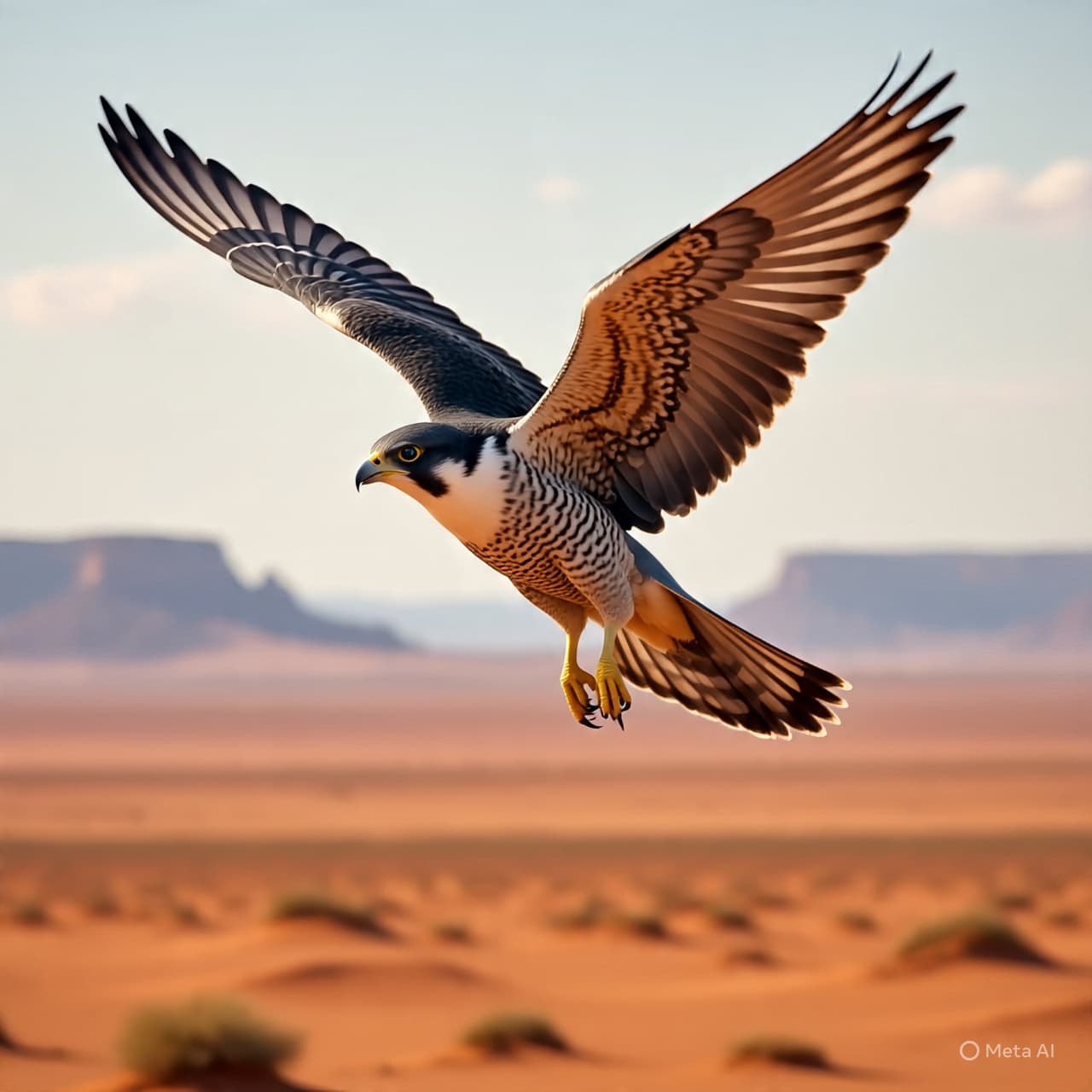
There are moments when the sky seems too vast, too still, too ancient for surprises — like the silent sweep of a desert dawn that carries dust and distant birdcalls rather than news. Yet one ordinary morning over the ochre plains of Central Australia, something extraordinary pierced that stillness. In a fleeting streak against the pale blue, a creature known for unmatched speed carved its presence into the open air. In a land that measures time in seasons of resilience, here was a visitor from the far North — a falcon born in Arctic winds, now veering unexpectedly through arid landscapes.
Birdwatcher and ecologist Dr. Tim Henderson was standing on Ngalia‑Walpiri and Luritja country near Alice Springs when he glimpsed what he at first thought was a blur, a swift shadow dancing on a solitary wind. The camera shutter clicked, a heartbeat frozen in time. Later, he realised he’d captured something truly remarkable — the Siberian peregrine falcon, a bird capable of diving at speeds exceeding 300 km/h, recorded far inland in Australia’s arid zone for the first time.
It was a sighting that set not one, but two new records: both the furthest inland appearance of this rare migratory falcon and its first documented presence over the outback’s red dust. Typically, these falcons are seen along coastal stretches or mountain ranges after migrating south from the Arctic tundra when the northern summer wanes. There were anecdotes from birders of peregrines along shores and cliffs, but this — deep in the continent’s heart — was wholly unexpected.
Dr. Henderson reflected that the unusual sighting might be tied to recent heavy rains that transformed the dry plains. In 2024, rains filled temporary wetlands, drawing freshwater life and the birds that follow them. In that fleeting flourish of life, prey became plentiful and predators answered the call. What is ordinary to one season can become the doorway to the extraordinary for another.
Though its visit was brief, the falcon’s presence in the outback reminds us how alive and dynamic even the most seemingly desolate places can be. It asks us to ponder the unseen routes of migration, the subtle cues of climate and land, and the quiet rhythms that bind all beings to the earth’s cycles. For now, that swift visitor is gone, but the image remains — a flash of nature’s wild poetry against the bright Central Australian sky.
AI Image Disclaimer Images in this article are AI‑generated illustrations, meant for concept only.
Sources : ABC News – World’s fastest falcon spotted in Central Australian outback for the first time. The Courier‑Mail – Siberian peregrine falcon photographed far inland in Australia’s arid zone. Australian Wildlife Conservancy Press Release – Historic appearance of Siberian peregrine falcon; context on weather and migration.
Published by Banx Network. This article is part of the Banx decentralized media programme, powered by the BXE token on the XRP Ledger.