Egypt’s outsourcing and offshoring services exports reached approximately $5.2 billion in 2025, according to figures cited by the country’s Ministry of Communications and Information Technology. The government has set a longer-term target of reaching $8 billion in outsourcing exports by 2028.
The expansion reflects growing demand for services such as information technology, customer support, business processes, software development, and other digitally delivered work. International companies have increasingly used Egypt as a location from which to serve customers and businesses in different parts of the world.
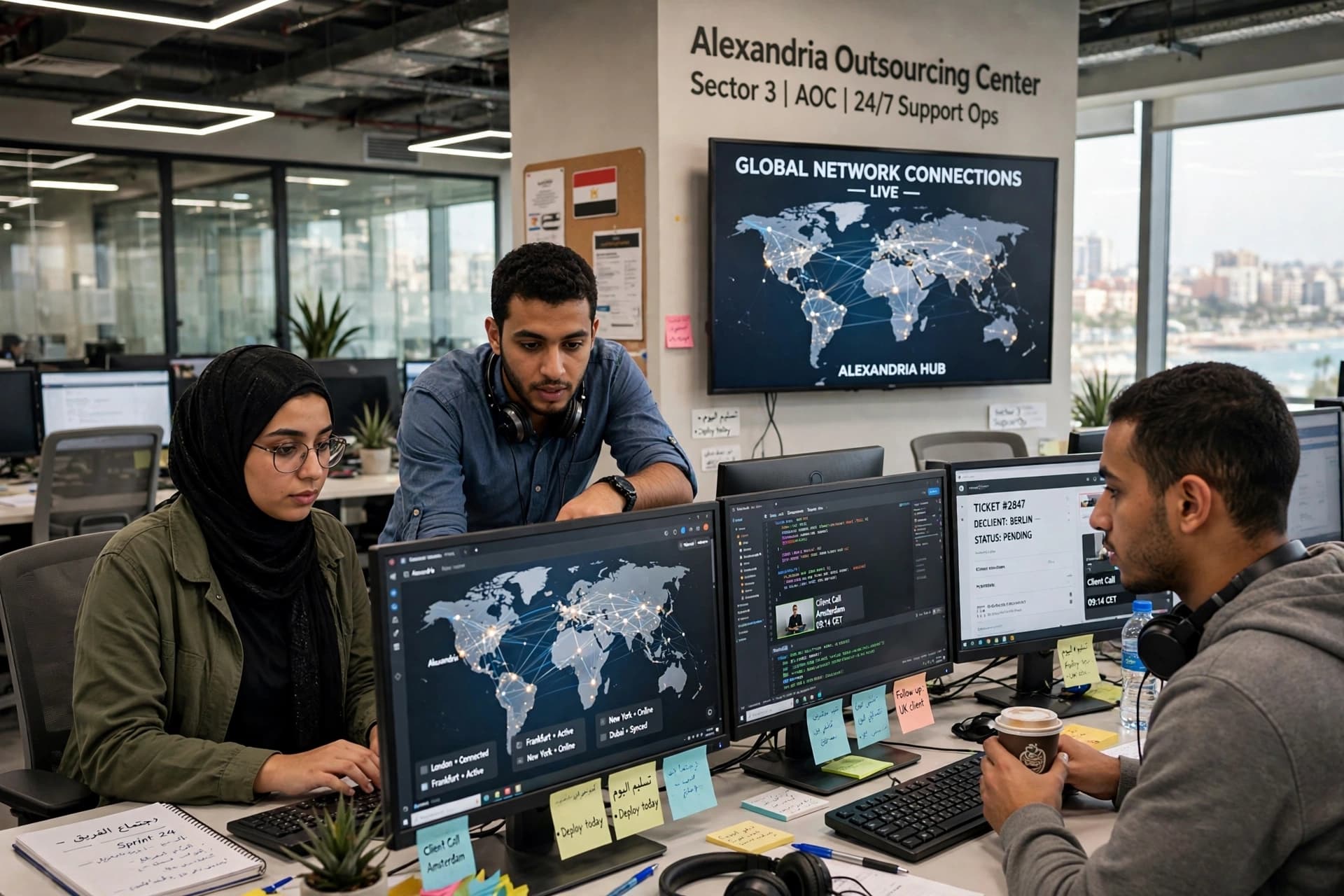
Cairo remains an important center for the industry, but activity is also spreading beyond the capital. Recent investments by technology and business-services companies have expanded operations in cities such as Alexandria, drawing attention to Egypt’s broader pool of young and digitally trained workers.
For Egypt, the attraction is partly connected to the size of its workforce. A large population of young people provides companies with access to workers capable of serving international markets in multiple languages and technical fields.
Artificial intelligence is also beginning to change the industry. Companies are increasingly incorporating AI-enabled tools into customer service, software development, business analysis, and other digital operations. That does not necessarily remove the need for workers; instead, it changes the skills expected from those workers.
The government is simultaneously expanding programs designed to prepare people for the digital economy. Training initiatives are aimed at improving technical skills and creating a larger pipeline of workers who can participate in technology and business-services industries.
The growth also has a foreign-exchange dimension. Unlike traditional exports, digitally delivered services can reach overseas customers without requiring physical products to cross a border. Revenue can therefore enter the Egyptian economy through services performed locally for companies and customers elsewhere.
Still, the industry depends on more than an abundant workforce. Reliable telecommunications, digital infrastructure, training, cybersecurity, international business standards, and the ability to retain skilled workers all influence how far the sector can expand.
The $5.2 billion figure therefore represents more than a financial milestone. It reflects a changing form of economic geography in which Egyptian workers can participate in international markets while remaining in cities such as Cairo and Alexandria. The work may happen behind screens, but its connection to the global economy is becoming increasingly tangible.
SEO SLUG
egypt-outsourcing-exports-digital-services-2026
HASHTAGS
#Egypt #Outsourcing #Offshoring #DigitalEconomy #Technology #ITServices #DigitalJobs #Business
IMAGE DISCLAIMER
This AI-generated visual is intended only as an editorial illustration and does not depict an actual company, employee, office, or business transaction.
SOURCES
Ahram Online Arab Finance Ministry of Communications and Information Technology Egypt
Published by Banx Network. This article is part of the Banx decentralized media programme, powered by the BXE token on the XRP Ledger.